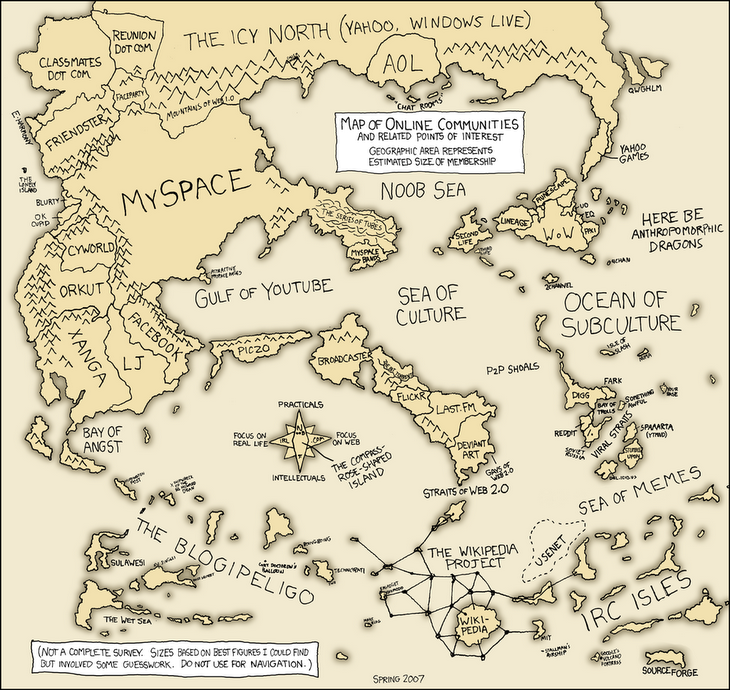
-Sought to uncover a semantic fabric of taste derived from the language used in 100,000 social networking profiles, dubbed the social Semantic Web.
-First mapped users onto taste-spaces, then compared the taste-similarities of participants.
-Moving away from formal semantics toward implicit and emergent semantics that are organized from the bottom up- folksonomies that include taste neighborhoods, identity hubs, and taste cliques.
Theoretical Background
1. Authentic Identity and Aesthetic Closure
-Contemporary culture is marked by consumeption preferences of diverse demographic categories- a culture of plenitude, in which identities are described using the vocabulary of preferences (McCracken).
-Simmel: the individual is born as an unidentified contents that evolves into identified forms, a truly authentic identity.
-Lacan: the self is a mediated construction in the Other (supported by the Sapir-Whorf hypothesis and feminism)
-Csikszentmihalyi and Rochberg-Halton: consolidates the above two theories- an individual's "symbolic environment" both echoes and reinforces her identity. This is the framework from within which this study works.
-Aesthetic Closure: when an individual's interest can be regarded as unified, interconnected, sharing a common aethetic.
-Diderot Unity: the compulsion of consumers for consistency, to like that which we consume in a consistent and unified manner- provides support for aesthetic closure.
2. Upper Bounds on Theoretical Ideal
The above theory is problematized by a number of factors:
-Goffman's theory that performance is inherent in socialization- we all wear different masks depending on the social context. Identities are viewed as multiplicitous- online profiles provide only a single flat view.
-boyd's theory that, because profiles may be viewed by myriad social circles, the individual is forced to take such publicity in account, resulting in self-censorship.
-boyd also points out profiles are often abandoned over time, resulting in static representations/artifacts of past identity performance.
3. Identity Keywords vs. Interest Keywords
-Examined both broad interests as well as special interests (such as cultural identities).
-Special Interests are usually placed at the top of profiles, while more specific interests are listed later on. The former is used to place individuals into categories, while the latter serve as more detailed descriptors.
Weaving the Taste Fabric
-A single crawl of two SNCs mined information from 100,000 profiles.
-To preserve anonymity, only the text of descriptors was used.
-Because language fragments are often used in specific categories, 90% of them were successfully segmented.
-In the case of general interests, about 75% were successfully segmented, as they often contained more idiosyncratic speech.
-Descriptors were then coded in order to create a common language of categories using sources such as wikipedia's article on subcultures, IMDB, AllMusic, AllRecipes, etc;
-21,000 interest descriptors and 1,000 identity descriptors coded.
-Correlation analysis was then conducted via numeric strength of semantic relatedness.
-Identity Hubs: One's location in the fabric is described in terms of proximity to the various identity hubs, which serve as an index of identities.
-Taste Cliques: cliques of interest based on taste- for instance, "Soccer," "Manu Chao", "tapas" and "Samba Music" would be an example of a Latin taste clique.
-Taste Neighborhoods: larger, more permanent taste cohesions
What is a Taste Fabric Good For?
-InterestMap: taste-based recommendation system- an interactive map where users can input descriptors and receive recommendations based on a navigatable map of descriptors
-Ambient Semantics: facilitates interaction between two strangers who share taste.
-IdentityMirror: makes identity self-management possible
-A dynamic model of taste would take context into account- current events, location
---
One of the implications I derived from this article was the potential for the creation of true interest-based communities that are capable of a radical clarification and reconfiguration of the networked individual. How addictive it would be, I imagine, to have a system before you powerful enough to know what you like before you're even aware that you did. Oh yeah, check this out:
Pentagon to Merge Next-Gen Binoculars With Soldiers' Brains
'Sup, Big Bro?
May 2, 2007


Lit Review: An Evaluation of Identity-Sharing Behavior in Social Network Communities (Stutzman)
-Though academic institutions have been working to protect student identities, their work is increasingly being undermined by social networking communities (SNCs).
-The goals of this study were twofold: obtaining quantitative data about SNC participation on college campuses, and analyzing member attitudes pertaining to SNC participation and online identity sharing. This data was gathered from the perspective of an outsider to these communities.
-A random survey of 200 students (38 of whom responded) inquired about the specifics of their involvement in SNCs as well as their feelings regarding online identity sharing. The researcher then created a disclosure matrix for each participant by examining the data made available in their SNC profiles.
-Limitations: Small sample size, internet survey may be biased toward the tech-savvy, outsider status, lexical differences in coding identity elements of the SNCs (favorite movies, sexual orientation, academic status, etc;).
Findings
-71% involvement in SNCs: 90% of undergrads, 44% of grads.
-Most popular was Facebook (90% of undergrads), followed by Friendster and MySpace.
-Though participants expressed doubt that their identity information was protected online (2.66 on a 5-point Likert scale), they were nevertheless okay with friends accessing this information (4.55), but markedly less so with strangers (3.15).
-Information of particular interest: location, sexual orientation, political status
-Urges discussion of new identity disclosure threats posed by SNCs.
---
The very small sample size of this study makes it almost entirely worthless to review, but it is worth noting that academic institutions are working to protect the identities of their students. In another vein, the enormous discrepency between SNC participation by undergrads and that of graduate students suggest that the undergaduate community may possess certain qualities or needs that SNCs fulfill, such as maintaining high school ties.
Seeing as identity disclosure would seem to be a pertinent issue, it would be interesting to reassess users' feelings on the matter now that SNCs have become both mainstream and problematized by media discourse. How is "stalking" defined (it is a commonly used term in Facebook discourse)? What sort of activities and degree of involvement are deemed acceptable by today's norms?
-The goals of this study were twofold: obtaining quantitative data about SNC participation on college campuses, and analyzing member attitudes pertaining to SNC participation and online identity sharing. This data was gathered from the perspective of an outsider to these communities.
-A random survey of 200 students (38 of whom responded) inquired about the specifics of their involvement in SNCs as well as their feelings regarding online identity sharing. The researcher then created a disclosure matrix for each participant by examining the data made available in their SNC profiles.
-Limitations: Small sample size, internet survey may be biased toward the tech-savvy, outsider status, lexical differences in coding identity elements of the SNCs (favorite movies, sexual orientation, academic status, etc;).
Findings
-71% involvement in SNCs: 90% of undergrads, 44% of grads.
-Most popular was Facebook (90% of undergrads), followed by Friendster and MySpace.
-Though participants expressed doubt that their identity information was protected online (2.66 on a 5-point Likert scale), they were nevertheless okay with friends accessing this information (4.55), but markedly less so with strangers (3.15).
-Information of particular interest: location, sexual orientation, political status
-Urges discussion of new identity disclosure threats posed by SNCs.
---
The very small sample size of this study makes it almost entirely worthless to review, but it is worth noting that academic institutions are working to protect the identities of their students. In another vein, the enormous discrepency between SNC participation by undergrads and that of graduate students suggest that the undergaduate community may possess certain qualities or needs that SNCs fulfill, such as maintaining high school ties.
Seeing as identity disclosure would seem to be a pertinent issue, it would be interesting to reassess users' feelings on the matter now that SNCs have become both mainstream and problematized by media discourse. How is "stalking" defined (it is a commonly used term in Facebook discourse)? What sort of activities and degree of involvement are deemed acceptable by today's norms?
Lit Review: Rhythms of Social Interaction: Messaging Within a Massive Online Network
-Extensive empirical analysis of 362 million message sent by 4.2 million Facebook users over a 26 month period.
-Results found a temporal rhythm that extended across campuses and seasons.
-Nearly all communication occurred between a small proportion of "friends".
-Social Network Research: how people make friends, number of friends, and forms of social support.
-Their understanding of the Poke: Users can ascribe whatever meaning in the context of their relationship to the poker or pokee; described as a "virtual intimate object", an active meaningful social gesture that necessitates reciprocity. Such a situation is a marker of a strong social bond.
-The privacy inherent in messaging/poking frees the act from the pressure of self-presentation.
Data
-Average of about 180 friends per user.
-About half of messages sent to friends at same school, 41% to friends at another school.
-Strangely, over 98% of pokes were sent between people from the same school.
-Reciprocity of messages occurs 59% of the time if senders are at the same school, but only 41% of the time if the sender is from a different school.
-Messaging/poking highest at the beginning of the week, declining drastically Friday and Saturday.
-The rhythm of activity differs from that of a corporate network, where most activity takes place during working hours.
-Trend of messages sent to those at different schools during the daytime, to nonfriends in the same school during the late-night hours.
-No change in rhythm, even during the summer, with the exception of a dramatic increase in messages sent to school friends during school break times.
-Different universities consistantly show either a disproportionately large or disproportionally small number of Facebookers who are active during the weekend.
Conclusions
-Concludes that internet sociality is an activity that frequently occurs alongside work-related tasks rather than as a leisure activity in and of itself.
-Though messages are sent primarily to friends, most friends do not receive messages. What does this say about the strength of Facebook "friend" ties?
-Seasonal variation in same/different school messaging demonstrates the importance of Facebook in supporting geographically distant relationships.
---
Not sure about the importance of this bit of research (though it could serve useful as a statistical supplement), however it was interesting to discover that such an intensive statistical analysis has been conducted on Facebook. With all the information available on the site, a vast array of studies concerning Internet activity could be conducted, as well as looking at the relationships between group memberships, interests, demographics (political and sexual orientation, gender, "looking for", religion) etc; The study would probably have been much more interesting had they focused on wall posts, the most active form of Facebook communication by far.
-Results found a temporal rhythm that extended across campuses and seasons.
-Nearly all communication occurred between a small proportion of "friends".
-Social Network Research: how people make friends, number of friends, and forms of social support.
-Their understanding of the Poke: Users can ascribe whatever meaning in the context of their relationship to the poker or pokee; described as a "virtual intimate object", an active meaningful social gesture that necessitates reciprocity. Such a situation is a marker of a strong social bond.
-The privacy inherent in messaging/poking frees the act from the pressure of self-presentation.
Data
-Average of about 180 friends per user.
-About half of messages sent to friends at same school, 41% to friends at another school.
-Strangely, over 98% of pokes were sent between people from the same school.
-Reciprocity of messages occurs 59% of the time if senders are at the same school, but only 41% of the time if the sender is from a different school.
-Messaging/poking highest at the beginning of the week, declining drastically Friday and Saturday.
-The rhythm of activity differs from that of a corporate network, where most activity takes place during working hours.
-Trend of messages sent to those at different schools during the daytime, to nonfriends in the same school during the late-night hours.
-No change in rhythm, even during the summer, with the exception of a dramatic increase in messages sent to school friends during school break times.
-Different universities consistantly show either a disproportionately large or disproportionally small number of Facebookers who are active during the weekend.
Conclusions
-Concludes that internet sociality is an activity that frequently occurs alongside work-related tasks rather than as a leisure activity in and of itself.
-Though messages are sent primarily to friends, most friends do not receive messages. What does this say about the strength of Facebook "friend" ties?
-Seasonal variation in same/different school messaging demonstrates the importance of Facebook in supporting geographically distant relationships.
---
Not sure about the importance of this bit of research (though it could serve useful as a statistical supplement), however it was interesting to discover that such an intensive statistical analysis has been conducted on Facebook. With all the information available on the site, a vast array of studies concerning Internet activity could be conducted, as well as looking at the relationships between group memberships, interests, demographics (political and sexual orientation, gender, "looking for", religion) etc; The study would probably have been much more interesting had they focused on wall posts, the most active form of Facebook communication by far.
Lit Review: Digital Relationships in the ‘MySpace’ Generation: Results From a Qualitative Study (Dwyer)
A qualitative study of online social networking sites and instant messaging.
Background
-CMC reduces the exchange of social context cues, affecting perceptions of truthfulness, interpretation and response to messages, and the formation of impressions.
--Social Information Processing Model (Walther): CMC relies on paralinguistics, slowing the rate at which social cues are received.
-Impression Management (Goffman): The subtle process of controlling another's perception of something by managing the information exchanged in a social interaction. When that something is one's own identity, it is referred to as self-presentation. We interpret others through inference of their roles, derived from the information they or others present to us.
-Social-Technical Gap: The space between what technology can support and what actually happens in the social world.
The Study
-Examined the use of technology to manage relationships, and the ways in which these technologies mediate behaviors pertaining to the management of these relationships.
-The semi-structured interview designed inquired about self-presentation/impression management, pros and cons of these systems, usage and dependency for social communication. It also probed participants for information on how they used the tools provided by this systems in developing new relationships, restricting access, and responding to negative events. Expectations of privacy were also investigated, pertaining to what individuals felt comfortable with sharing and why.
-Interviews were conducted by 6 undergraduates, who interviewed a total of 19 college-aged participants. The transcripts were content-analyzed and coded.
-Participants reported heavy use of communication technologies, heralding their low cost, entertainment value, and convenience.
-Profiles provide the opportunity for impression management. Authenticity plays a large role here- profiles that appear (or are known to be) false or contrived trigger a very negative impression. However, they also discussed the need to create a "cool" persona and intense awareness of how others would perceive their self-presentations. Nevertheless, the act of constructing one's profile was generally considered a fun, entertaining activity.
-As one participant put it, "The defining characteristic of social networking sites is extreme impersonality. The people that one talks to on these sites are not treated as other human beings. They appear more like characters in a story."
-Though privacy concerns have been well-documented, the participants expressed general apathy, countering that they as members are responsible for the content and management of their virtual personas.
-Acknowledged that relationships formed online are superficial in nature.
-General enjoyment of these systems' ability to maintain bonds with those one doesn't see every day, as well as reunite one with old friends.
-Instant Messenger Away Messages: A user is able to monitor others while behind the "barrier" of the away message.
-Comfort level increased as the degree of their own anonymity rose, decreased with the anonymity of others.
Framework
Communication technology features (profile, visibility, and identity management) enable interpersonal relationship management (forming new relationships, maintaining existing relationships), which is in turn influenced by individual attitudes (impression management, concern for information privacy).
Questions Raised
How is impression management carried out within CMC?
How to explain the apparent contradiction between privacy concerns and the overwhelming popularity of social networking sites?
---
Individuals are fluid, not static, and in the act of creating a profile of the self one undergoes a strangely simplified process of impression management. I would like to examine the paralanguage of Internet communities, the ways in which social cues are subtly communicated, as well as the complex ways in which impression management is enacted.
Background
-CMC reduces the exchange of social context cues, affecting perceptions of truthfulness, interpretation and response to messages, and the formation of impressions.
--Social Information Processing Model (Walther): CMC relies on paralinguistics, slowing the rate at which social cues are received.
-Impression Management (Goffman): The subtle process of controlling another's perception of something by managing the information exchanged in a social interaction. When that something is one's own identity, it is referred to as self-presentation. We interpret others through inference of their roles, derived from the information they or others present to us.
-Social-Technical Gap: The space between what technology can support and what actually happens in the social world.
The Study
-Examined the use of technology to manage relationships, and the ways in which these technologies mediate behaviors pertaining to the management of these relationships.
-The semi-structured interview designed inquired about self-presentation/impression management, pros and cons of these systems, usage and dependency for social communication. It also probed participants for information on how they used the tools provided by this systems in developing new relationships, restricting access, and responding to negative events. Expectations of privacy were also investigated, pertaining to what individuals felt comfortable with sharing and why.
-Interviews were conducted by 6 undergraduates, who interviewed a total of 19 college-aged participants. The transcripts were content-analyzed and coded.
-Participants reported heavy use of communication technologies, heralding their low cost, entertainment value, and convenience.
-Profiles provide the opportunity for impression management. Authenticity plays a large role here- profiles that appear (or are known to be) false or contrived trigger a very negative impression. However, they also discussed the need to create a "cool" persona and intense awareness of how others would perceive their self-presentations. Nevertheless, the act of constructing one's profile was generally considered a fun, entertaining activity.
-As one participant put it, "The defining characteristic of social networking sites is extreme impersonality. The people that one talks to on these sites are not treated as other human beings. They appear more like characters in a story."
-Though privacy concerns have been well-documented, the participants expressed general apathy, countering that they as members are responsible for the content and management of their virtual personas.
-Acknowledged that relationships formed online are superficial in nature.
-General enjoyment of these systems' ability to maintain bonds with those one doesn't see every day, as well as reunite one with old friends.
-Instant Messenger Away Messages: A user is able to monitor others while behind the "barrier" of the away message.
-Comfort level increased as the degree of their own anonymity rose, decreased with the anonymity of others.
Framework
Communication technology features (profile, visibility, and identity management) enable interpersonal relationship management (forming new relationships, maintaining existing relationships), which is in turn influenced by individual attitudes (impression management, concern for information privacy).
Questions Raised
How is impression management carried out within CMC?
How to explain the apparent contradiction between privacy concerns and the overwhelming popularity of social networking sites?
---
Individuals are fluid, not static, and in the act of creating a profile of the self one undergoes a strangely simplified process of impression management. I would like to examine the paralanguage of Internet communities, the ways in which social cues are subtly communicated, as well as the complex ways in which impression management is enacted.
Lit Review: Personal Relationships: On and Off the Internet (Boase & Wellman)
From Computer-Mediated Small Groups to the Internet
-The authors surmise that we are experiencing an era of "networked individualism", shifting from tight-knit, geographically local communities to dispersed, sparsely-knit personal networks.
-Past research on computer-mediated communication (CMC) failed to situate CMC within broader social contexts.
-Past research demonstrates that, thus far, the Internet has had no salient destructive or radical effect on society.
The Social Affordances of the Internet
-supports a greater number of geographically dispersed interactions.
-asynchronous: these interactions can occur between those with very different temporal rhythms.
-rapidity: increased velocity of interpersonal exchange.
-reduced social presence may lessen commitment, complexity, and/or strength of virtual bonds.
-textuality: reduces image-based hierarchies, such as race and class.
-absence of direct feedback --> increased likelihood for flaming.
-societal connectivity: transitive, indirect contact facilitated in a manner that often crosses group boundaries.
-mass messaging: allows contact with multiple social circles.
-HOWEVER, often social networks do not interact, and information diffuses quickly.
Utopianism and Dystopianism
-Utopianism represented by the transformative ideals of Barlow, McLuhan, and others.
-Dystopians warned of the isolating and alienating potential of the Internet, warning ominously of societal decline (Kroker & Weinstein, Stoll) and fractured identities (Turkle).
-Both views are overly simplistic, lacking ethnographic and empirical data.
-Technological Determinism: Attributing causal effects to the technology rather than the way in which people choose to utilize it. For instance, the Internet was the effect rather than the cause of the desire for distant communication.
Contact With Friends and Family- Online and Off
-Though early findings demonstrated negative effects of Internet use, later findings uncovered that Internet use is inextricably tied to one's preexisting personality characteristics (Kraut).
-Other studies used time diaries to examine the everyday practices and effects of Internet use in comparison to offline interaction and found little to no causal relationship (various studies by Katz).
-Evidence exists that demonstrates the correlation between using the Internet to meet new people and decreased TV watching (Kraut, Kiesler, Boneva, & Shklovski).
-The needs of the individual must be examined as causally affecting the everyday usages of the Internet.
Forming Relationships Online
-Research has shown that only a very small percentage of Internet users have formed new relationships online (Katz).
-The Internet serves as an important tool for forming relationships for those who are physically or psychologically disadvantaged, including those with very low self-image (McKenna).
-Often, most users who form relationships online eventually express the desire to meet offline.
Neighboring and the Internet
-A study by Hampton and Wellman on a networked Toronto suburb, "Netville" demonstrated an increase in neighborhood contact, offline visits, and neighborhood ties. Furthermore, the networked residents showed an increase in contact with geographically distant social bonds. The combination of these two effects is defined by the researcher as "glocalization".
Towards a Theory of Networked Individualism
-Since the Industrial Revolution and the rise of mass transit and telecommunications, there has been a shift in social relations that Wellman coins "networked individualism".
-Networked Individualism:
1. Both local and long distance relationships:
Most likely, individuals virtually interact with those they are close to, but just far away from that it is inconvenient to visit.
2. Sparsely-knit personal networks that include densely-knit groups:
Ease in coordinating group events through mass messaging; direct and autonomous nature of the Internet helps one to maintain a large network of contacts with relatively little work.
3. Relationships more easily formed and abandoned:
In this era of mobility and frequent change in environment, CMC helps people stay in touch with those they've left behind. Additionally, the Internet may aid the sociality of those who have trouble forming relationships offline. It also aids in neighborhood connectivity, as demonstrated by the Netville study.
4. Many relationships with people from different social backgrounds:
Devoid of many of the social cues implicit in offline interactions, the Internet facilitates the formation of relationships between individuals of differing backgrounds.
5. Few strong ties and many weak ones:
The asynchronous nature of the Internet means that interactions need not take place in the same space at the same time. This can be an asset in everyday activities (such as shopping) that involve coordination with strong ties, for communicating in a way that lacks intrusion or disruption. Weak ties can be more easily maintained as well, allowing for affirmation of a connection to even the most geographically distant acquaintance.
In conclusion, the authors point to a need to examine the psychological effects of networked individualism, such as information overload and dissatisfaction or, more positively, cognitive flexibility, social tolerance, and increased knowledge.
---
This paper was published in 2004, around the time online social networking services were becoming mainstream in popularity, and before the advent of social media services such as YouTube. It focuses primarily on e-mail as a form of CMC. Examining society's relationship to the Internet in general, the authors are a bit too empirical and generalistic for my taste.
In developing surveys regarding interaction in online social networks, it would be interesting to examine a subpopulation of those who have recently transitioned into a new environment (such as college alumni) and their use of these tools in maintaining important social ties. How useful and satisfying is this medium? Furthermore, does the Internet actually facilitate group formation, or are these group memberships illusory in nature (serving the purpose of identity development and performance)?
-The authors surmise that we are experiencing an era of "networked individualism", shifting from tight-knit, geographically local communities to dispersed, sparsely-knit personal networks.
-Past research on computer-mediated communication (CMC) failed to situate CMC within broader social contexts.
-Past research demonstrates that, thus far, the Internet has had no salient destructive or radical effect on society.
The Social Affordances of the Internet
-supports a greater number of geographically dispersed interactions.
-asynchronous: these interactions can occur between those with very different temporal rhythms.
-rapidity: increased velocity of interpersonal exchange.
-reduced social presence may lessen commitment, complexity, and/or strength of virtual bonds.
-textuality: reduces image-based hierarchies, such as race and class.
-absence of direct feedback --> increased likelihood for flaming.
-societal connectivity: transitive, indirect contact facilitated in a manner that often crosses group boundaries.
-mass messaging: allows contact with multiple social circles.
-HOWEVER, often social networks do not interact, and information diffuses quickly.
Utopianism and Dystopianism
-Utopianism represented by the transformative ideals of Barlow, McLuhan, and others.
-Dystopians warned of the isolating and alienating potential of the Internet, warning ominously of societal decline (Kroker & Weinstein, Stoll) and fractured identities (Turkle).
-Both views are overly simplistic, lacking ethnographic and empirical data.
-Technological Determinism: Attributing causal effects to the technology rather than the way in which people choose to utilize it. For instance, the Internet was the effect rather than the cause of the desire for distant communication.
Contact With Friends and Family- Online and Off
-Though early findings demonstrated negative effects of Internet use, later findings uncovered that Internet use is inextricably tied to one's preexisting personality characteristics (Kraut).
-Other studies used time diaries to examine the everyday practices and effects of Internet use in comparison to offline interaction and found little to no causal relationship (various studies by Katz).
-Evidence exists that demonstrates the correlation between using the Internet to meet new people and decreased TV watching (Kraut, Kiesler, Boneva, & Shklovski).
-The needs of the individual must be examined as causally affecting the everyday usages of the Internet.
Forming Relationships Online
-Research has shown that only a very small percentage of Internet users have formed new relationships online (Katz).
-The Internet serves as an important tool for forming relationships for those who are physically or psychologically disadvantaged, including those with very low self-image (McKenna).
-Often, most users who form relationships online eventually express the desire to meet offline.
Neighboring and the Internet
-A study by Hampton and Wellman on a networked Toronto suburb, "Netville" demonstrated an increase in neighborhood contact, offline visits, and neighborhood ties. Furthermore, the networked residents showed an increase in contact with geographically distant social bonds. The combination of these two effects is defined by the researcher as "glocalization".
Towards a Theory of Networked Individualism
-Since the Industrial Revolution and the rise of mass transit and telecommunications, there has been a shift in social relations that Wellman coins "networked individualism".
-Networked Individualism:
1. Both local and long distance relationships:
Most likely, individuals virtually interact with those they are close to, but just far away from that it is inconvenient to visit.
2. Sparsely-knit personal networks that include densely-knit groups:
Ease in coordinating group events through mass messaging; direct and autonomous nature of the Internet helps one to maintain a large network of contacts with relatively little work.
3. Relationships more easily formed and abandoned:
In this era of mobility and frequent change in environment, CMC helps people stay in touch with those they've left behind. Additionally, the Internet may aid the sociality of those who have trouble forming relationships offline. It also aids in neighborhood connectivity, as demonstrated by the Netville study.
4. Many relationships with people from different social backgrounds:
Devoid of many of the social cues implicit in offline interactions, the Internet facilitates the formation of relationships between individuals of differing backgrounds.
5. Few strong ties and many weak ones:
The asynchronous nature of the Internet means that interactions need not take place in the same space at the same time. This can be an asset in everyday activities (such as shopping) that involve coordination with strong ties, for communicating in a way that lacks intrusion or disruption. Weak ties can be more easily maintained as well, allowing for affirmation of a connection to even the most geographically distant acquaintance.
In conclusion, the authors point to a need to examine the psychological effects of networked individualism, such as information overload and dissatisfaction or, more positively, cognitive flexibility, social tolerance, and increased knowledge.
---
This paper was published in 2004, around the time online social networking services were becoming mainstream in popularity, and before the advent of social media services such as YouTube. It focuses primarily on e-mail as a form of CMC. Examining society's relationship to the Internet in general, the authors are a bit too empirical and generalistic for my taste.
In developing surveys regarding interaction in online social networks, it would be interesting to examine a subpopulation of those who have recently transitioned into a new environment (such as college alumni) and their use of these tools in maintaining important social ties. How useful and satisfying is this medium? Furthermore, does the Internet actually facilitate group formation, or are these group memberships illusory in nature (serving the purpose of identity development and performance)?
May 1, 2007
Lit Review: Trust in Electronic Environments (Chopra & Wallace)
The article examines the widely dispersed literature on trust with regard to information technologies. Trust is considered a crucial element with regard to social capital, and exists on four levels: the individual (psychological), the interpersonal (one to another), the relational (social glue), and the societal (functioning). The authors put forth a unified definition of trust as "the willingness to rely on a specific other, based on confidence that one's trust will lead to positive outcomes (3)."
When an individual possesses uncertainty or vulnerability in a particular domain, she may seek a dependent relationship with that which one is confident can fulfill that particular need, and this often entails risk on the part of the vulnerable individual. Systems trust (and here we bring the Internet into play) necessitates the establishment of social norms shared by other trusting individuals.
Trustworthiness is defined along four dimensions: competence and credibility, positive intentions, ethics, and predictability/consistency.
There are multiple processes invoked in the development of trust:
-prediction based on past behavior.
-intentionality of the trustee.
-emotional bonding and reciprocity of trust.
-reputation or institutional trust established through the trust of others.
-identification with the trustee (shared goals/values)
Four domains of trust are important in virtual environments:
1. Trustworthiness of information on the Internet.
-Users in need of information place themselves at risk for potential inaccuracy of information viewed. Factors at work include accuracy, bias, methodology, stability (of website address, currency), and validity.
2. Trustworthiness of the information/computing systems themselves.
-This includes interpersonal trust in one's own system as well as societal trust in network structures. One's emotional attitude, or technological bias, toward technology (technophilia/technophobia) is a crucial factor.
3. Trustworthiness of the economic stability of e-commerce.
-Both the buyer and the seller take risks. Reputation hinders on offline reputation and/or online ratings.
4. Trustworthiness of the individuals with whom one interacts in virtual environments.
-Motivations include information, friendship, or simply entertainment, and the truster has the authority to sever the relationship in case of fraudulent identity, abuse, or harassment. One's propensity to trust in this situation is highly dependent on one's technological bias, disposition, referrals, and the context of the relationship.
Computer technology challenges traditional notions of personhood, as machines increasingly take on roles and duties once assigned to people. Thus, it is apparent that trust plays a role in the relationship between human and computer in much the same way as in interpersonal relationships.
---
Social capital will be a central issue of discussion in my ensuing ethnography, and trust (as well as reciprocity and shared values and norms) is a crucial element.
MySpace: Little trust amongst generations outside the MySpace generation (today's teenagers), however a great deal of trust within that generation due to established cultural norms of participation in the community. Trust on MySpace is diminished by the proliferation of fraudulant identities and predatorial behavior, the finicky nature of the site, censorship, and the popular reputation I have just summated.
Facebook: High degree of trust in other users in one's network, who are usually preexisting relationships. However, growing wariness in the corporation itself due to the enormous amount of data that is collected and recorded and legal reprecussions to naive assumptions of privacy. Its quickly evolving nature, as well as its mass popularization (thus losing its niche identity) have led many to become suspicious of the intentions of the site.
Tribe: Very high degree of trust due to Tribe's subcultural history (as evidenced by its enormous popularity in the San Francisco Bay area). A haven for free speech, Tribe is also locally-based. Furthermore, many of Tribe's users possess shared cultural and social values (such as neotribalism). Users form tribes that often extend to the offline world, and vice versa.
SoundClick: Very high degree of trust, though few strong ties. What ties do exist are based around common interests (such as music genre or production tools) as well as reputation (established through rankings, popularity, degree of involvement on the site). SoundClick's niche audience authenticates the site, gives it legitimacy, and its users are able to share information with disparate others interested in the same thing (shared values and goals... globalizing potential).
When an individual possesses uncertainty or vulnerability in a particular domain, she may seek a dependent relationship with that which one is confident can fulfill that particular need, and this often entails risk on the part of the vulnerable individual. Systems trust (and here we bring the Internet into play) necessitates the establishment of social norms shared by other trusting individuals.
Trustworthiness is defined along four dimensions: competence and credibility, positive intentions, ethics, and predictability/consistency.
There are multiple processes invoked in the development of trust:
-prediction based on past behavior.
-intentionality of the trustee.
-emotional bonding and reciprocity of trust.
-reputation or institutional trust established through the trust of others.
-identification with the trustee (shared goals/values)
Four domains of trust are important in virtual environments:
1. Trustworthiness of information on the Internet.
-Users in need of information place themselves at risk for potential inaccuracy of information viewed. Factors at work include accuracy, bias, methodology, stability (of website address, currency), and validity.
2. Trustworthiness of the information/computing systems themselves.
-This includes interpersonal trust in one's own system as well as societal trust in network structures. One's emotional attitude, or technological bias, toward technology (technophilia/technophobia) is a crucial factor.
3. Trustworthiness of the economic stability of e-commerce.
-Both the buyer and the seller take risks. Reputation hinders on offline reputation and/or online ratings.
4. Trustworthiness of the individuals with whom one interacts in virtual environments.
-Motivations include information, friendship, or simply entertainment, and the truster has the authority to sever the relationship in case of fraudulent identity, abuse, or harassment. One's propensity to trust in this situation is highly dependent on one's technological bias, disposition, referrals, and the context of the relationship.
Computer technology challenges traditional notions of personhood, as machines increasingly take on roles and duties once assigned to people. Thus, it is apparent that trust plays a role in the relationship between human and computer in much the same way as in interpersonal relationships.
---
Social capital will be a central issue of discussion in my ensuing ethnography, and trust (as well as reciprocity and shared values and norms) is a crucial element.
MySpace: Little trust amongst generations outside the MySpace generation (today's teenagers), however a great deal of trust within that generation due to established cultural norms of participation in the community. Trust on MySpace is diminished by the proliferation of fraudulant identities and predatorial behavior, the finicky nature of the site, censorship, and the popular reputation I have just summated.
Facebook: High degree of trust in other users in one's network, who are usually preexisting relationships. However, growing wariness in the corporation itself due to the enormous amount of data that is collected and recorded and legal reprecussions to naive assumptions of privacy. Its quickly evolving nature, as well as its mass popularization (thus losing its niche identity) have led many to become suspicious of the intentions of the site.
Tribe: Very high degree of trust due to Tribe's subcultural history (as evidenced by its enormous popularity in the San Francisco Bay area). A haven for free speech, Tribe is also locally-based. Furthermore, many of Tribe's users possess shared cultural and social values (such as neotribalism). Users form tribes that often extend to the offline world, and vice versa.
SoundClick: Very high degree of trust, though few strong ties. What ties do exist are based around common interests (such as music genre or production tools) as well as reputation (established through rankings, popularity, degree of involvement on the site). SoundClick's niche audience authenticates the site, gives it legitimacy, and its users are able to share information with disparate others interested in the same thing (shared values and goals... globalizing potential).
April 28, 2007
Lit Review: From Counterculture to Cyberculture (cont.)
Chapter 2: Stewart Brand Meets the Cybernetic Counterculture
-In the era of the Beat generation and the Merry Pranksters, the social ideals of the New Communalists and the products of the Cold War technocracy were merged in the San Francisco LSD scene. Trips Festivals created spaces in which the technological and the social came together in ecstatic communal experiences marked by lights, images, and music brought about through electronic media, as well as LSD. These experiences integrated those who attended into a single techno-biological system:
---
Chapter 3: The Whole Earth Catalog as Information Technology
-Brand's desire to merge systems theory and New Communalist politics resulted in the creation of the Whole Earth Catalog, a disperse project offering products such as books, camping gear, and blueprints for houses and machines for those migrating to form communes in the hills of New Mexico and Colorado.
-The Catalog reflected both the technological and scientific achievements of the time as well as the acid-drenched, Eastern religion-inspired hippie movement. In addition, the contributions of its readers established a network forum enhanced by mobility between several countercultural, academic, and technological communities.
-Collaboration of disparate, disembodied communities, small-scale personal and informational technology that supported the development of individual consciousness and ecstatic communion.
---
In comparing the Whole Earth Catalog to current Internet culture, the following snippets are particularly of note:
-both a reflection of and a doorway to the world
-nomadic technocratism
-interactive elements increase commitment, as well as involvement.
-by publishing financial accounts, Whole Earth was also viewed as "open source"
-appropriation by the subculture(s) for the purposes of transformation of the superculture- does this succeed? Dominated by white, affluent, educated population...
-In the era of the Beat generation and the Merry Pranksters, the social ideals of the New Communalists and the products of the Cold War technocracy were merged in the San Francisco LSD scene. Trips Festivals created spaces in which the technological and the social came together in ecstatic communal experiences marked by lights, images, and music brought about through electronic media, as well as LSD. These experiences integrated those who attended into a single techno-biological system:
Far from asserting direct control over events, he [Brand] had built an environment, a happening, a laboratory. He had set forth the conditions under which a system might evolve and flower, and he had stocked the biological and social worlds of those who entered that system with technologies that allowed them to feel as though the boundaries between the social and the biological, between their minds and their bodies, and between themselves and their friends, were highly permeable. He had helped found a new tribe of technology-loving Indians, artistic engineers of the self.
---
Chapter 3: The Whole Earth Catalog as Information Technology
-Brand's desire to merge systems theory and New Communalist politics resulted in the creation of the Whole Earth Catalog, a disperse project offering products such as books, camping gear, and blueprints for houses and machines for those migrating to form communes in the hills of New Mexico and Colorado.
-The Catalog reflected both the technological and scientific achievements of the time as well as the acid-drenched, Eastern religion-inspired hippie movement. In addition, the contributions of its readers established a network forum enhanced by mobility between several countercultural, academic, and technological communities.
-Collaboration of disparate, disembodied communities, small-scale personal and informational technology that supported the development of individual consciousness and ecstatic communion.
We are as gods and might as well get good at it. So far, remotely done power and glory- as via government, big business, formal education, church- has succeeded to the point where gross defects obscure actual gains. In response to this dilemma and to these gains a realm of intimate, personal power is developing- power of the individual to conduct his own education, find his own inspiration, shape his own environment, and share his adventure with whoever is interested. Tools that aid this process are sought and promoted by the Whole Earth Catalog (Brand, inside cover of the Catalog).
---
In comparing the Whole Earth Catalog to current Internet culture, the following snippets are particularly of note:
-both a reflection of and a doorway to the world
-nomadic technocratism
-interactive elements increase commitment, as well as involvement.
-by publishing financial accounts, Whole Earth was also viewed as "open source"
-appropriation by the subculture(s) for the purposes of transformation of the superculture- does this succeed? Dominated by white, affluent, educated population...
The Rise of Digital Utopianism: Implications for Analysis
Barlow, an information technology journalist and pundit, was also once a lyricist for the Grateful Dead. Following an international summit in which the Communications Decency Act was passed, which sought to restrict pornography on the Internet, he crafted a treatise in defense of the independence of the Internet from bureaucratic attempts at regulation. This essay, which was posted and widely circulated on the Internet, suggested that the Internet allowed for the possibility of a social revolution. Barlow painted a picture of a world in which the oppressive forces of the government were replaced by the pursuit of individual enlightenment, communality, and collective consciousness.
Barlow’s work in collaboration with Wired magazine established a movement inspired by an ideology of digital utopianism. In what ways has this ideology integrated into the public consciousness? In my own research on online social networking communities, I would like to examine how these sites contribute to as well as diminish the creation of a “digital utopia”.
Cyberspace consists of transactions, relationships, and thought itself, arrayed like a standing wave in the web of our communications. Ours is a world that is both everywhere and nowhere, but it is not where bodies live.
We are creating a world that all may enter without privilege or prejudice accorded by race, economic power, military force, or station of birth.
We are creating a world where anyone, anywhere may express his or her beliefs, no matter how singular, without fear of being coerced into silence or conformity.
Your legal concepts of property, expression, identity, movement, and context do not apply to us. They are all based on matter, and there is no matter here.
Our identities have no bodies, so, unlike you, we cannot obtain order by physical coercion. We believe that from ethics, enlightened self-interest, and the commonweal, our governance will emerge . Our identities may be distributed across many of your jurisdictions. The only law that all our constituent cultures would generally recognize is the Golden Rule. We hope we will be able to build our particular solutions on that basis. But we cannot accept the solutions you are attempting to impose.
Barlow’s work in collaboration with Wired magazine established a movement inspired by an ideology of digital utopianism. In what ways has this ideology integrated into the public consciousness? In my own research on online social networking communities, I would like to examine how these sites contribute to as well as diminish the creation of a “digital utopia”.
April 26, 2007
Lit Review: From Counterculture to Cyberculture (Fred Turner)
Chapter 1: The Shifting Politics of the Computational Metaphor
-Sacio and the Free Speech Movement of the 60s opposed the mechanization of society through the guise of the university, the military, and information technologies.
-30 years later, what was once a threat was now a promise of liberation, expressed through the evolving personalization of the Internet.
-Barlow's Declaration of the Independence of Cyberspace in proclamation of the liberating nature of the Internet for overthrowing the bureaucracy. Social revolution?
-Esther Dyson believed that the Internet would become a digital marketplace that would allow consumers and corporations to negotiate equally, thus dissolving the tyranny of corporate hierarchies (Release 2.0: A Design for Living in the Digital Age).
-Kevin Kelly believed we were moving toward a "computational metaphor" in human understanding, in which the universe is a computer according to a new vocabulary that is now emerging.
-Disembodiment: dehumanization or equality?
The Forgotten Openness of the Closed World
-Post WWII era was dominated by a "closed world discourse", in which both the individual mind and the military were viewed as mechanized tools of control- cognitive psychology began utilizing the computational metaphor to describe the human brain, and in the military plans and operations were visually rendered through computer programming.
-Though this mechanization of society is exactly what students of the 60's rebelled against, at the time this discourse allowed for a quite flexible and creative style of research. This led to the rise of the military industrial complex and interdisciplinary collaboration.
-In the pursuit of military technology, scientists and researchers from many disciplines devised a new language with which to communicate.
-Humans and machines in collaboration within a larger, fluid socio-technical system- a "feedback system" that was then extended to human biology and society.
-This led to the deveopment of cybernetics (Norbert Wiener)- "the study of messages as a means of controlling machinery and society".
-In this frame, the media is viewed as a "servomechanism" that maintains the homeostasis of society through a feedback system of messages.
-Though computers threatened automation of people and society, they also brought hope for the possibility of a more democratic creation of order.
The Countercultural Embrace of Technology and Consciousness
-In the eyes of the left, the computational metaphor was one designed to create and maintain an unfeeling "technocracy" (Roszak).
-Lewis Mumford's The Myth of the Machine envisioned a world in which the technocratic elite are bent on designing man as an automaton whose proper functions will be controlled by the machine.
-In the postwar period, thanks in large part to research grants funded by the military, university enrollment exploded.
-Two forms of counterculture emerged in the 1960's: the New Left, which struggled for civil rights, free speech and voter registration (outward political action); and cold war-era culture marked by Zen Buddhism, Beat writings, action painting, and psychedelic drugs (inward consciousness and communalism).
-The New Communalists, contrary to the New Left, embraced the communal and egalitarian potential of cybernetics.
The New Left worked within the political structure in order to achieve their goals of establishing a true community and ending alienation. The New Communalists, however, believed political activism to be beside the point- that true community existed outside of traditional notions of chains of command. True community was to be found when transcendence from "the myth of objective consciousness" was achieved, and individual selves transformed.
-Charles Reich's The Greening of America detailed 3 historical stages of socioeconomic consciousness:
1. agriculture: farmers and small businessmen
2. industrial bureaucracies: society organized through complex organizations and new technologies of control and communication.
3. beaureaucratically levelled communities: harmonious collaborations working to end technocratic institutions.
-In this vein, if the mind is to be the source of change, then the sharing of information is a crucial step in that process- an "ebb and flow of communication".
---
This well explains the history of perceptions regarding information technologies. With this history in mind, it would be interesting to gauge the current perception of the Internet as it becomes increasingly a site for both interactivity/communication/community-building and corporate schemas, economically entrenched but intellectually dispersed.
On one end we have open source collaboration, but on the other we have the rise of a hegemonic Google institution. Somewhere in the middle lie social networking services such as Facebook and Myspace. In the ephemeral space of the Internet, however, time and power work together to allow for immediate collective awareness and consequent action. The trick is in the hook- for instance, Facebook alienated its users with the implementation of the News Feed, to the extent that its users collectively organized in protest. However, this collective organization would not have been possible WITHOUT Facebook, and in this way they are institutionalized. This happens when certain Internet systems become integrated in the daily functioning of individuals in society. To disengage from these systems would be to disengage with a symbolic structure of one's membership in her community.
If we are to examine Internet culture through the lens of Reich, it would seem we exist still in the second level of consciousness. If a counterculture exists on the Internet, it could do so in two ways: by utilizing the existing social institutions of the Internet to spread awareness and make political statements, or to abandon the existing institutions altogether in favor of a back-to-cyberspace approach of creating communal sites in which individuals work to raise their own consciousnesses and fulfill their human potentials.
-Sacio and the Free Speech Movement of the 60s opposed the mechanization of society through the guise of the university, the military, and information technologies.
-30 years later, what was once a threat was now a promise of liberation, expressed through the evolving personalization of the Internet.
-Barlow's Declaration of the Independence of Cyberspace in proclamation of the liberating nature of the Internet for overthrowing the bureaucracy. Social revolution?
-Esther Dyson believed that the Internet would become a digital marketplace that would allow consumers and corporations to negotiate equally, thus dissolving the tyranny of corporate hierarchies (Release 2.0: A Design for Living in the Digital Age).
-Kevin Kelly believed we were moving toward a "computational metaphor" in human understanding, in which the universe is a computer according to a new vocabulary that is now emerging.
-Disembodiment: dehumanization or equality?
The Forgotten Openness of the Closed World
-Post WWII era was dominated by a "closed world discourse", in which both the individual mind and the military were viewed as mechanized tools of control- cognitive psychology began utilizing the computational metaphor to describe the human brain, and in the military plans and operations were visually rendered through computer programming.
-Though this mechanization of society is exactly what students of the 60's rebelled against, at the time this discourse allowed for a quite flexible and creative style of research. This led to the rise of the military industrial complex and interdisciplinary collaboration.
-In the pursuit of military technology, scientists and researchers from many disciplines devised a new language with which to communicate.
-Humans and machines in collaboration within a larger, fluid socio-technical system- a "feedback system" that was then extended to human biology and society.
-This led to the deveopment of cybernetics (Norbert Wiener)- "the study of messages as a means of controlling machinery and society".
-In this frame, the media is viewed as a "servomechanism" that maintains the homeostasis of society through a feedback system of messages.
-Though computers threatened automation of people and society, they also brought hope for the possibility of a more democratic creation of order.
The Countercultural Embrace of Technology and Consciousness
-In the eyes of the left, the computational metaphor was one designed to create and maintain an unfeeling "technocracy" (Roszak).
-Lewis Mumford's The Myth of the Machine envisioned a world in which the technocratic elite are bent on designing man as an automaton whose proper functions will be controlled by the machine.
-In the postwar period, thanks in large part to research grants funded by the military, university enrollment exploded.
-Two forms of counterculture emerged in the 1960's: the New Left, which struggled for civil rights, free speech and voter registration (outward political action); and cold war-era culture marked by Zen Buddhism, Beat writings, action painting, and psychedelic drugs (inward consciousness and communalism).
-The New Communalists, contrary to the New Left, embraced the communal and egalitarian potential of cybernetics.
The New Left worked within the political structure in order to achieve their goals of establishing a true community and ending alienation. The New Communalists, however, believed political activism to be beside the point- that true community existed outside of traditional notions of chains of command. True community was to be found when transcendence from "the myth of objective consciousness" was achieved, and individual selves transformed.
-Charles Reich's The Greening of America detailed 3 historical stages of socioeconomic consciousness:
1. agriculture: farmers and small businessmen
2. industrial bureaucracies: society organized through complex organizations and new technologies of control and communication.
3. beaureaucratically levelled communities: harmonious collaborations working to end technocratic institutions.
-In this vein, if the mind is to be the source of change, then the sharing of information is a crucial step in that process- an "ebb and flow of communication".
---
This well explains the history of perceptions regarding information technologies. With this history in mind, it would be interesting to gauge the current perception of the Internet as it becomes increasingly a site for both interactivity/communication/community-building and corporate schemas, economically entrenched but intellectually dispersed.
On one end we have open source collaboration, but on the other we have the rise of a hegemonic Google institution. Somewhere in the middle lie social networking services such as Facebook and Myspace. In the ephemeral space of the Internet, however, time and power work together to allow for immediate collective awareness and consequent action. The trick is in the hook- for instance, Facebook alienated its users with the implementation of the News Feed, to the extent that its users collectively organized in protest. However, this collective organization would not have been possible WITHOUT Facebook, and in this way they are institutionalized. This happens when certain Internet systems become integrated in the daily functioning of individuals in society. To disengage from these systems would be to disengage with a symbolic structure of one's membership in her community.
If we are to examine Internet culture through the lens of Reich, it would seem we exist still in the second level of consciousness. If a counterculture exists on the Internet, it could do so in two ways: by utilizing the existing social institutions of the Internet to spread awareness and make political statements, or to abandon the existing institutions altogether in favor of a back-to-cyberspace approach of creating communal sites in which individuals work to raise their own consciousnesses and fulfill their human potentials.
April 18, 2007
Lit Review: Managing Visibility, Intimacy, and Focus in Online Critical Ethnography (LeBesco)
Focus: Studying communication about fat identification (on the Internet).
Method: Downloaded posts and threads, participated in the community, made community aware of her status as researcher.
Theory: Critical ethnographic approach that sought to challenge mainstream political and social discourse about fat bodies.
Points of Consideration: Changes in embodiment allowed for by the use of technology; alternative model of personhood (observing communicative processes and social interaction, as opposed to individualistic narratives); the "cybernetic shape of information technologies" as a political arena.
Questions Raised: How are bodies and identities "policed" in internet forums? How does the design of Internet space affect deployments of power?
---
Many of those with whom I've discussed the political and cultural potential of the internet believe that the lack of face-to-face interaction renders individuals essentially isolated. However, is it not possible that meaning can be created irrespective of time and space? That you or I could psychically connect through the sharing of information and ideas across immense distances?
Identity projection, or "egocasting" (see Christine Rosen), allows for an enormous amount of social creativity and identity play. In this arena, the body exists apart from the mind- a condition which may be extraordinarily appealing for those who undergo consistent prejudice and discrimination instigated by their physical forms.
Method: Downloaded posts and threads, participated in the community, made community aware of her status as researcher.
Theory: Critical ethnographic approach that sought to challenge mainstream political and social discourse about fat bodies.
Points of Consideration: Changes in embodiment allowed for by the use of technology; alternative model of personhood (observing communicative processes and social interaction, as opposed to individualistic narratives); the "cybernetic shape of information technologies" as a political arena.
Questions Raised: How are bodies and identities "policed" in internet forums? How does the design of Internet space affect deployments of power?
---
Many of those with whom I've discussed the political and cultural potential of the internet believe that the lack of face-to-face interaction renders individuals essentially isolated. However, is it not possible that meaning can be created irrespective of time and space? That you or I could psychically connect through the sharing of information and ideas across immense distances?
Identity projection, or "egocasting" (see Christine Rosen), allows for an enormous amount of social creativity and identity play. In this arena, the body exists apart from the mind- a condition which may be extraordinarily appealing for those who undergo consistent prejudice and discrimination instigated by their physical forms.
Facebook Play
From allusions to illusions, fakery to forgery, Facebook is an arena for social performative play. One would do well to ensure the secrecy of one's password and to log out with consistency, because you (yes you!) could be the next victim of identity appropriation and warping of the most embarassing variety.
This subject comes to mind in light of today's Facebook experiences: a high school friend of mine had suddenly become a black lesbian. Also, it was apparently her birthday, and in the hour or two it took for her to realize what had occurred, several friends had posted somewhat confused birthday greetings on her wall.
This is not the first time I have witnessed this particular form of public humiliation. You have been warned.
It could happen to you.
This subject comes to mind in light of today's Facebook experiences: a high school friend of mine had suddenly become a black lesbian. Also, it was apparently her birthday, and in the hour or two it took for her to realize what had occurred, several friends had posted somewhat confused birthday greetings on her wall.
This is not the first time I have witnessed this particular form of public humiliation. You have been warned.
It could happen to you.
April 17, 2007
Lit Review: Technological Environments and the Evolution of Social Research Methods (Christians & Chen)
-From Newton --> Shannon and Weaver's The Mathematical Theory of Communication
-Carl Couch: Audio and video recording of human interactions.
Internet Research Pros:
-24-hour, instantaneous access.
-Massive sampling possibilities.
-Ability to pinpoint special interest groups
-Logs of conversations.
Issues in Internet Research:
-the bias of technology: what are the optimum qualities, and in what cases is the Internet less advantageous than other media?
-the technological imperative: tendency to allow Internet technology to monopolize other forms, yet this technology could not exist with the others.
-Marshall McLuhan
-organic communities: electronic culture dislocats us from space and history. Lacking acoustical symbols, assured markers of identity, and its dependence on the offline world, the online "world" cannot be one of its own making, per se.
--
I would argue that online environments can indeed be historically situated, and that we are in the midst of crafting a virtual world that will come to allow for extensive and imaginative identity play. However, what is often observed online is not the creation but rather the extension of real-world phenomena. In what ways are new forms of communication and community-building being created in virtual environments (cultural appropriation, network-bridging, etc;)?
-Carl Couch: Audio and video recording of human interactions.
Internet Research Pros:
-24-hour, instantaneous access.
-Massive sampling possibilities.
-Ability to pinpoint special interest groups
-Logs of conversations.
Issues in Internet Research:
-the bias of technology: what are the optimum qualities, and in what cases is the Internet less advantageous than other media?
-the technological imperative: tendency to allow Internet technology to monopolize other forms, yet this technology could not exist with the others.
Media of communication are vast social metaphors that not only transmit information but determine what is knowledge, that not only orient us to the world but tell us what kind of world exists.
-Marshall McLuhan
-organic communities: electronic culture dislocats us from space and history. Lacking acoustical symbols, assured markers of identity, and its dependence on the offline world, the online "world" cannot be one of its own making, per se.
--
I would argue that online environments can indeed be historically situated, and that we are in the midst of crafting a virtual world that will come to allow for extensive and imaginative identity play. However, what is often observed online is not the creation but rather the extension of real-world phenomena. In what ways are new forms of communication and community-building being created in virtual environments (cultural appropriation, network-bridging, etc;)?
April 15, 2007
Lit Review: "Seeing and Sensing" Online Interaction: An Interpretive Interactionist Approach to USENET Support Group Research (Walstrom)
A third-person observation cannot uncover the invisible bonds of connection that motivate people to interact with and feel responsible toward one another, particularly in sensitive cases in which anonymity can provide the comfort needed to become uninhibited with others, such as support groups. Traditional ethnographic methods may work for some online groups, but an interpretive interactive approach of forming an emotional connection to the participant may be essential to understanding her processes of sense-making.
In this study, the researcher was obliged to also have undergone the experiences of those in specific support groups, allowing both a third- and second-person position (analyst and participant-experiencer). Her own participation in an eating disorders support group yielded three central tenets: the formation of a public, group narrative to serve as a collective resource, discursive practices such as politeness to serve as protection of individual/group face, and the co-construction of eating disorder identities.
Social Constructionism: "the self-other dimension of interaction"- all cultural meanings are co-constructed.
Rhetorical-responsive Approach: Seeking understandings of "living utterances"
Interpretive Interactionism: Attending to the everyday experiences (feelings, actions, meanings) of interacting individuals.
-Researchers must make interpretive processes as public as they can, as well as the multiple methods employed.
-Micro-level: Local meanings to illuminate the inner lives of partipcipants.
-Macro-level: Connecting these micro-lvel findings to the poicies or institutions that can affect them.
-Rejects generalizations, positivism
In this study, the mainstream discourse of objectifying, pathologizing, and trivializing the experience of those suffering from eating disorders is problematized by fully representing the visceral experiences, competencies, and emotions through an interpretive interactionist approach. The approach was also feminist in nature, contesting the scientific discourse for its inability to recognize the authority of women in describing their own experiences. This merging of methodological approaches enhances the rigor by expanding the scope of inquiry into shared experiences.
Grounded Theory: Locating a core category for organizing the vast numbers of responses generated by a group and coding the actions and experiences in written accounts. For example- a category used in this study was the frequent and systematic tendency to personify the eating disorders ("the monster within"). This tendency can be invoked in a variety of situations, which were also coded (eg; introduction, ephiphany, cry for help). Can reveal much about the co-construction of identity.
Conversational Analysis: Noting what is displayed as salient in the structure of one's talk. Some things that are examined are the rules governing turn-taking, normative responses, use of genre (public narrative)
Discourse Analysis: Includes critical discourse analysis- critique of the hegemonic and institutional forces at work in local interactions. Also self-other positionings, responses to emotionally-charged displays.
Online Interpretive Interactionist Approach
-Self-presentation at introduction of link to group, sharing the dilemma/discourse.
-A feminist communitarian approach reflects the researcher's shared emotionality with paritcipants, research that will make a difference.
-Benefits: 1. representing participants' own voices validated their perspective, 2. thick description of shared problematic experiences enhances self-understandings, 3. critique of dominant discourses that affect the participants' potential for change.
----
Unlike this study, I am not seeking to uncover particularly sensitive issues. I am interested, however, in the formation of relationships with participants in order to understand more empathically, as well as challenge dominant discourses (such as predator threats, grand delusions of privacy, inability for computer-mediated communication to evoke tangible responses/form true social bonds, meeting of strangers, etc;). It will be important to examine the priority that individuals themselves place on online interactions, thus the first segment of my methodology will involve asking participants to articulate their own experiences in written accounts (through internet-based surveys). The accumulation of a large quantity of written data will serve my aim in categorizing experiences through the lens of public narratives and shared emotional displays.
Also, rather than "recruiting" subjects, I will be posting information about the study, as well as a link to the online survey(s) on public message forums, through which individuals will be self-motivated to participate. In addition, I will be evoking an interactionist approach through engagement with others in public dialogue spaces, such as message boards and group forums.
In this study, the researcher was obliged to also have undergone the experiences of those in specific support groups, allowing both a third- and second-person position (analyst and participant-experiencer). Her own participation in an eating disorders support group yielded three central tenets: the formation of a public, group narrative to serve as a collective resource, discursive practices such as politeness to serve as protection of individual/group face, and the co-construction of eating disorder identities.
Social Constructionism: "the self-other dimension of interaction"- all cultural meanings are co-constructed.
Rhetorical-responsive Approach: Seeking understandings of "living utterances"
Interpretive Interactionism: Attending to the everyday experiences (feelings, actions, meanings) of interacting individuals.
-Researchers must make interpretive processes as public as they can, as well as the multiple methods employed.
-Micro-level: Local meanings to illuminate the inner lives of partipcipants.
-Macro-level: Connecting these micro-lvel findings to the poicies or institutions that can affect them.
-Rejects generalizations, positivism
In this study, the mainstream discourse of objectifying, pathologizing, and trivializing the experience of those suffering from eating disorders is problematized by fully representing the visceral experiences, competencies, and emotions through an interpretive interactionist approach. The approach was also feminist in nature, contesting the scientific discourse for its inability to recognize the authority of women in describing their own experiences. This merging of methodological approaches enhances the rigor by expanding the scope of inquiry into shared experiences.
Grounded Theory: Locating a core category for organizing the vast numbers of responses generated by a group and coding the actions and experiences in written accounts. For example- a category used in this study was the frequent and systematic tendency to personify the eating disorders ("the monster within"). This tendency can be invoked in a variety of situations, which were also coded (eg; introduction, ephiphany, cry for help). Can reveal much about the co-construction of identity.
Conversational Analysis: Noting what is displayed as salient in the structure of one's talk. Some things that are examined are the rules governing turn-taking, normative responses, use of genre (public narrative)
Discourse Analysis: Includes critical discourse analysis- critique of the hegemonic and institutional forces at work in local interactions. Also self-other positionings, responses to emotionally-charged displays.
Online Interpretive Interactionist Approach
-Self-presentation at introduction of link to group, sharing the dilemma/discourse.
-A feminist communitarian approach reflects the researcher's shared emotionality with paritcipants, research that will make a difference.
-Benefits: 1. representing participants' own voices validated their perspective, 2. thick description of shared problematic experiences enhances self-understandings, 3. critique of dominant discourses that affect the participants' potential for change.
----
Unlike this study, I am not seeking to uncover particularly sensitive issues. I am interested, however, in the formation of relationships with participants in order to understand more empathically, as well as challenge dominant discourses (such as predator threats, grand delusions of privacy, inability for computer-mediated communication to evoke tangible responses/form true social bonds, meeting of strangers, etc;). It will be important to examine the priority that individuals themselves place on online interactions, thus the first segment of my methodology will involve asking participants to articulate their own experiences in written accounts (through internet-based surveys). The accumulation of a large quantity of written data will serve my aim in categorizing experiences through the lens of public narratives and shared emotional displays.
Also, rather than "recruiting" subjects, I will be posting information about the study, as well as a link to the online survey(s) on public message forums, through which individuals will be self-motivated to participate. In addition, I will be evoking an interactionist approach through engagement with others in public dialogue spaces, such as message boards and group forums.
April 5, 2007
Lit Review: Using Empirical Research Data to Reason about Internet Research Ethics
• The Internet blurs notions of public vs. private, published vs. unpublished, and identified vs. anonymous individuals.
Reasonable Expectations of Privacy
• How do we know when individuals expect privacy on the internet?
• If membership is unrestricted, some researchers declare it a public space. Others argue that the ephemeral nature of online conversations creates the expectation that they will not be recorded.
• The disinhibiting nature of online environments creates a false illusion of privacy.
A Need For Empirical Work
• Knowing what people do does not inform us on what they should do; we need to know how subjects feel.
• How much do users object when they know they are being studied in a public online environment?
• Empirical study of chatroom responses to 4 conditions of declaring research intent conducted- 4 times more likely to be kicked out of the chatroom if the researchers said anything about recording.
• The requirement of informed consent can be waived if there is little risk to the subjects, there is no other way to conduct the research, and subjects will be debriefed following their participation in the study.
Discussions
• Only one individual expressed interest in learning more about the study.
• Reasons to believe in privacy online: ephemerality of text, invisibility of audience, feelings of anonymity.
• It could be argued that violating a person's right to consent to a study constitutes harm, even if they remain unaware.
• Must convince an IRB to issue a formal waiver of consent.
• Individuals filling out surveys on the computer reveal much more than they would on paper surveys (Greist et al, 1973; Weisband & Kiesler, 1996).
• Power hierarchies in f2f environments disappear in online discussions (Sproull & Kiesler, 1991)
• Shy students have no problem interacting online (Bruce et al, 1993; Hudson & Bruckman, 2002, 2004a)
• Polite people get into flame wars online (Dery, 1993)
• Novice bloggers are not concerned about privacy (Nardi et al, 2004) despite problems of unintended audiences (Hart, 2005)
Beyond the US
• Notions of privacy are culture-specific- online research risks involving populations from other cultures.
• Like countries, online communities develop their own cultural norms.
While this study makes a good case for the potentially negative reprecussions of asking consent of participants in online environments, I personally have had the opposite response. I've found that the anonymity of the Internet has a positive effect on participant response and willingness to engage with the subject matter.
Chatroom environments have a more intimate and ephemeral nature, as opposed to message-board style online social networks such as Tribe. Especially pertaining to intimate matters (see my work on LiveJournal and OpenDiary eating disorder communities), seeking connection and empathic understanding should take precedence.
Literature to Look Into:
• Bassett, E. H., & O'Riordan, K. (2002). Ethics of Internet Research: Contesting the Human Subjects Research Model. Ethics and Information Technology, 4(3).
• Boehlefeld, S. P. (1996). Doing the Right Thing: Ethical Cyberspace Research. The Information Society, 12(2), 141 - 152.
• Bruckman, A. (2002). Studying the Amateur Artist: A Perspective on Disguising Data Collected in Human Subjects Research on the Internet. Ethics and Information Technology, 4(3), 217- 231.
• Danet, B.
• Ess, C. (2002). Ethical Decision-Making and Internet Research: Recommendations from the AoIR Ethics Working Committee
• Eysenbach, G., & Till, J. E. (2001, 10 November). Ethical Issues in Qualitative Research on Internet Communities. BMJ, 323, 1103-1105.
• Herring, S. (1996a). Linguistic and Critical Analysis of Computer-Mediated Communication: Some Ethical and Scholarly Considerations. The Information Society, 12(2), 153 - 168.
• Herring, S. C. (Ed.). (1996b). Computer-Mediated Communication: Linguistic, Social and Cross-Cultural Perspectives.
• Joinson, A. N.
• Keller, H. E., & Lee, S. (2003). Ethical Issues Surrounding Human Participants Research Using the Internet. Ethics and Behavior, 13(3), 211 - 219.
• Nonnecke, B., & Preece, J. (2000). Lurker Demographics: Counting the Silent. In Preedeedings of the 2000 Conference on Human Factors in Computing Systems (CHI) (pp. 73-80).
Reasonable Expectations of Privacy
• How do we know when individuals expect privacy on the internet?
• If membership is unrestricted, some researchers declare it a public space. Others argue that the ephemeral nature of online conversations creates the expectation that they will not be recorded.
• The disinhibiting nature of online environments creates a false illusion of privacy.
A Need For Empirical Work
• Knowing what people do does not inform us on what they should do; we need to know how subjects feel.
• How much do users object when they know they are being studied in a public online environment?
• Empirical study of chatroom responses to 4 conditions of declaring research intent conducted- 4 times more likely to be kicked out of the chatroom if the researchers said anything about recording.
• The requirement of informed consent can be waived if there is little risk to the subjects, there is no other way to conduct the research, and subjects will be debriefed following their participation in the study.
Discussions
• Only one individual expressed interest in learning more about the study.
• Reasons to believe in privacy online: ephemerality of text, invisibility of audience, feelings of anonymity.
• It could be argued that violating a person's right to consent to a study constitutes harm, even if they remain unaware.
• Must convince an IRB to issue a formal waiver of consent.
• Individuals filling out surveys on the computer reveal much more than they would on paper surveys (Greist et al, 1973; Weisband & Kiesler, 1996).
• Power hierarchies in f2f environments disappear in online discussions (Sproull & Kiesler, 1991)
• Shy students have no problem interacting online (Bruce et al, 1993; Hudson & Bruckman, 2002, 2004a)
• Polite people get into flame wars online (Dery, 1993)
• Novice bloggers are not concerned about privacy (Nardi et al, 2004) despite problems of unintended audiences (Hart, 2005)
Beyond the US
• Notions of privacy are culture-specific- online research risks involving populations from other cultures.
• Like countries, online communities develop their own cultural norms.
While this study makes a good case for the potentially negative reprecussions of asking consent of participants in online environments, I personally have had the opposite response. I've found that the anonymity of the Internet has a positive effect on participant response and willingness to engage with the subject matter.
Chatroom environments have a more intimate and ephemeral nature, as opposed to message-board style online social networks such as Tribe. Especially pertaining to intimate matters (see my work on LiveJournal and OpenDiary eating disorder communities), seeking connection and empathic understanding should take precedence.
Literature to Look Into:
• Bassett, E. H., & O'Riordan, K. (2002). Ethics of Internet Research: Contesting the Human Subjects Research Model. Ethics and Information Technology, 4(3).
• Boehlefeld, S. P. (1996). Doing the Right Thing: Ethical Cyberspace Research. The Information Society, 12(2), 141 - 152.
• Bruckman, A. (2002). Studying the Amateur Artist: A Perspective on Disguising Data Collected in Human Subjects Research on the Internet. Ethics and Information Technology, 4(3), 217- 231.
• Danet, B.
• Ess, C. (2002). Ethical Decision-Making and Internet Research: Recommendations from the AoIR Ethics Working Committee
• Eysenbach, G., & Till, J. E. (2001, 10 November). Ethical Issues in Qualitative Research on Internet Communities. BMJ, 323, 1103-1105.
• Herring, S. (1996a). Linguistic and Critical Analysis of Computer-Mediated Communication: Some Ethical and Scholarly Considerations. The Information Society, 12(2), 153 - 168.
• Herring, S. C. (Ed.). (1996b). Computer-Mediated Communication: Linguistic, Social and Cross-Cultural Perspectives.
• Joinson, A. N.
• Keller, H. E., & Lee, S. (2003). Ethical Issues Surrounding Human Participants Research Using the Internet. Ethics and Behavior, 13(3), 211 - 219.
• Nonnecke, B., & Preece, J. (2000). Lurker Demographics: Counting the Silent. In Preedeedings of the 2000 Conference on Human Factors in Computing Systems (CHI) (pp. 73-80).
April 3, 2007
Lit Review: Spatially Bounded Social Networks and Social Capital: The Role of Facebook
A fantastic empirical study using paychological assessment measures...
Intro
•discusses responses to Facebook as well as describes it- negative reprecussions the popular focus- schism between perceived and actual audience; privacy issues.
•A 2005 survey found that 90% of undergrads use an online social networking service (Stutzman)
•In spatially bounded sites such as Facebook, identity claims are less easily falsified, allow for accumulation of social capital with regard to acquaintances (though not necessarily deepening relationships) and ability to maintain a large network of social ties.
•Rheingold's work explored communities whose interaction extended from offline to online, as opposed to the Facebook.
•The gaps between connected individuals may actually increase the flow of information- from one group for which the knowledge is mundance, to another for which the information is novel.
•Differentiates between bridging and bonding social capital.
Method
•Study asked three questions: Who is using Facebook? How are students using Facebook? and What is the relationship between Facebook use and social capital?
•Random sample of 800 MSU students were surveyed (survey site: http://www.zommerang.com). 286 responded.
•Four measures:
1. Demographics/descriptives
2. Facebook usage
a. Intensity: integration into daily life, emotional connection, number of friends, time spent on site
b. Types of Use: information seeking vs. entertainment, maintaining old contacts vs. seeking new ones
c. Perceived Critical Mass: whether respondents perceived their contacts as also using Facebook.
3. psychological assessment
a. Satisfaction with life at MSU
b. Self-esteem
4. social capital measures
a. Bridging Social Capital: outward looking, broad range of contact, perception of oneself as part of a larger group,
reciprocity with a broader community
b. Bonding Social Capital
c. High School Social Capital
Results
• 94% use Facebook, no difference in demographics.
• Members report significantly higher high school social capital.
• More likely to use for killing time than gathering information.
• 10-30 minutes/day, 150-200 friends.
• Much more likely to interact with preexisting connections than meet new people.
• Assume their friends are using Facebook and will continue to do so.
• Results demonstrated the large role Facebook plays in developing and maintaining bridging social capital at their school.
• Those reporting low satisfaction and self-esteem appear to gain the most social capital from intense Facebook use.
• Using Facebook to meet new people was negatively associated with social capital.
• NO CORRELATION BETWEEN GPA AND INTENSITY OF FACEBOOK USE
• Implication that Facebook may crystallize relationships that would otherwise remain latent, such as classmates.
---
Repeat studies over time would help to establish causality- this study only proves correlation. Also, the researchers suggest pairing survey methods with actual measures of use (assessing Facebook profiles themselves)- a possibility for my own research. Another possibility is looking at how alumni use Facebook to maintain old college ties.
There is a notable trend in the use of online communities to strengthen and maintain existing relationships, as opposed to the older research on online communities (which focused on the formation of new ties). This suggests a movement toward integration of the offline and online worlds. In this way, internet communities may be seen as extensions of offline communities, offering a plethora of tools to strengthen weak bonds and maintain strong ones.
---
References to check out:
-Hampton & Wellman - online social networking enhances place-based communities
-Gross & Acquisti - Facebook 2005
-Stutzman - Facebook 2006
-Hamatake et al; - Facebook 2005
Intro
•discusses responses to Facebook as well as describes it- negative reprecussions the popular focus- schism between perceived and actual audience; privacy issues.
•A 2005 survey found that 90% of undergrads use an online social networking service (Stutzman)
•In spatially bounded sites such as Facebook, identity claims are less easily falsified, allow for accumulation of social capital with regard to acquaintances (though not necessarily deepening relationships) and ability to maintain a large network of social ties.
•Rheingold's work explored communities whose interaction extended from offline to online, as opposed to the Facebook.
•The gaps between connected individuals may actually increase the flow of information- from one group for which the knowledge is mundance, to another for which the information is novel.
•Differentiates between bridging and bonding social capital.
Method
•Study asked three questions: Who is using Facebook? How are students using Facebook? and What is the relationship between Facebook use and social capital?
•Random sample of 800 MSU students were surveyed (survey site: http://www.zommerang.com). 286 responded.
•Four measures:
1. Demographics/descriptives
2. Facebook usage
a. Intensity: integration into daily life, emotional connection, number of friends, time spent on site
b. Types of Use: information seeking vs. entertainment, maintaining old contacts vs. seeking new ones
c. Perceived Critical Mass: whether respondents perceived their contacts as also using Facebook.
3. psychological assessment
a. Satisfaction with life at MSU
b. Self-esteem
4. social capital measures
a. Bridging Social Capital: outward looking, broad range of contact, perception of oneself as part of a larger group,
reciprocity with a broader community
b. Bonding Social Capital
c. High School Social Capital
Results
• 94% use Facebook, no difference in demographics.
• Members report significantly higher high school social capital.
• More likely to use for killing time than gathering information.
• 10-30 minutes/day, 150-200 friends.
• Much more likely to interact with preexisting connections than meet new people.
• Assume their friends are using Facebook and will continue to do so.
• Results demonstrated the large role Facebook plays in developing and maintaining bridging social capital at their school.
• Those reporting low satisfaction and self-esteem appear to gain the most social capital from intense Facebook use.
• Using Facebook to meet new people was negatively associated with social capital.
• NO CORRELATION BETWEEN GPA AND INTENSITY OF FACEBOOK USE
• Implication that Facebook may crystallize relationships that would otherwise remain latent, such as classmates.
---
Repeat studies over time would help to establish causality- this study only proves correlation. Also, the researchers suggest pairing survey methods with actual measures of use (assessing Facebook profiles themselves)- a possibility for my own research. Another possibility is looking at how alumni use Facebook to maintain old college ties.
There is a notable trend in the use of online communities to strengthen and maintain existing relationships, as opposed to the older research on online communities (which focused on the formation of new ties). This suggests a movement toward integration of the offline and online worlds. In this way, internet communities may be seen as extensions of offline communities, offering a plethora of tools to strengthen weak bonds and maintain strong ones.
---
References to check out:
-Hampton & Wellman - online social networking enhances place-based communities
-Gross & Acquisti - Facebook 2005
-Stutzman - Facebook 2006
-Hamatake et al; - Facebook 2005
Full Circle? From the Lumiere Brothers to YouTube
In what are considered the first anthropological films, the Lumiere brothers captured the daily lives of ordinary individuals in society. In light of the novelty of the technology at this time, however, these films were later criticized as spectacles of self-conscious humanity. The field of anthropology began to lean ever more toward lexical ethnographic data collection and presentation, as the genre of filmmaking diverged toward the technical and imaginative processes of the filmmakers themselves. Today, both the technologies involved in making visual ethnographies as well as the publication of such documentation are readily available to anyone in possession of a camera and a computer. Such a trend begs one to examine the following: In what ways are anthropology and film converging in this era of interactive technologies?
Little more than two years old, YouTube (whose motto is “Broadcast Yourself”.) has fast become one of the most popular sites on the web. Users can create accounts in order to share videos with friends, comment on the videos of others, save favorite clips, and create playlists. Unlike television, YouTube is a fully interactive medium. The service is free of charge, allowing anyone to view videos generated from around the world and engage in discourse with other viewers. The Internet is truly a point of liminality, that space in between ephemeral experience and the social structure- that which is without structure itself but works to create it.
Anthropology as a discipline is dependent upon claims to expertise. However, there has been “an increasing recognition that ethnographic understanding involves a process, and that it is mediated through subjective exchange (Grimshaw 170).” One could find no better way of describing the YouTube community in anthropological terms. What film lacks in depth of lexical discussion, YouTube makes up for in the sheer quantity and variety of subjective understandings available. Its tendency to depict life informally recalls the fundamental nature of ethnography itself, though it is not without a fair share of self-consciousness.
A central tenet of applied anthropology in particular is depicting the issues faced by subordinate peoples. Anna Grimshaw discusses one of the major flaws of anthropology- its specialized, inaccessible nature does little to promote public visibility of issues such as human rights, oppression, and war. The work of Llewelyn-Davies in televising her documentary fieldwork with the Maasai women, informal in nature, seems a proper precedent for the emergence of ethnographic video on the Internet. Drawing on feminist practices of giving voice to the oppressed, the Internet has become a virtual arena for the politically concerned. A quick search of YouTube with the term “Baghdad” yielded 2,490 video clips. Television and Internet mediums share the power of evoking embodied viewing by the audience, who are able to engage with the subjects from the comfort of their own homes.
In light of the current postmodern trend in anthropological thought, a discussion of the reflexive and discursive nature of YouTube is also warranted. These elements are exemplified in a short clip by a Michigan State University student, who asked the question “why do you tube?” His question generated 364 video responses from members of the YouTube community, many of whom described the allure of acquiring insight into the lives of people different from their own, a shining example of globalization in practice. It is this element, as well as YouTube’s capacity to evoke public engagement with ethnographic film, that I seek to explore further in an extended work.
Little more than two years old, YouTube (whose motto is “Broadcast Yourself”.) has fast become one of the most popular sites on the web. Users can create accounts in order to share videos with friends, comment on the videos of others, save favorite clips, and create playlists. Unlike television, YouTube is a fully interactive medium. The service is free of charge, allowing anyone to view videos generated from around the world and engage in discourse with other viewers. The Internet is truly a point of liminality, that space in between ephemeral experience and the social structure- that which is without structure itself but works to create it.
Anthropology as a discipline is dependent upon claims to expertise. However, there has been “an increasing recognition that ethnographic understanding involves a process, and that it is mediated through subjective exchange (Grimshaw 170).” One could find no better way of describing the YouTube community in anthropological terms. What film lacks in depth of lexical discussion, YouTube makes up for in the sheer quantity and variety of subjective understandings available. Its tendency to depict life informally recalls the fundamental nature of ethnography itself, though it is not without a fair share of self-consciousness.
A central tenet of applied anthropology in particular is depicting the issues faced by subordinate peoples. Anna Grimshaw discusses one of the major flaws of anthropology- its specialized, inaccessible nature does little to promote public visibility of issues such as human rights, oppression, and war. The work of Llewelyn-Davies in televising her documentary fieldwork with the Maasai women, informal in nature, seems a proper precedent for the emergence of ethnographic video on the Internet. Drawing on feminist practices of giving voice to the oppressed, the Internet has become a virtual arena for the politically concerned. A quick search of YouTube with the term “Baghdad” yielded 2,490 video clips. Television and Internet mediums share the power of evoking embodied viewing by the audience, who are able to engage with the subjects from the comfort of their own homes.
In light of the current postmodern trend in anthropological thought, a discussion of the reflexive and discursive nature of YouTube is also warranted. These elements are exemplified in a short clip by a Michigan State University student, who asked the question “why do you tube?” His question generated 364 video responses from members of the YouTube community, many of whom described the allure of acquiring insight into the lives of people different from their own, a shining example of globalization in practice. It is this element, as well as YouTube’s capacity to evoke public engagement with ethnographic film, that I seek to explore further in an extended work.
March 29, 2007
Notes of Interest on the Internets
Political blogging is nothing new, but a brief visit to BarackObama.com caught me by surprise: visitors can sign up for My.BarackObama.Com, where Obama supporters can create individual profiles, host a blog on-site, find out about local events or create one's own events, participate in fundraiser programs, send and receive messages to other members, and join groups.
The groups section is by far the most compelling. Each group has its own profile, replete with a directory, pertinent events, and a group blog. The third most popular group, "One Million Strong For Barack," actually began on Facebook, and claims to have been the fastest growing group ever on the site, though I don't believe that claim can be qualified.
MoveOn.org is holding a Virtual Town Hall meeting with candidates chosen by voters on the site. The Virtual March on Washington ( http://pol.moveon.org/virtualmarch/ ) displays a GPS visualizer, with pins in counties across the US representing the number of call-ins by citizens working to end the war in Iraq. There is something about being able to view oneself, however abstractly, that adds to its allure. To visually represent solidarity, community, is a powerful tool.
--
Why Do You Tube?
http://www.youtube.com/watch?v=vPl6QeK87sM
--
Google Earth + Second Life = Google Metaverse
http://www.techcrunch.com/2007/01/24/googles-metaverse/
There's a great video detailing Second Life. Evidently, the monetary potential of developing and selling objects in Second Life is huge- a teenager who developed an impressive gun is using the profits (they're about $5 each) to get through college; a woman in Germany buys real estate in Second Life, builds houses and resells the land, making over $170,000 a year.
The lecture can be found here: http://video.google.com/videoplay?docid=-5182759758975402950
Musicians can play live music at clubs and cafes in Second Life, collect tips and sell CDs. Popular venues on Friday nights can pull in an easy 50-100 people. One of the stories in this clip describes a homeless man (real-life homeless) who stayed at a friend's house and started playing his music in Second Life, leaving out a tip jar and informing listeners that he was collecting money to get an apartment again, and eventually made enough to do just that.
As virtual worlds become more seamless, powerful, and ubiquitous, blending media sharing, social networking, geomapping, gaming, open source programming, and the proliferation of knowledge, they will come to replicate society in a more communal, global manner. Businesses, governments, libraries, and universities are evolving in new ways in this virtual world. This might have to become more of a focus in my project...
"We believe this is better than the real world in a lot of ways... We don't see this as a game, we see this as a platform that is in many ways better than the real world."
The groups section is by far the most compelling. Each group has its own profile, replete with a directory, pertinent events, and a group blog. The third most popular group, "One Million Strong For Barack," actually began on Facebook, and claims to have been the fastest growing group ever on the site, though I don't believe that claim can be qualified.
MoveOn.org is holding a Virtual Town Hall meeting with candidates chosen by voters on the site. The Virtual March on Washington ( http://pol.moveon.org/virtualmarch/ ) displays a GPS visualizer, with pins in counties across the US representing the number of call-ins by citizens working to end the war in Iraq. There is something about being able to view oneself, however abstractly, that adds to its allure. To visually represent solidarity, community, is a powerful tool.
--
Why Do You Tube?
http://www.youtube.com/watch?v=vPl6QeK87sM
--
Google Earth + Second Life = Google Metaverse
http://www.techcrunch.com/2007/01/24/googles-metaverse/
There's a great video detailing Second Life. Evidently, the monetary potential of developing and selling objects in Second Life is huge- a teenager who developed an impressive gun is using the profits (they're about $5 each) to get through college; a woman in Germany buys real estate in Second Life, builds houses and resells the land, making over $170,000 a year.
The lecture can be found here: http://video.google.com/videoplay?docid=-5182759758975402950
Musicians can play live music at clubs and cafes in Second Life, collect tips and sell CDs. Popular venues on Friday nights can pull in an easy 50-100 people. One of the stories in this clip describes a homeless man (real-life homeless) who stayed at a friend's house and started playing his music in Second Life, leaving out a tip jar and informing listeners that he was collecting money to get an apartment again, and eventually made enough to do just that.
As virtual worlds become more seamless, powerful, and ubiquitous, blending media sharing, social networking, geomapping, gaming, open source programming, and the proliferation of knowledge, they will come to replicate society in a more communal, global manner. Businesses, governments, libraries, and universities are evolving in new ways in this virtual world. This might have to become more of a focus in my project...
"We believe this is better than the real world in a lot of ways... We don't see this as a game, we see this as a platform that is in many ways better than the real world."
March 19, 2007
Lit Review: Mediating Ethnography: Objectivity and the Making of Ethnographies of the Internet
“To skilled online players, it’s easier to fake flesh-world personae than to maintain a consistent long-term online presence.” (Mortensen and Walker)
Pros:
• In an Internet setting, the ethnographer can “lurk” and thus be rendered invisible- enhanced objectivity. This position is usually also socially acceptable.
• However, lurking for the sake of ethnography may not be quite as acceptable- some information can only be learnt through the processes of interaction and participation, but this is also often made easier on the Internet.
Cons:
• Community on the Internet as illusory; research proving computer-mediated communication is not rich enough to sustain meaningful relationships.
• Rapidly evolving pace of technology poses many challenges to fixing an ethnographic work to a particularly meaningful time.
• Virtual fieldwork can be exhausting and overwhelming, highly uncertain.
• Blogging poses the challenge of blurring the distinction between the field and the writing up.
Some Questions...
• How to interpret and describe a textual landscape that is constantly expanding and being altered?
• Rather than transcribing and textualizing a community, the ethnographer is instead faced with the problem of justification- what, truly, can we add to something that describes itself better than we could?
• Mediated communication is defined by a distancing variable- in this case, the textuality and lack of presence associated with the Internet. Might this be at the root of such distrust, so many privacy concerns, so much misrepresentation?
Some ideas raised: videotape users, log chat sessions, network diagrams.
• Focus on the debates concerning multiple identities and dynamic communities, rather than traditional over-fetishised notions of community.
• Network ethnography relies on Social Network Analysis techniques (Howard)- the Internet makes this easier- mechanical objectivity.
• Wakeford: 3 types of online textualized activities: information spaces (WWW), communication spaces (listservs), and interaction spaces (AIM, IRC)
• Mason and Dicks: Ethnographic Hypermedia Environment works with notions of authorship, as the reader is granted agency in navigation and restructuring of the hypertext ethnography.
• Making an objective claim relies on knowledge of objects, which is informed by the kinds of claims one wishes to make.Thus, the production of ethnographic knowledge, particularly on the Internet, must be considered in the context of the ethnographer’s assumptions. Basic theoretical assumptions about anthropology may be at stake: society, the self, nature/culture distinctions. The Internet is not exotic, ‘net ethnographers do not hold position or special access…search engines hold more power. So the power of the ethnographer is in the investigatory and intersubjective potentials… telling the stories, explicating vocabularies, delineating new forms of group structure and communication.
---
The blogging is a good start, I like presenting my process and making connections between ideas. However, this article was a bit of a downer. What is the point? Do cultures even exist on the Internet? Perhaps I should discard the notion of "culture" altogether, and concentrate on human interaction. True interaction is embodied, but you don't need a body for that. All you need is an embodied mind, and not even full concentration at that.
A past paper I wrote grappled endlessly with the concept of the "real". Is the Internet "reality". Can computer-mediated communication come close to face to face interaction. Etcetera etcetera. On and on. Making distinctions. Trying to make distinctions. Everything is distinctions, muddy, muddy, muddy distinctions, and this virtual arena is no different. And by that I mean it's just different. I think I'm going to settle on that: this novel form of communication and connection. Not culture, but communitas.
I think I should make a little project of creating a network diagram, and see where that leads me... maybe overlapping multiple communities/multiple identities...
Pros:
• In an Internet setting, the ethnographer can “lurk” and thus be rendered invisible- enhanced objectivity. This position is usually also socially acceptable.
• However, lurking for the sake of ethnography may not be quite as acceptable- some information can only be learnt through the processes of interaction and participation, but this is also often made easier on the Internet.
Cons:
• Community on the Internet as illusory; research proving computer-mediated communication is not rich enough to sustain meaningful relationships.
• Rapidly evolving pace of technology poses many challenges to fixing an ethnographic work to a particularly meaningful time.
• Virtual fieldwork can be exhausting and overwhelming, highly uncertain.
• Blogging poses the challenge of blurring the distinction between the field and the writing up.
Some Questions...
• How to interpret and describe a textual landscape that is constantly expanding and being altered?
• Rather than transcribing and textualizing a community, the ethnographer is instead faced with the problem of justification- what, truly, can we add to something that describes itself better than we could?
• Mediated communication is defined by a distancing variable- in this case, the textuality and lack of presence associated with the Internet. Might this be at the root of such distrust, so many privacy concerns, so much misrepresentation?
Some ideas raised: videotape users, log chat sessions, network diagrams.
• Focus on the debates concerning multiple identities and dynamic communities, rather than traditional over-fetishised notions of community.
• Network ethnography relies on Social Network Analysis techniques (Howard)- the Internet makes this easier- mechanical objectivity.
• Wakeford: 3 types of online textualized activities: information spaces (WWW), communication spaces (listservs), and interaction spaces (AIM, IRC)
• Mason and Dicks: Ethnographic Hypermedia Environment works with notions of authorship, as the reader is granted agency in navigation and restructuring of the hypertext ethnography.
• Making an objective claim relies on knowledge of objects, which is informed by the kinds of claims one wishes to make.Thus, the production of ethnographic knowledge, particularly on the Internet, must be considered in the context of the ethnographer’s assumptions. Basic theoretical assumptions about anthropology may be at stake: society, the self, nature/culture distinctions. The Internet is not exotic, ‘net ethnographers do not hold position or special access…search engines hold more power. So the power of the ethnographer is in the investigatory and intersubjective potentials… telling the stories, explicating vocabularies, delineating new forms of group structure and communication.
---
The blogging is a good start, I like presenting my process and making connections between ideas. However, this article was a bit of a downer. What is the point? Do cultures even exist on the Internet? Perhaps I should discard the notion of "culture" altogether, and concentrate on human interaction. True interaction is embodied, but you don't need a body for that. All you need is an embodied mind, and not even full concentration at that.
A past paper I wrote grappled endlessly with the concept of the "real". Is the Internet "reality". Can computer-mediated communication come close to face to face interaction. Etcetera etcetera. On and on. Making distinctions. Trying to make distinctions. Everything is distinctions, muddy, muddy, muddy distinctions, and this virtual arena is no different. And by that I mean it's just different. I think I'm going to settle on that: this novel form of communication and connection. Not culture, but communitas.
I think I should make a little project of creating a network diagram, and see where that leads me... maybe overlapping multiple communities/multiple identities...
March 16, 2007
A dream I awoke from.
I am standing in a room, it's kind of bouncy and round, and the walls encircling me are covered with monitors, consoles, keypads, speakers... one screen is of incoming e-mails, a hundred e-mail accounts for a hundred separate identities. Another screen displays whole pages of text flipping past as a program picks up its pertinent information, summarizes and files it. Moments pass and suddenly I glance above me, and am shocked to find a window through which the most bizarre cyborg gazes back at me, eyes slightly concealed beneath small monitors, ears plugged into half a dozen conversations discussing psychology, ethics, geography, pollution, the best deal on a new car, and one with oneself in a public diary on the Internet.
How are we engineering ourselves? What are the crucial digital parts pf the social organism of the future? What are the perils we will come to face? How am I not myself?
How are we engineering ourselves? What are the crucial digital parts pf the social organism of the future? What are the perils we will come to face? How am I not myself?
March 15, 2007
Aside: Come Together
Last night, I walked into my family living room to find my dad on the couch, listening intently to his cellphone. He looked up at me excitedly and said, "Jenny, listen, your whole family is on the phone!" He pressed speakerphone, and I could hear several of my uncles and aunts speaking to my grandmother, lying in a hospital bed hours away at a holistic care facility. A few weeks ago, my grandmother was terminally diagnosed with cancer. She is mother to 14 children, ten of whom were currently connected to her via conference call. She told us she'd had a rough day, and that she would return home in a week. Starting with the oldest, each of my aunts and uncles told her they loved her and believed in her, that they were praying for her. Tears came to my eyes as the sheer beauty of their collective engagement hit me.
She couldn't talk much, but the rest of my family stayed on the line long after she left to rest. The conversation was lively, though occasionally confusing, and my Uncle Jack took the lead in going through a list of tasks to be independently assigned. Their goal: to recreate the healing environment that had been helping her so much in the past week. They were working in perfect symbiosis: insurance matters handled by Mary (who works in insurance), medicinal supplies questions answered by Joe (who runs a medicinal supplies store), my mother providing medical advice, and Mike discussing the specifics of hiring aides. Faced with the enormous challenge of organizing a schedule for care, I offered to find a calender wiki they could all have access to. "You can do that?" they asked. 'Modern technology can do that," I responded. I wanted badly to offer something, anything to help. They seemed not to realize how potently they had just exemplified the power of technology to bring people closer, to bridge the gaps of time and space and provide a means for communication to flow quickly and easily.
It took me all of ten minutes to find said wiki (30boxes.com). Users can share calendars as well as to-do lists, which are easily viewable either by themselves or integrated onto a virtual desktop (your "Webtop"). However, 30Boxes is still rather individuated, so I did a search for "group calendar wiki" and found that PBWiki had integrated the 30Boxes application- and PBWiki was exactly what I needed. I was able to easily create a wiki-site complete with a calendar, a to-do list, a blog, an address book, and a photo album. It will be interesting to watch the site evolve- who catches on, how many people lose interest, how they use the site. etc;
She couldn't talk much, but the rest of my family stayed on the line long after she left to rest. The conversation was lively, though occasionally confusing, and my Uncle Jack took the lead in going through a list of tasks to be independently assigned. Their goal: to recreate the healing environment that had been helping her so much in the past week. They were working in perfect symbiosis: insurance matters handled by Mary (who works in insurance), medicinal supplies questions answered by Joe (who runs a medicinal supplies store), my mother providing medical advice, and Mike discussing the specifics of hiring aides. Faced with the enormous challenge of organizing a schedule for care, I offered to find a calender wiki they could all have access to. "You can do that?" they asked. 'Modern technology can do that," I responded. I wanted badly to offer something, anything to help. They seemed not to realize how potently they had just exemplified the power of technology to bring people closer, to bridge the gaps of time and space and provide a means for communication to flow quickly and easily.
It took me all of ten minutes to find said wiki (30boxes.com). Users can share calendars as well as to-do lists, which are easily viewable either by themselves or integrated onto a virtual desktop (your "Webtop"). However, 30Boxes is still rather individuated, so I did a search for "group calendar wiki" and found that PBWiki had integrated the 30Boxes application- and PBWiki was exactly what I needed. I was able to easily create a wiki-site complete with a calendar, a to-do list, a blog, an address book, and a photo album. It will be interesting to watch the site evolve- who catches on, how many people lose interest, how they use the site. etc;
Subscribe to:
Posts (Atom)


 Posts
Posts