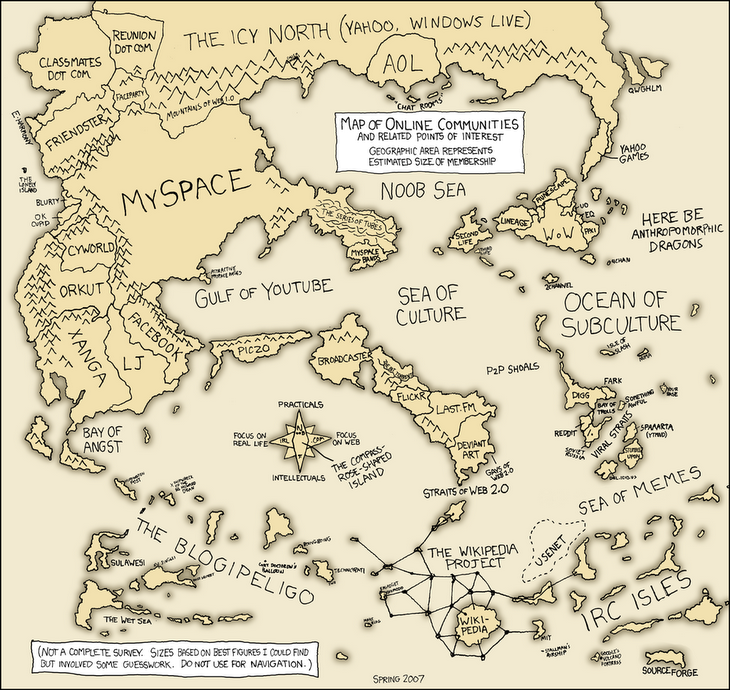
In the third of a continuing series of Facebook research projects, Lampe et al; drew data from over 30,000 Facebook profiles at Michigan State University in order to uncover the relationships between the amount and type of profile elements presented and number of friends.
Walther's Social Information Processing Theory: Online, lack of traditional cues leads to the development of new social cues, such as spelling ability.
Signaling Theory: Profile elements are signals used by individuals to communicate personal qualities that are interpreted by others in order to make judgments.
-Donath differentiates between assessment signals (which are observable qualities) and conventionial signals (indicated through social conventions). Online signals are generally conventional.
-In the world of Facebook, relationships are generally formed first offline. Thus, the structure of Facebook encourages honesty in profiles. Dishonesty is typically playful or ironic in nature.
-The researchers propose that the number of legitimate conventional signals included in Facebook profiles is proportionate to the size of one's online social network, as well as the signaling value of less verifiable cues (such as interests).
Common Ground Theory: Profile creation is motivated by a desire "to establish common frames or reference that enhance mutual understanding."
-Community membership is integral to assessing the amount of shared understandings, working to establish common frames of reference.
-Information derived from Facebook profiles works much in the same way as face-to-face "interviewing", indicating shared common ground that may enhance understanding between individuals (such as shared location or academic major).
Transaction Cost Theory: In establishing these common frames of reference through profiles, costly negotations ensue that work to enhance communication between interactants.
-Facebook profiles reduce the cost of connections by creating an easy way for individuals to search for those who share their interests or other attributes. Thus, the more information that is provided by an individual, the more likely they are to be found by others, enhancing the number of connections displayed by that individual.
-From this lens, the researchers suggest that the more verifiable elements and contact information is exhibited in one's Facebook profile, the greater the effects will be on the number of friends that person has.
The study used automated scripts to gather profile information, which was then encoded into four variables:
1. Control Variables: Network characteristics. (Sex, Length of Membership, Institutional Status, Last Updated)
2. Referents Index: Common points of reference, possibly assessment signals. (Hometown, High School, Residence, Concentration)
3. Interests Index: Conventional signals of identity. (Favorite Movies/Music/Books/TV Shows/Quotes, Interests, Political Views, About Me)
4. Contact Index: Willingness to share off-site connections. (Relationship Status, Looking For, Website, Address, Birthday, AIM, Email)
5. Dependent Variables: Total number of friends (Same School, Other School)
Results
-Users completed 59% of fields on average.
-Median number of preferences listed: 5 interests, 1 book, 5 movies, 3 music, 0 TV shows, 36 characters in "About Me" section.
-Median number of friends: 75 same school, 68 other school, 0.53 ratio.
-Number of friends is highly correlated with undergraduate status, as well as how long the account has been active.
-The act of providing information on one's profile is highly correlated with number of friends, most notably High School (92:35), AIM (100:50), Birthday (80:26), Favorite Music (83:37), and About Me (88:56). The first three aid in supporting pre-existing bonds, such as high school bonds, while the former provide information about one's identity to all users.
-There is a weak correlation between the AMOUNT of information in profiles and the number of friends. The researchers posit two possible explanations: either a user with many friends feels social pressure to include more information, or such a user includes more information while also seeking out more people to add as friends.
---
One of the main limitations described by the researchers is that their study focused on the behaviors of Facebook users, but not their attitudes toward or motivations behind these behaviors, and that they did not examine the content of profile fields, but rather the existence of them.
My examination of online social networking communities will be considerably less quantitative than many of the studies I have been reviewing. An emphasis on qualitative interviewing of SNC members (both face-to-face and online) will be a considerable benefit to the current research in this field.
Showing posts with label social capital. Show all posts
Showing posts with label social capital. Show all posts
May 15, 2007


May 2, 2007
Lit Review: Personal Relationships: On and Off the Internet (Boase & Wellman)
From Computer-Mediated Small Groups to the Internet
-The authors surmise that we are experiencing an era of "networked individualism", shifting from tight-knit, geographically local communities to dispersed, sparsely-knit personal networks.
-Past research on computer-mediated communication (CMC) failed to situate CMC within broader social contexts.
-Past research demonstrates that, thus far, the Internet has had no salient destructive or radical effect on society.
The Social Affordances of the Internet
-supports a greater number of geographically dispersed interactions.
-asynchronous: these interactions can occur between those with very different temporal rhythms.
-rapidity: increased velocity of interpersonal exchange.
-reduced social presence may lessen commitment, complexity, and/or strength of virtual bonds.
-textuality: reduces image-based hierarchies, such as race and class.
-absence of direct feedback --> increased likelihood for flaming.
-societal connectivity: transitive, indirect contact facilitated in a manner that often crosses group boundaries.
-mass messaging: allows contact with multiple social circles.
-HOWEVER, often social networks do not interact, and information diffuses quickly.
Utopianism and Dystopianism
-Utopianism represented by the transformative ideals of Barlow, McLuhan, and others.
-Dystopians warned of the isolating and alienating potential of the Internet, warning ominously of societal decline (Kroker & Weinstein, Stoll) and fractured identities (Turkle).
-Both views are overly simplistic, lacking ethnographic and empirical data.
-Technological Determinism: Attributing causal effects to the technology rather than the way in which people choose to utilize it. For instance, the Internet was the effect rather than the cause of the desire for distant communication.
Contact With Friends and Family- Online and Off
-Though early findings demonstrated negative effects of Internet use, later findings uncovered that Internet use is inextricably tied to one's preexisting personality characteristics (Kraut).
-Other studies used time diaries to examine the everyday practices and effects of Internet use in comparison to offline interaction and found little to no causal relationship (various studies by Katz).
-Evidence exists that demonstrates the correlation between using the Internet to meet new people and decreased TV watching (Kraut, Kiesler, Boneva, & Shklovski).
-The needs of the individual must be examined as causally affecting the everyday usages of the Internet.
Forming Relationships Online
-Research has shown that only a very small percentage of Internet users have formed new relationships online (Katz).
-The Internet serves as an important tool for forming relationships for those who are physically or psychologically disadvantaged, including those with very low self-image (McKenna).
-Often, most users who form relationships online eventually express the desire to meet offline.
Neighboring and the Internet
-A study by Hampton and Wellman on a networked Toronto suburb, "Netville" demonstrated an increase in neighborhood contact, offline visits, and neighborhood ties. Furthermore, the networked residents showed an increase in contact with geographically distant social bonds. The combination of these two effects is defined by the researcher as "glocalization".
Towards a Theory of Networked Individualism
-Since the Industrial Revolution and the rise of mass transit and telecommunications, there has been a shift in social relations that Wellman coins "networked individualism".
-Networked Individualism:
1. Both local and long distance relationships:
Most likely, individuals virtually interact with those they are close to, but just far away from that it is inconvenient to visit.
2. Sparsely-knit personal networks that include densely-knit groups:
Ease in coordinating group events through mass messaging; direct and autonomous nature of the Internet helps one to maintain a large network of contacts with relatively little work.
3. Relationships more easily formed and abandoned:
In this era of mobility and frequent change in environment, CMC helps people stay in touch with those they've left behind. Additionally, the Internet may aid the sociality of those who have trouble forming relationships offline. It also aids in neighborhood connectivity, as demonstrated by the Netville study.
4. Many relationships with people from different social backgrounds:
Devoid of many of the social cues implicit in offline interactions, the Internet facilitates the formation of relationships between individuals of differing backgrounds.
5. Few strong ties and many weak ones:
The asynchronous nature of the Internet means that interactions need not take place in the same space at the same time. This can be an asset in everyday activities (such as shopping) that involve coordination with strong ties, for communicating in a way that lacks intrusion or disruption. Weak ties can be more easily maintained as well, allowing for affirmation of a connection to even the most geographically distant acquaintance.
In conclusion, the authors point to a need to examine the psychological effects of networked individualism, such as information overload and dissatisfaction or, more positively, cognitive flexibility, social tolerance, and increased knowledge.
---
This paper was published in 2004, around the time online social networking services were becoming mainstream in popularity, and before the advent of social media services such as YouTube. It focuses primarily on e-mail as a form of CMC. Examining society's relationship to the Internet in general, the authors are a bit too empirical and generalistic for my taste.
In developing surveys regarding interaction in online social networks, it would be interesting to examine a subpopulation of those who have recently transitioned into a new environment (such as college alumni) and their use of these tools in maintaining important social ties. How useful and satisfying is this medium? Furthermore, does the Internet actually facilitate group formation, or are these group memberships illusory in nature (serving the purpose of identity development and performance)?
-The authors surmise that we are experiencing an era of "networked individualism", shifting from tight-knit, geographically local communities to dispersed, sparsely-knit personal networks.
-Past research on computer-mediated communication (CMC) failed to situate CMC within broader social contexts.
-Past research demonstrates that, thus far, the Internet has had no salient destructive or radical effect on society.
The Social Affordances of the Internet
-supports a greater number of geographically dispersed interactions.
-asynchronous: these interactions can occur between those with very different temporal rhythms.
-rapidity: increased velocity of interpersonal exchange.
-reduced social presence may lessen commitment, complexity, and/or strength of virtual bonds.
-textuality: reduces image-based hierarchies, such as race and class.
-absence of direct feedback --> increased likelihood for flaming.
-societal connectivity: transitive, indirect contact facilitated in a manner that often crosses group boundaries.
-mass messaging: allows contact with multiple social circles.
-HOWEVER, often social networks do not interact, and information diffuses quickly.
Utopianism and Dystopianism
-Utopianism represented by the transformative ideals of Barlow, McLuhan, and others.
-Dystopians warned of the isolating and alienating potential of the Internet, warning ominously of societal decline (Kroker & Weinstein, Stoll) and fractured identities (Turkle).
-Both views are overly simplistic, lacking ethnographic and empirical data.
-Technological Determinism: Attributing causal effects to the technology rather than the way in which people choose to utilize it. For instance, the Internet was the effect rather than the cause of the desire for distant communication.
Contact With Friends and Family- Online and Off
-Though early findings demonstrated negative effects of Internet use, later findings uncovered that Internet use is inextricably tied to one's preexisting personality characteristics (Kraut).
-Other studies used time diaries to examine the everyday practices and effects of Internet use in comparison to offline interaction and found little to no causal relationship (various studies by Katz).
-Evidence exists that demonstrates the correlation between using the Internet to meet new people and decreased TV watching (Kraut, Kiesler, Boneva, & Shklovski).
-The needs of the individual must be examined as causally affecting the everyday usages of the Internet.
Forming Relationships Online
-Research has shown that only a very small percentage of Internet users have formed new relationships online (Katz).
-The Internet serves as an important tool for forming relationships for those who are physically or psychologically disadvantaged, including those with very low self-image (McKenna).
-Often, most users who form relationships online eventually express the desire to meet offline.
Neighboring and the Internet
-A study by Hampton and Wellman on a networked Toronto suburb, "Netville" demonstrated an increase in neighborhood contact, offline visits, and neighborhood ties. Furthermore, the networked residents showed an increase in contact with geographically distant social bonds. The combination of these two effects is defined by the researcher as "glocalization".
Towards a Theory of Networked Individualism
-Since the Industrial Revolution and the rise of mass transit and telecommunications, there has been a shift in social relations that Wellman coins "networked individualism".
-Networked Individualism:
1. Both local and long distance relationships:
Most likely, individuals virtually interact with those they are close to, but just far away from that it is inconvenient to visit.
2. Sparsely-knit personal networks that include densely-knit groups:
Ease in coordinating group events through mass messaging; direct and autonomous nature of the Internet helps one to maintain a large network of contacts with relatively little work.
3. Relationships more easily formed and abandoned:
In this era of mobility and frequent change in environment, CMC helps people stay in touch with those they've left behind. Additionally, the Internet may aid the sociality of those who have trouble forming relationships offline. It also aids in neighborhood connectivity, as demonstrated by the Netville study.
4. Many relationships with people from different social backgrounds:
Devoid of many of the social cues implicit in offline interactions, the Internet facilitates the formation of relationships between individuals of differing backgrounds.
5. Few strong ties and many weak ones:
The asynchronous nature of the Internet means that interactions need not take place in the same space at the same time. This can be an asset in everyday activities (such as shopping) that involve coordination with strong ties, for communicating in a way that lacks intrusion or disruption. Weak ties can be more easily maintained as well, allowing for affirmation of a connection to even the most geographically distant acquaintance.
In conclusion, the authors point to a need to examine the psychological effects of networked individualism, such as information overload and dissatisfaction or, more positively, cognitive flexibility, social tolerance, and increased knowledge.
---
This paper was published in 2004, around the time online social networking services were becoming mainstream in popularity, and before the advent of social media services such as YouTube. It focuses primarily on e-mail as a form of CMC. Examining society's relationship to the Internet in general, the authors are a bit too empirical and generalistic for my taste.
In developing surveys regarding interaction in online social networks, it would be interesting to examine a subpopulation of those who have recently transitioned into a new environment (such as college alumni) and their use of these tools in maintaining important social ties. How useful and satisfying is this medium? Furthermore, does the Internet actually facilitate group formation, or are these group memberships illusory in nature (serving the purpose of identity development and performance)?
May 1, 2007
Lit Review: Trust in Electronic Environments (Chopra & Wallace)
The article examines the widely dispersed literature on trust with regard to information technologies. Trust is considered a crucial element with regard to social capital, and exists on four levels: the individual (psychological), the interpersonal (one to another), the relational (social glue), and the societal (functioning). The authors put forth a unified definition of trust as "the willingness to rely on a specific other, based on confidence that one's trust will lead to positive outcomes (3)."
When an individual possesses uncertainty or vulnerability in a particular domain, she may seek a dependent relationship with that which one is confident can fulfill that particular need, and this often entails risk on the part of the vulnerable individual. Systems trust (and here we bring the Internet into play) necessitates the establishment of social norms shared by other trusting individuals.
Trustworthiness is defined along four dimensions: competence and credibility, positive intentions, ethics, and predictability/consistency.
There are multiple processes invoked in the development of trust:
-prediction based on past behavior.
-intentionality of the trustee.
-emotional bonding and reciprocity of trust.
-reputation or institutional trust established through the trust of others.
-identification with the trustee (shared goals/values)
Four domains of trust are important in virtual environments:
1. Trustworthiness of information on the Internet.
-Users in need of information place themselves at risk for potential inaccuracy of information viewed. Factors at work include accuracy, bias, methodology, stability (of website address, currency), and validity.
2. Trustworthiness of the information/computing systems themselves.
-This includes interpersonal trust in one's own system as well as societal trust in network structures. One's emotional attitude, or technological bias, toward technology (technophilia/technophobia) is a crucial factor.
3. Trustworthiness of the economic stability of e-commerce.
-Both the buyer and the seller take risks. Reputation hinders on offline reputation and/or online ratings.
4. Trustworthiness of the individuals with whom one interacts in virtual environments.
-Motivations include information, friendship, or simply entertainment, and the truster has the authority to sever the relationship in case of fraudulent identity, abuse, or harassment. One's propensity to trust in this situation is highly dependent on one's technological bias, disposition, referrals, and the context of the relationship.
Computer technology challenges traditional notions of personhood, as machines increasingly take on roles and duties once assigned to people. Thus, it is apparent that trust plays a role in the relationship between human and computer in much the same way as in interpersonal relationships.
---
Social capital will be a central issue of discussion in my ensuing ethnography, and trust (as well as reciprocity and shared values and norms) is a crucial element.
MySpace: Little trust amongst generations outside the MySpace generation (today's teenagers), however a great deal of trust within that generation due to established cultural norms of participation in the community. Trust on MySpace is diminished by the proliferation of fraudulant identities and predatorial behavior, the finicky nature of the site, censorship, and the popular reputation I have just summated.
Facebook: High degree of trust in other users in one's network, who are usually preexisting relationships. However, growing wariness in the corporation itself due to the enormous amount of data that is collected and recorded and legal reprecussions to naive assumptions of privacy. Its quickly evolving nature, as well as its mass popularization (thus losing its niche identity) have led many to become suspicious of the intentions of the site.
Tribe: Very high degree of trust due to Tribe's subcultural history (as evidenced by its enormous popularity in the San Francisco Bay area). A haven for free speech, Tribe is also locally-based. Furthermore, many of Tribe's users possess shared cultural and social values (such as neotribalism). Users form tribes that often extend to the offline world, and vice versa.
SoundClick: Very high degree of trust, though few strong ties. What ties do exist are based around common interests (such as music genre or production tools) as well as reputation (established through rankings, popularity, degree of involvement on the site). SoundClick's niche audience authenticates the site, gives it legitimacy, and its users are able to share information with disparate others interested in the same thing (shared values and goals... globalizing potential).
When an individual possesses uncertainty or vulnerability in a particular domain, she may seek a dependent relationship with that which one is confident can fulfill that particular need, and this often entails risk on the part of the vulnerable individual. Systems trust (and here we bring the Internet into play) necessitates the establishment of social norms shared by other trusting individuals.
Trustworthiness is defined along four dimensions: competence and credibility, positive intentions, ethics, and predictability/consistency.
There are multiple processes invoked in the development of trust:
-prediction based on past behavior.
-intentionality of the trustee.
-emotional bonding and reciprocity of trust.
-reputation or institutional trust established through the trust of others.
-identification with the trustee (shared goals/values)
Four domains of trust are important in virtual environments:
1. Trustworthiness of information on the Internet.
-Users in need of information place themselves at risk for potential inaccuracy of information viewed. Factors at work include accuracy, bias, methodology, stability (of website address, currency), and validity.
2. Trustworthiness of the information/computing systems themselves.
-This includes interpersonal trust in one's own system as well as societal trust in network structures. One's emotional attitude, or technological bias, toward technology (technophilia/technophobia) is a crucial factor.
3. Trustworthiness of the economic stability of e-commerce.
-Both the buyer and the seller take risks. Reputation hinders on offline reputation and/or online ratings.
4. Trustworthiness of the individuals with whom one interacts in virtual environments.
-Motivations include information, friendship, or simply entertainment, and the truster has the authority to sever the relationship in case of fraudulent identity, abuse, or harassment. One's propensity to trust in this situation is highly dependent on one's technological bias, disposition, referrals, and the context of the relationship.
Computer technology challenges traditional notions of personhood, as machines increasingly take on roles and duties once assigned to people. Thus, it is apparent that trust plays a role in the relationship between human and computer in much the same way as in interpersonal relationships.
---
Social capital will be a central issue of discussion in my ensuing ethnography, and trust (as well as reciprocity and shared values and norms) is a crucial element.
MySpace: Little trust amongst generations outside the MySpace generation (today's teenagers), however a great deal of trust within that generation due to established cultural norms of participation in the community. Trust on MySpace is diminished by the proliferation of fraudulant identities and predatorial behavior, the finicky nature of the site, censorship, and the popular reputation I have just summated.
Facebook: High degree of trust in other users in one's network, who are usually preexisting relationships. However, growing wariness in the corporation itself due to the enormous amount of data that is collected and recorded and legal reprecussions to naive assumptions of privacy. Its quickly evolving nature, as well as its mass popularization (thus losing its niche identity) have led many to become suspicious of the intentions of the site.
Tribe: Very high degree of trust due to Tribe's subcultural history (as evidenced by its enormous popularity in the San Francisco Bay area). A haven for free speech, Tribe is also locally-based. Furthermore, many of Tribe's users possess shared cultural and social values (such as neotribalism). Users form tribes that often extend to the offline world, and vice versa.
SoundClick: Very high degree of trust, though few strong ties. What ties do exist are based around common interests (such as music genre or production tools) as well as reputation (established through rankings, popularity, degree of involvement on the site). SoundClick's niche audience authenticates the site, gives it legitimacy, and its users are able to share information with disparate others interested in the same thing (shared values and goals... globalizing potential).
April 3, 2007
Lit Review: Spatially Bounded Social Networks and Social Capital: The Role of Facebook
A fantastic empirical study using paychological assessment measures...
Intro
•discusses responses to Facebook as well as describes it- negative reprecussions the popular focus- schism between perceived and actual audience; privacy issues.
•A 2005 survey found that 90% of undergrads use an online social networking service (Stutzman)
•In spatially bounded sites such as Facebook, identity claims are less easily falsified, allow for accumulation of social capital with regard to acquaintances (though not necessarily deepening relationships) and ability to maintain a large network of social ties.
•Rheingold's work explored communities whose interaction extended from offline to online, as opposed to the Facebook.
•The gaps between connected individuals may actually increase the flow of information- from one group for which the knowledge is mundance, to another for which the information is novel.
•Differentiates between bridging and bonding social capital.
Method
•Study asked three questions: Who is using Facebook? How are students using Facebook? and What is the relationship between Facebook use and social capital?
•Random sample of 800 MSU students were surveyed (survey site: http://www.zommerang.com). 286 responded.
•Four measures:
1. Demographics/descriptives
2. Facebook usage
a. Intensity: integration into daily life, emotional connection, number of friends, time spent on site
b. Types of Use: information seeking vs. entertainment, maintaining old contacts vs. seeking new ones
c. Perceived Critical Mass: whether respondents perceived their contacts as also using Facebook.
3. psychological assessment
a. Satisfaction with life at MSU
b. Self-esteem
4. social capital measures
a. Bridging Social Capital: outward looking, broad range of contact, perception of oneself as part of a larger group,
reciprocity with a broader community
b. Bonding Social Capital
c. High School Social Capital
Results
• 94% use Facebook, no difference in demographics.
• Members report significantly higher high school social capital.
• More likely to use for killing time than gathering information.
• 10-30 minutes/day, 150-200 friends.
• Much more likely to interact with preexisting connections than meet new people.
• Assume their friends are using Facebook and will continue to do so.
• Results demonstrated the large role Facebook plays in developing and maintaining bridging social capital at their school.
• Those reporting low satisfaction and self-esteem appear to gain the most social capital from intense Facebook use.
• Using Facebook to meet new people was negatively associated with social capital.
• NO CORRELATION BETWEEN GPA AND INTENSITY OF FACEBOOK USE
• Implication that Facebook may crystallize relationships that would otherwise remain latent, such as classmates.
---
Repeat studies over time would help to establish causality- this study only proves correlation. Also, the researchers suggest pairing survey methods with actual measures of use (assessing Facebook profiles themselves)- a possibility for my own research. Another possibility is looking at how alumni use Facebook to maintain old college ties.
There is a notable trend in the use of online communities to strengthen and maintain existing relationships, as opposed to the older research on online communities (which focused on the formation of new ties). This suggests a movement toward integration of the offline and online worlds. In this way, internet communities may be seen as extensions of offline communities, offering a plethora of tools to strengthen weak bonds and maintain strong ones.
---
References to check out:
-Hampton & Wellman - online social networking enhances place-based communities
-Gross & Acquisti - Facebook 2005
-Stutzman - Facebook 2006
-Hamatake et al; - Facebook 2005
Intro
•discusses responses to Facebook as well as describes it- negative reprecussions the popular focus- schism between perceived and actual audience; privacy issues.
•A 2005 survey found that 90% of undergrads use an online social networking service (Stutzman)
•In spatially bounded sites such as Facebook, identity claims are less easily falsified, allow for accumulation of social capital with regard to acquaintances (though not necessarily deepening relationships) and ability to maintain a large network of social ties.
•Rheingold's work explored communities whose interaction extended from offline to online, as opposed to the Facebook.
•The gaps between connected individuals may actually increase the flow of information- from one group for which the knowledge is mundance, to another for which the information is novel.
•Differentiates between bridging and bonding social capital.
Method
•Study asked three questions: Who is using Facebook? How are students using Facebook? and What is the relationship between Facebook use and social capital?
•Random sample of 800 MSU students were surveyed (survey site: http://www.zommerang.com). 286 responded.
•Four measures:
1. Demographics/descriptives
2. Facebook usage
a. Intensity: integration into daily life, emotional connection, number of friends, time spent on site
b. Types of Use: information seeking vs. entertainment, maintaining old contacts vs. seeking new ones
c. Perceived Critical Mass: whether respondents perceived their contacts as also using Facebook.
3. psychological assessment
a. Satisfaction with life at MSU
b. Self-esteem
4. social capital measures
a. Bridging Social Capital: outward looking, broad range of contact, perception of oneself as part of a larger group,
reciprocity with a broader community
b. Bonding Social Capital
c. High School Social Capital
Results
• 94% use Facebook, no difference in demographics.
• Members report significantly higher high school social capital.
• More likely to use for killing time than gathering information.
• 10-30 minutes/day, 150-200 friends.
• Much more likely to interact with preexisting connections than meet new people.
• Assume their friends are using Facebook and will continue to do so.
• Results demonstrated the large role Facebook plays in developing and maintaining bridging social capital at their school.
• Those reporting low satisfaction and self-esteem appear to gain the most social capital from intense Facebook use.
• Using Facebook to meet new people was negatively associated with social capital.
• NO CORRELATION BETWEEN GPA AND INTENSITY OF FACEBOOK USE
• Implication that Facebook may crystallize relationships that would otherwise remain latent, such as classmates.
---
Repeat studies over time would help to establish causality- this study only proves correlation. Also, the researchers suggest pairing survey methods with actual measures of use (assessing Facebook profiles themselves)- a possibility for my own research. Another possibility is looking at how alumni use Facebook to maintain old college ties.
There is a notable trend in the use of online communities to strengthen and maintain existing relationships, as opposed to the older research on online communities (which focused on the formation of new ties). This suggests a movement toward integration of the offline and online worlds. In this way, internet communities may be seen as extensions of offline communities, offering a plethora of tools to strengthen weak bonds and maintain strong ones.
---
References to check out:
-Hampton & Wellman - online social networking enhances place-based communities
-Gross & Acquisti - Facebook 2005
-Stutzman - Facebook 2006
-Hamatake et al; - Facebook 2005
Subscribe to:
Posts (Atom)


 Posts
Posts