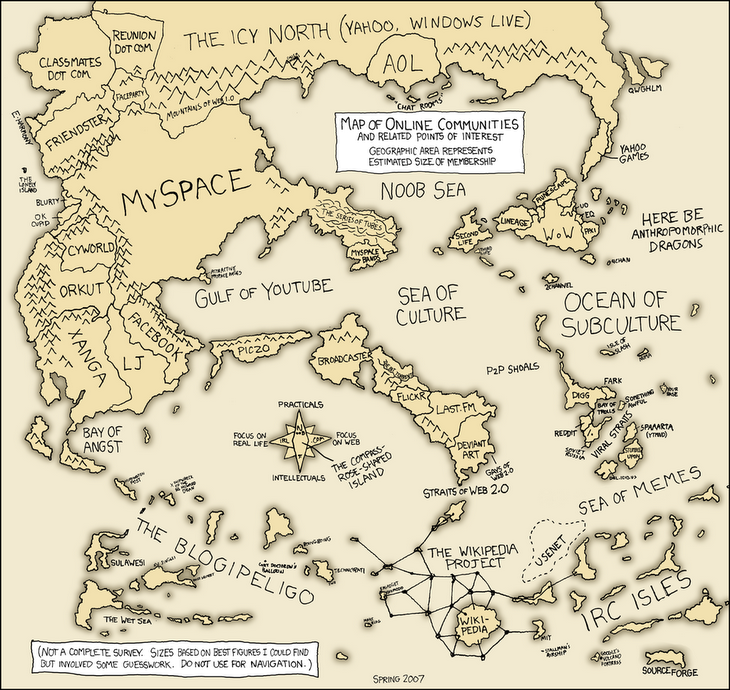
From the mid-19th century California Gold Rush to the turn-of-the-20th century cinematic fame of Hollywood, the furthest-west segment of the United States has inherited the legacy of the New Frontier. Today, the San Francisco Bay Area serves as the nexus of American utopianism, home of Silicon Valley and the dot-com frenzy, haven for hippies new and old.
I seek not to conclude my research of online social networking, but to extend its implications and apply it toward understanding the interconnected mysteries that keep me captivated by anthropology. The literature of cyberspace has quite literally predicted the future now within which we are currently living. The first step, then, is to become familiar with this literature, ranging from science fiction books and films to new ways of crafting contemporary folklore through the use of modern media technologies.
I've been chatting with James Curcio, author of Join My Cult! and, more recently, Fallen Nation. They're also on my summer reading list, and fit quite neatly into the literature I'm looking to submerge myself in (indeed, our chats have been a substantial part of the inspiration behind this post). I'm hoping to contribute to one of his new projects, Mythos Media, which seeks to produce contemporary myths in new ways through the use of new media. Thus, the second step is my own active participation in storycrafting, immersing myself in the mythology of the future-now and constructing parables utilizing new technologies.
From the open source culture of the Internet to the gift culture found at Burning Man and psytrance parties, the mythological legacy of California depicts all the essential dramaturgical elements: a paradisiacal land of angels and devils replete with struggles for power, legitimacy, and authenticity in an age where the world stands poised on the brink of apocalypse, anxiously awaiting salvation in the form of a charismatic prophet, a new world order, scientology, etc;
Or global consciousness.
The third and simultaneous step is a paper I am currently writing for an edited collection on psytrance culture, entitled Weaving the Underground Web: Neotribalism and Psytrance on Tribe.net.
Essentially, I'm building on the segments of my thesis that dealt with Tribe.net and subcultural capital theory, discussing the ways in which members of Tribe.net utilize the site as a facilitator of local scenes as well as a conduit for the spread of a global subculture.
The culture of the New Age (defined by Steven Sutcliffe [2003] as "a diffuse collectivity of questing individuals") circulates through the intersection of a wide array of beliefs and lifestyles that coalesce with the aid of such liminal spaces as the internet and international psytrance gatherings. Today, this mythology pervades in American popular media, which circulates readily on a global scale. Proper experience of this "global underground" is thus twofold, entailing both online ethnography of Tribe.net as well as adventures around the world- but that will probably have to wait until I find a Ph.D program suitable for this project. That would be step four.
Comments, suggestions, conversation welcome and encouraged.
Showing posts with label computer mediated communication. Show all posts
Showing posts with label computer mediated communication. Show all posts
July 4, 2008


February 20, 2008
Arranged-Marriages Online, Social Network-Style
Several months ago, someone told me about social networking sites that function as matchmaking tools for arranging marriages- a cultural practice that is common for nearly half the world's population, including India, China, and Indonesia, as well as Hindus, Muslims, and Buddhists. In a fit of brainstorming for my next research project, this conversation came to mind and I quickly discovered Shaadi.com, an Indian version of an online dating site. Curious, I filled out a profile of my own to see what kinds of categories one could choose amongst for self-representation.
Well, first of all, it's clear that most of the profiles on the site are filled out by parents, who are traditionally responsible for the search for and approval of potential husbands and wives. Among the more salient identity markers are Religion/Community (Hindu, Muslim, Christian, Sikh, Jain, Parsi, Buddhist, Jewish, "No Religion," "Spiritual- Not Religious," and "Other), Education, Profession, and Lifestyle (diet, smoking and drinking habits). Arranged-Marriages are ideally between two members of the same caste or sect, and Shaadi.com certainly covers the gamut. Potential matches are also frequently judged by education level and profession, as well as the aforementioned "lifestyle habits," which are heavily informed by religious beliefs.
A few other things I learned about while creating a profile on the site:
• The alignment of the stars at one's birth determines if a person is a Manglik, and Shaadi.com inquires as to one is. In Indian astrology, Mangliks are destined for difficulties in marriage. In order to balance out these negative forces, it is often suggested that a Manglik marry another Manglik, based on the idea that two negatives make a positive. Astrology in general is quite important for many Indians, especially Hindus, when it comes to marriage, and Shaadi.com users may incorporate a variety of astrological readings in their profiles.
• Like pretty much every social networking site, one can fill in an open-ended "About Me" box. However, on this site, there is also a significant section called "About My Family." Shaadi.com offers a few pointers for users filling out this section, the first of which suggests describing the family's outlook and approach towards life. Early on in the registration process, one could select whether her "Family Values" are traditional, moderate, or liberal. Clearly, the degree to which one's family embraces more traditional or more liberal attitudes and values has a significant effect on the matrimonial process.
• Admirably, the site also inquires about users' HIV status. Though figures place the percentage of HIV-infected people in India at a seemingly minute 0.36%, with the country's enormous population this amounts to between 2 million and 3.6 million Indians living with HIV. While there is some evidence that the rate of infection is currently declining, likely due to successful prevention and awareness campaigns, there is also plenty of evidence to the contrary. Given the rampant fear and stigmatization of HIV-positive individuals in communities everywhere, marking oneself as HIV-positive on the site likely drastically reduces one's chances at finding a spouse. However, as with both Mangliks and "Special Cases," another profile category wherein one can indicate mental and/or physical handicaps, the site makes finding others who share their "condition" a much easier process in many ways.
This semester, I am taking only one class as I complete my graduate thesis, the last class I will ever take at Wesleyan: Nationalism and the Politics of Gender and Sexuality with Professor Kauanui. Like most of the classes I've taken, I'm to conduct a semester-long research project, giving me the opportunity to conduct another mini-ethnography related to online social networking. As such, I'll be regularly posting my most pertinent and interesting findings. Stay tuned!
October 5, 2007
Musings on the Big Picture
I have been thinking of online social networks as pertinent examples of a generational trend, marked by the increasing appropriation of the media and proliferation of contextualized interpretations by disparate individuals, connected through shared taste fabrics that are founded, by and large, on mass media. The rise of Web 2.0 signifies a shift toward user-generated content in the form of blogs, photo albums, videos, music, niche communities, message board dialogue, playful interaction, computer media, and creative displays of identity (what I call the "mashup").
The locale of the hearth (that which is safe, secure) has shifted, from the family home theater clustered around the television to a dynamic mirror of ourselves as relational wholes, albeit individually fragmented. We have begun to bridge the gap between producers and consumers of media- increasing interactivity allows for a two-way dialogue as opposed to the directional nature of mass media.
However, all is not oral. New media is rather a hybrid of oral and written language- at once casual yet permanent, private yet public, intimate yet mediated. We are creating the media, but must not forgot the role of the media in inculcating our understandings of reality.
May 15, 2007
The Age of Egocasting?
Rosen, a technology journalist, discusses emerging online community practices in terms of a modern-day process she has coined “egocasting”. She documents the recent history of communicative technologies, which allow individuals to control with increasing precision the information they consume. Popular contraptions such as TiVo and the iPod allow individuals the capacity to avoid the sounds, images, and ideas we don’t agree with. She warns of the potential of this power for crafting a culture that is profoundly impatient and critical of all that does not align with their ideologies of choice.
The parallels to online communities are cutting. Though our culture frequently heralds the globalizing force of technology, there are darker implications that this technology may allow use to blind ourselves entirely to ideas and information that contest our beliefs and challenge our comfortable notions of ourselves, others, and the world at large.
TiVos and iPods will never destroy us. But our romance with technologies of personalization has partially fulfilled Krutch’s prediction. We haven’t become more like machines. We’ve made the machines more like us. In the process we are encouraging the flourishing of some of our less attractive human tendencies: for passive spectacle; for constant, escapist fantasy; for excesses of consumption. These impulses are age-old, of course, but they are now fantastically easy to satisfy. Instead of attending a bear-baiting, we can TiVo the wrestling match. From the remote control to TiVo and iPod, we have crafted technologies that are superbly capable of giving us what we want. Our pleasure at exercising control over what we hear, what we see, and what we read is not intrinsically dangerous. But an unwillingness to recognize the potential excesses of this power—egocasting, fetishization, a vast cultural impatience, and the triumph of individual choice over all critical standards—is perilous indeed.
The parallels to online communities are cutting. Though our culture frequently heralds the globalizing force of technology, there are darker implications that this technology may allow use to blind ourselves entirely to ideas and information that contest our beliefs and challenge our comfortable notions of ourselves, others, and the world at large.
May 2, 2007
Lit Review: Rhythms of Social Interaction: Messaging Within a Massive Online Network
-Extensive empirical analysis of 362 million message sent by 4.2 million Facebook users over a 26 month period.
-Results found a temporal rhythm that extended across campuses and seasons.
-Nearly all communication occurred between a small proportion of "friends".
-Social Network Research: how people make friends, number of friends, and forms of social support.
-Their understanding of the Poke: Users can ascribe whatever meaning in the context of their relationship to the poker or pokee; described as a "virtual intimate object", an active meaningful social gesture that necessitates reciprocity. Such a situation is a marker of a strong social bond.
-The privacy inherent in messaging/poking frees the act from the pressure of self-presentation.
Data
-Average of about 180 friends per user.
-About half of messages sent to friends at same school, 41% to friends at another school.
-Strangely, over 98% of pokes were sent between people from the same school.
-Reciprocity of messages occurs 59% of the time if senders are at the same school, but only 41% of the time if the sender is from a different school.
-Messaging/poking highest at the beginning of the week, declining drastically Friday and Saturday.
-The rhythm of activity differs from that of a corporate network, where most activity takes place during working hours.
-Trend of messages sent to those at different schools during the daytime, to nonfriends in the same school during the late-night hours.
-No change in rhythm, even during the summer, with the exception of a dramatic increase in messages sent to school friends during school break times.
-Different universities consistantly show either a disproportionately large or disproportionally small number of Facebookers who are active during the weekend.
Conclusions
-Concludes that internet sociality is an activity that frequently occurs alongside work-related tasks rather than as a leisure activity in and of itself.
-Though messages are sent primarily to friends, most friends do not receive messages. What does this say about the strength of Facebook "friend" ties?
-Seasonal variation in same/different school messaging demonstrates the importance of Facebook in supporting geographically distant relationships.
---
Not sure about the importance of this bit of research (though it could serve useful as a statistical supplement), however it was interesting to discover that such an intensive statistical analysis has been conducted on Facebook. With all the information available on the site, a vast array of studies concerning Internet activity could be conducted, as well as looking at the relationships between group memberships, interests, demographics (political and sexual orientation, gender, "looking for", religion) etc; The study would probably have been much more interesting had they focused on wall posts, the most active form of Facebook communication by far.
Lit Review: Digital Relationships in the ‘MySpace’ Generation: Results From a Qualitative Study (Dwyer)
A qualitative study of online social networking sites and instant messaging.
Background
-CMC reduces the exchange of social context cues, affecting perceptions of truthfulness, interpretation and response to messages, and the formation of impressions.
--Social Information Processing Model (Walther): CMC relies on paralinguistics, slowing the rate at which social cues are received.
-Impression Management (Goffman): The subtle process of controlling another's perception of something by managing the information exchanged in a social interaction. When that something is one's own identity, it is referred to as self-presentation. We interpret others through inference of their roles, derived from the information they or others present to us.
-Social-Technical Gap: The space between what technology can support and what actually happens in the social world.
The Study
-Examined the use of technology to manage relationships, and the ways in which these technologies mediate behaviors pertaining to the management of these relationships.
-The semi-structured interview designed inquired about self-presentation/impression management, pros and cons of these systems, usage and dependency for social communication. It also probed participants for information on how they used the tools provided by this systems in developing new relationships, restricting access, and responding to negative events. Expectations of privacy were also investigated, pertaining to what individuals felt comfortable with sharing and why.
-Interviews were conducted by 6 undergraduates, who interviewed a total of 19 college-aged participants. The transcripts were content-analyzed and coded.
-Participants reported heavy use of communication technologies, heralding their low cost, entertainment value, and convenience.
-Profiles provide the opportunity for impression management. Authenticity plays a large role here- profiles that appear (or are known to be) false or contrived trigger a very negative impression. However, they also discussed the need to create a "cool" persona and intense awareness of how others would perceive their self-presentations. Nevertheless, the act of constructing one's profile was generally considered a fun, entertaining activity.
-As one participant put it, "The defining characteristic of social networking sites is extreme impersonality. The people that one talks to on these sites are not treated as other human beings. They appear more like characters in a story."
-Though privacy concerns have been well-documented, the participants expressed general apathy, countering that they as members are responsible for the content and management of their virtual personas.
-Acknowledged that relationships formed online are superficial in nature.
-General enjoyment of these systems' ability to maintain bonds with those one doesn't see every day, as well as reunite one with old friends.
-Instant Messenger Away Messages: A user is able to monitor others while behind the "barrier" of the away message.
-Comfort level increased as the degree of their own anonymity rose, decreased with the anonymity of others.
Framework
Communication technology features (profile, visibility, and identity management) enable interpersonal relationship management (forming new relationships, maintaining existing relationships), which is in turn influenced by individual attitudes (impression management, concern for information privacy).
Questions Raised
How is impression management carried out within CMC?
How to explain the apparent contradiction between privacy concerns and the overwhelming popularity of social networking sites?
---
Individuals are fluid, not static, and in the act of creating a profile of the self one undergoes a strangely simplified process of impression management. I would like to examine the paralanguage of Internet communities, the ways in which social cues are subtly communicated, as well as the complex ways in which impression management is enacted.
Lit Review: Personal Relationships: On and Off the Internet (Boase & Wellman)
From Computer-Mediated Small Groups to the Internet
-The authors surmise that we are experiencing an era of "networked individualism", shifting from tight-knit, geographically local communities to dispersed, sparsely-knit personal networks.
-Past research on computer-mediated communication (CMC) failed to situate CMC within broader social contexts.
-Past research demonstrates that, thus far, the Internet has had no salient destructive or radical effect on society.
The Social Affordances of the Internet
-supports a greater number of geographically dispersed interactions.
-asynchronous: these interactions can occur between those with very different temporal rhythms.
-rapidity: increased velocity of interpersonal exchange.
-reduced social presence may lessen commitment, complexity, and/or strength of virtual bonds.
-textuality: reduces image-based hierarchies, such as race and class.
-absence of direct feedback --> increased likelihood for flaming.
-societal connectivity: transitive, indirect contact facilitated in a manner that often crosses group boundaries.
-mass messaging: allows contact with multiple social circles.
-HOWEVER, often social networks do not interact, and information diffuses quickly.
Utopianism and Dystopianism
-Utopianism represented by the transformative ideals of Barlow, McLuhan, and others.
-Dystopians warned of the isolating and alienating potential of the Internet, warning ominously of societal decline (Kroker & Weinstein, Stoll) and fractured identities (Turkle).
-Both views are overly simplistic, lacking ethnographic and empirical data.
-Technological Determinism: Attributing causal effects to the technology rather than the way in which people choose to utilize it. For instance, the Internet was the effect rather than the cause of the desire for distant communication.
Contact With Friends and Family- Online and Off
-Though early findings demonstrated negative effects of Internet use, later findings uncovered that Internet use is inextricably tied to one's preexisting personality characteristics (Kraut).
-Other studies used time diaries to examine the everyday practices and effects of Internet use in comparison to offline interaction and found little to no causal relationship (various studies by Katz).
-Evidence exists that demonstrates the correlation between using the Internet to meet new people and decreased TV watching (Kraut, Kiesler, Boneva, & Shklovski).
-The needs of the individual must be examined as causally affecting the everyday usages of the Internet.
Forming Relationships Online
-Research has shown that only a very small percentage of Internet users have formed new relationships online (Katz).
-The Internet serves as an important tool for forming relationships for those who are physically or psychologically disadvantaged, including those with very low self-image (McKenna).
-Often, most users who form relationships online eventually express the desire to meet offline.
Neighboring and the Internet
-A study by Hampton and Wellman on a networked Toronto suburb, "Netville" demonstrated an increase in neighborhood contact, offline visits, and neighborhood ties. Furthermore, the networked residents showed an increase in contact with geographically distant social bonds. The combination of these two effects is defined by the researcher as "glocalization".
Towards a Theory of Networked Individualism
-Since the Industrial Revolution and the rise of mass transit and telecommunications, there has been a shift in social relations that Wellman coins "networked individualism".
-Networked Individualism:
1. Both local and long distance relationships:
Most likely, individuals virtually interact with those they are close to, but just far away from that it is inconvenient to visit.
2. Sparsely-knit personal networks that include densely-knit groups:
Ease in coordinating group events through mass messaging; direct and autonomous nature of the Internet helps one to maintain a large network of contacts with relatively little work.
3. Relationships more easily formed and abandoned:
In this era of mobility and frequent change in environment, CMC helps people stay in touch with those they've left behind. Additionally, the Internet may aid the sociality of those who have trouble forming relationships offline. It also aids in neighborhood connectivity, as demonstrated by the Netville study.
4. Many relationships with people from different social backgrounds:
Devoid of many of the social cues implicit in offline interactions, the Internet facilitates the formation of relationships between individuals of differing backgrounds.
5. Few strong ties and many weak ones:
The asynchronous nature of the Internet means that interactions need not take place in the same space at the same time. This can be an asset in everyday activities (such as shopping) that involve coordination with strong ties, for communicating in a way that lacks intrusion or disruption. Weak ties can be more easily maintained as well, allowing for affirmation of a connection to even the most geographically distant acquaintance.
In conclusion, the authors point to a need to examine the psychological effects of networked individualism, such as information overload and dissatisfaction or, more positively, cognitive flexibility, social tolerance, and increased knowledge.
---
This paper was published in 2004, around the time online social networking services were becoming mainstream in popularity, and before the advent of social media services such as YouTube. It focuses primarily on e-mail as a form of CMC. Examining society's relationship to the Internet in general, the authors are a bit too empirical and generalistic for my taste.
In developing surveys regarding interaction in online social networks, it would be interesting to examine a subpopulation of those who have recently transitioned into a new environment (such as college alumni) and their use of these tools in maintaining important social ties. How useful and satisfying is this medium? Furthermore, does the Internet actually facilitate group formation, or are these group memberships illusory in nature (serving the purpose of identity development and performance)?
April 18, 2007
Lit Review: Managing Visibility, Intimacy, and Focus in Online Critical Ethnography (LeBesco)
Focus: Studying communication about fat identification (on the Internet).
Method: Downloaded posts and threads, participated in the community, made community aware of her status as researcher.
Theory: Critical ethnographic approach that sought to challenge mainstream political and social discourse about fat bodies.
Points of Consideration: Changes in embodiment allowed for by the use of technology; alternative model of personhood (observing communicative processes and social interaction, as opposed to individualistic narratives); the "cybernetic shape of information technologies" as a political arena.
Questions Raised: How are bodies and identities "policed" in internet forums? How does the design of Internet space affect deployments of power?
---
Many of those with whom I've discussed the political and cultural potential of the internet believe that the lack of face-to-face interaction renders individuals essentially isolated. However, is it not possible that meaning can be created irrespective of time and space? That you or I could psychically connect through the sharing of information and ideas across immense distances?
Identity projection, or "egocasting" (see Christine Rosen), allows for an enormous amount of social creativity and identity play. In this arena, the body exists apart from the mind- a condition which may be extraordinarily appealing for those who undergo consistent prejudice and discrimination instigated by their physical forms.
April 17, 2007
Lit Review: Technological Environments and the Evolution of Social Research Methods (Christians & Chen)
-From Newton --> Shannon and Weaver's The Mathematical Theory of Communication
-Carl Couch: Audio and video recording of human interactions.
Internet Research Pros:
-24-hour, instantaneous access.
-Massive sampling possibilities.
-Ability to pinpoint special interest groups
-Logs of conversations.
Issues in Internet Research:
-the bias of technology: what are the optimum qualities, and in what cases is the Internet less advantageous than other media?
-the technological imperative: tendency to allow Internet technology to monopolize other forms, yet this technology could not exist with the others.
-Marshall McLuhan
-organic communities: electronic culture dislocats us from space and history. Lacking acoustical symbols, assured markers of identity, and its dependence on the offline world, the online "world" cannot be one of its own making, per se.
--
I would argue that online environments can indeed be historically situated, and that we are in the midst of crafting a virtual world that will come to allow for extensive and imaginative identity play. However, what is often observed online is not the creation but rather the extension of real-world phenomena. In what ways are new forms of communication and community-building being created in virtual environments (cultural appropriation, network-bridging, etc;)?
-Carl Couch: Audio and video recording of human interactions.
Internet Research Pros:
-24-hour, instantaneous access.
-Massive sampling possibilities.
-Ability to pinpoint special interest groups
-Logs of conversations.
Issues in Internet Research:
-the bias of technology: what are the optimum qualities, and in what cases is the Internet less advantageous than other media?
-the technological imperative: tendency to allow Internet technology to monopolize other forms, yet this technology could not exist with the others.
Media of communication are vast social metaphors that not only transmit information but determine what is knowledge, that not only orient us to the world but tell us what kind of world exists.
-Marshall McLuhan
-organic communities: electronic culture dislocats us from space and history. Lacking acoustical symbols, assured markers of identity, and its dependence on the offline world, the online "world" cannot be one of its own making, per se.
--
I would argue that online environments can indeed be historically situated, and that we are in the midst of crafting a virtual world that will come to allow for extensive and imaginative identity play. However, what is often observed online is not the creation but rather the extension of real-world phenomena. In what ways are new forms of communication and community-building being created in virtual environments (cultural appropriation, network-bridging, etc;)?
April 15, 2007
Lit Review: "Seeing and Sensing" Online Interaction: An Interpretive Interactionist Approach to USENET Support Group Research (Walstrom)
A third-person observation cannot uncover the invisible bonds of connection that motivate people to interact with and feel responsible toward one another, particularly in sensitive cases in which anonymity can provide the comfort needed to become uninhibited with others, such as support groups. Traditional ethnographic methods may work for some online groups, but an interpretive interactive approach of forming an emotional connection to the participant may be essential to understanding her processes of sense-making.
In this study, the researcher was obliged to also have undergone the experiences of those in specific support groups, allowing both a third- and second-person position (analyst and participant-experiencer). Her own participation in an eating disorders support group yielded three central tenets: the formation of a public, group narrative to serve as a collective resource, discursive practices such as politeness to serve as protection of individual/group face, and the co-construction of eating disorder identities.
Social Constructionism: "the self-other dimension of interaction"- all cultural meanings are co-constructed.
Rhetorical-responsive Approach: Seeking understandings of "living utterances"
Interpretive Interactionism: Attending to the everyday experiences (feelings, actions, meanings) of interacting individuals.
-Researchers must make interpretive processes as public as they can, as well as the multiple methods employed.
-Micro-level: Local meanings to illuminate the inner lives of partipcipants.
-Macro-level: Connecting these micro-lvel findings to the poicies or institutions that can affect them.
-Rejects generalizations, positivism
In this study, the mainstream discourse of objectifying, pathologizing, and trivializing the experience of those suffering from eating disorders is problematized by fully representing the visceral experiences, competencies, and emotions through an interpretive interactionist approach. The approach was also feminist in nature, contesting the scientific discourse for its inability to recognize the authority of women in describing their own experiences. This merging of methodological approaches enhances the rigor by expanding the scope of inquiry into shared experiences.
Grounded Theory: Locating a core category for organizing the vast numbers of responses generated by a group and coding the actions and experiences in written accounts. For example- a category used in this study was the frequent and systematic tendency to personify the eating disorders ("the monster within"). This tendency can be invoked in a variety of situations, which were also coded (eg; introduction, ephiphany, cry for help). Can reveal much about the co-construction of identity.
Conversational Analysis: Noting what is displayed as salient in the structure of one's talk. Some things that are examined are the rules governing turn-taking, normative responses, use of genre (public narrative)
Discourse Analysis: Includes critical discourse analysis- critique of the hegemonic and institutional forces at work in local interactions. Also self-other positionings, responses to emotionally-charged displays.
Online Interpretive Interactionist Approach
-Self-presentation at introduction of link to group, sharing the dilemma/discourse.
-A feminist communitarian approach reflects the researcher's shared emotionality with paritcipants, research that will make a difference.
-Benefits: 1. representing participants' own voices validated their perspective, 2. thick description of shared problematic experiences enhances self-understandings, 3. critique of dominant discourses that affect the participants' potential for change.
----
Unlike this study, I am not seeking to uncover particularly sensitive issues. I am interested, however, in the formation of relationships with participants in order to understand more empathically, as well as challenge dominant discourses (such as predator threats, grand delusions of privacy, inability for computer-mediated communication to evoke tangible responses/form true social bonds, meeting of strangers, etc;). It will be important to examine the priority that individuals themselves place on online interactions, thus the first segment of my methodology will involve asking participants to articulate their own experiences in written accounts (through internet-based surveys). The accumulation of a large quantity of written data will serve my aim in categorizing experiences through the lens of public narratives and shared emotional displays.
Also, rather than "recruiting" subjects, I will be posting information about the study, as well as a link to the online survey(s) on public message forums, through which individuals will be self-motivated to participate. In addition, I will be evoking an interactionist approach through engagement with others in public dialogue spaces, such as message boards and group forums.
March 19, 2007
Lit Review: Mediating Ethnography: Objectivity and the Making of Ethnographies of the Internet
“To skilled online players, it’s easier to fake flesh-world personae than to maintain a consistent long-term online presence.” (Mortensen and Walker)
Pros:
• In an Internet setting, the ethnographer can “lurk” and thus be rendered invisible- enhanced objectivity. This position is usually also socially acceptable.
• However, lurking for the sake of ethnography may not be quite as acceptable- some information can only be learnt through the processes of interaction and participation, but this is also often made easier on the Internet.
Cons:
• Community on the Internet as illusory; research proving computer-mediated communication is not rich enough to sustain meaningful relationships.
• Rapidly evolving pace of technology poses many challenges to fixing an ethnographic work to a particularly meaningful time.
• Virtual fieldwork can be exhausting and overwhelming, highly uncertain.
• Blogging poses the challenge of blurring the distinction between the field and the writing up.
Some Questions...
• How to interpret and describe a textual landscape that is constantly expanding and being altered?
• Rather than transcribing and textualizing a community, the ethnographer is instead faced with the problem of justification- what, truly, can we add to something that describes itself better than we could?
• Mediated communication is defined by a distancing variable- in this case, the textuality and lack of presence associated with the Internet. Might this be at the root of such distrust, so many privacy concerns, so much misrepresentation?
Some ideas raised: videotape users, log chat sessions, network diagrams.
• Focus on the debates concerning multiple identities and dynamic communities, rather than traditional over-fetishised notions of community.
• Network ethnography relies on Social Network Analysis techniques (Howard)- the Internet makes this easier- mechanical objectivity.
• Wakeford: 3 types of online textualized activities: information spaces (WWW), communication spaces (listservs), and interaction spaces (AIM, IRC)
• Mason and Dicks: Ethnographic Hypermedia Environment works with notions of authorship, as the reader is granted agency in navigation and restructuring of the hypertext ethnography.
• Making an objective claim relies on knowledge of objects, which is informed by the kinds of claims one wishes to make.Thus, the production of ethnographic knowledge, particularly on the Internet, must be considered in the context of the ethnographer’s assumptions. Basic theoretical assumptions about anthropology may be at stake: society, the self, nature/culture distinctions. The Internet is not exotic, ‘net ethnographers do not hold position or special access…search engines hold more power. So the power of the ethnographer is in the investigatory and intersubjective potentials… telling the stories, explicating vocabularies, delineating new forms of group structure and communication.
---
The blogging is a good start, I like presenting my process and making connections between ideas. However, this article was a bit of a downer. What is the point? Do cultures even exist on the Internet? Perhaps I should discard the notion of "culture" altogether, and concentrate on human interaction. True interaction is embodied, but you don't need a body for that. All you need is an embodied mind, and not even full concentration at that.
A past paper I wrote grappled endlessly with the concept of the "real". Is the Internet "reality". Can computer-mediated communication come close to face to face interaction. Etcetera etcetera. On and on. Making distinctions. Trying to make distinctions. Everything is distinctions, muddy, muddy, muddy distinctions, and this virtual arena is no different. And by that I mean it's just different. I think I'm going to settle on that: this novel form of communication and connection. Not culture, but communitas.
I think I should make a little project of creating a network diagram, and see where that leads me... maybe overlapping multiple communities/multiple identities...
March 6, 2007
Lit Review: Profiles as Conversation: Networked Identity Performance on Friendster, by danah boyd and Jeffrey Heer
o The Friendster profile represents not a static individual, but rather “a communicative body in conversation with other represented bodies.”
o Communication as multimodal; performance and interpretation.
o How are unknown audiences negotiated in light of such public-private technologies as blogs and photosharing communities such as Flickr?
Background
o Description of content/functions
o Visual example of a profile
o Purpose of site: initially, dating, but interpreted as presentation of self, playful network-building, competition & voyeurism.
o Audience: gay men, bloggers, Burners
o History: Since 2003, has rapidly declined in popularity amongst initial members.
o Methodology
o Ethnography: 9 mo. Participant-observation, interviews, surveys, focus groups; 200 participants; 1.5 million profiles
o Visualization: Egocentric & interactive
Context
o Internal homophily / homogeneity
o As with Facebook, the network grew in population and diversity and challenged conceptions of perceived audience
o Playfulness depicted by Fakesters, encouraging creative performance while also mocking serious networkers…
Conversing
o Exchanging information- from performance → conversation
o Semi-public (bulletin board) & private (messaging)
o Embodiment through profiles
• Markers: photos, relationship status, looking for,
o Cultural rules: when is friending appropriate? What are the deeper meanings beneath the various facets of the profile? Reciprocity of testimonials…
o Photosharing as conversation and reinforcement of social bonds
o Friendster vocabulary much like Facebook vocabulary- a “friendster” / “Facebook friend”
Frozen Performances
o Lack of updating profiles – frozen identities, “time capsules”…
o Future a digital graveyard of past identity performance?
o Confusion of public/private in the virtual realm- persistence
---
This study could serve as useful in comparative analyses- Friendster was one of the first online social networks to become popular, as well as one of the first to become unpopular for a host of reasons (namely, the impact of moderating that resulted in the "Facebook Genocide", a lack of network limitations, a lack of new interactive content- that is, until Facebook became popular). Will MySpace head in a similar direction? Same potential for Tribe if it sells out...
New forms of conversation through digital content, especially photosharing. Facebook's "photo tagging" function was key to its popularity boom. The ability to add content of any sort is essential for conversation.
MySpace: User's can edit their own profiles as well as the comments they leave others with HTML, granting users an enormous degree of agency. However, this can get messy when profiles take minutes to load content (often encounter blaring music, seizure-inducing videos, slow-loading photo galleries, inane ego-capsules).
Facebook: Much cleaner than MySpace, but also much less agency. Users can import blogs, create slick Event and Group pages and invite users, and share content from the web (including video and audio).
Tribe: Users can choose from a variety of profile templates and arrange the content blocks on those templates. Again, less agency, however users are given a great variety of easy fill-in-the-blank templates. Above all, Tribe is the least susceptible to media-overload- message board forums are still the principle tenet of groups (Tribes), and users can choose the hierarchy of the information they divulge about themselves.
Subscribe to:
Posts (Atom)


 Posts