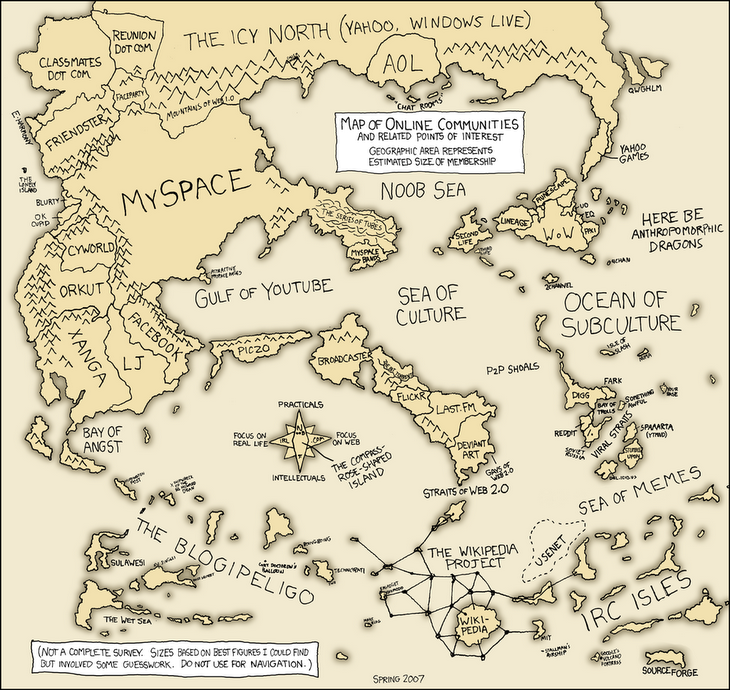
From the mid-19th century California Gold Rush to the turn-of-the-20th century cinematic fame of Hollywood, the furthest-west segment of the United States has inherited the legacy of the New Frontier. Today, the San Francisco Bay Area serves as the nexus of American utopianism, home of Silicon Valley and the dot-com frenzy, haven for hippies new and old.
I seek not to conclude my research of online social networking, but to extend its implications and apply it toward understanding the interconnected mysteries that keep me captivated by anthropology. The literature of cyberspace has quite literally predicted the future now within which we are currently living. The first step, then, is to become familiar with this literature, ranging from science fiction books and films to new ways of crafting contemporary folklore through the use of modern media technologies.
I've been chatting with James Curcio, author of Join My Cult! and, more recently, Fallen Nation. They're also on my summer reading list, and fit quite neatly into the literature I'm looking to submerge myself in (indeed, our chats have been a substantial part of the inspiration behind this post). I'm hoping to contribute to one of his new projects, Mythos Media, which seeks to produce contemporary myths in new ways through the use of new media. Thus, the second step is my own active participation in storycrafting, immersing myself in the mythology of the future-now and constructing parables utilizing new technologies.
From the open source culture of the Internet to the gift culture found at Burning Man and psytrance parties, the mythological legacy of California depicts all the essential dramaturgical elements: a paradisiacal land of angels and devils replete with struggles for power, legitimacy, and authenticity in an age where the world stands poised on the brink of apocalypse, anxiously awaiting salvation in the form of a charismatic prophet, a new world order, scientology, etc;
Or global consciousness.
The third and simultaneous step is a paper I am currently writing for an edited collection on psytrance culture, entitled Weaving the Underground Web: Neotribalism and Psytrance on Tribe.net.
Essentially, I'm building on the segments of my thesis that dealt with Tribe.net and subcultural capital theory, discussing the ways in which members of Tribe.net utilize the site as a facilitator of local scenes as well as a conduit for the spread of a global subculture.
The culture of the New Age (defined by Steven Sutcliffe [2003] as "a diffuse collectivity of questing individuals") circulates through the intersection of a wide array of beliefs and lifestyles that coalesce with the aid of such liminal spaces as the internet and international psytrance gatherings. Today, this mythology pervades in American popular media, which circulates readily on a global scale. Proper experience of this "global underground" is thus twofold, entailing both online ethnography of Tribe.net as well as adventures around the world- but that will probably have to wait until I find a Ph.D program suitable for this project. That would be step four.
Comments, suggestions, conversation welcome and encouraged.
Showing posts with label digital utopianism. Show all posts
Showing posts with label digital utopianism. Show all posts
July 4, 2008


October 9, 2007
Mass Media Belongs to the Masses
The character of mass media has been shifting dramatically over the past century- from the one-directional consumption of television, to the dialogical (yet niche) nature of online bulletin boards, to the enormous multimedia production of today. As the tools of new media increase in accessibility and expand in ubiquity, we find ourselves in conversation with a public audience that is more or less evident.
Knowing who one's audience is can be a tricky process. Blogs, websites, and publicly-accessible online profiles entail invisible publics. The creation of Friend Lists and the implementation of privacy features restricts one's audience and enhances awareness of it. Through the lens of the social graph, we can create categorical definitions of our audiences by labeling clusters of relations.
(From the looks of it, it would appear that my social network revolves around the following sites: Wesleyan, Boston, NY, San Francisco, Washington D.C, and the Northwest US):

There is something intrinsically satisfying in visual representation that text lacks. There are also few things more desirable than that which reflects oneself, however iconically.
TouchGraph, the company behind this Facebook application, says on their website:
Just the name of the company- TouchGraph, beckons us outside of the textuality of the Internet (a quality that is becoming progressively less prominent), allowing us to grasp our wider place in the virtual world on a more intuitive level.
Such data also allows us to understand exactly how limited our individual, direct scope actually is. I predict that the practice of mirroring real-life social networks will soon become secondary to the process of producing engaging media- which, as the Internet becomes increasingly searchable, will find its place amongst wider taste fabrics. These "taste fabrics" are constructed through "word of mouth" reconfigured to the modern sense- that is, hyperlinked. In turn we may find ourselves navigating visual representations of the taste fabrics we create through our Google searches, our social networks, and our own content.
Knowing who one's audience is can be a tricky process. Blogs, websites, and publicly-accessible online profiles entail invisible publics. The creation of Friend Lists and the implementation of privacy features restricts one's audience and enhances awareness of it. Through the lens of the social graph, we can create categorical definitions of our audiences by labeling clusters of relations.
(From the looks of it, it would appear that my social network revolves around the following sites: Wesleyan, Boston, NY, San Francisco, Washington D.C, and the Northwest US):

There is something intrinsically satisfying in visual representation that text lacks. There are also few things more desirable than that which reflects oneself, however iconically.
TouchGraph, the company behind this Facebook application, says on their website:
"Traditional search engines provide a way to sift through this data. However, the greatest insights can be achieved not by sifting, but by looking at the big picture to see how items are connected."
Just the name of the company- TouchGraph, beckons us outside of the textuality of the Internet (a quality that is becoming progressively less prominent), allowing us to grasp our wider place in the virtual world on a more intuitive level.
Such data also allows us to understand exactly how limited our individual, direct scope actually is. I predict that the practice of mirroring real-life social networks will soon become secondary to the process of producing engaging media- which, as the Internet becomes increasingly searchable, will find its place amongst wider taste fabrics. These "taste fabrics" are constructed through "word of mouth" reconfigured to the modern sense- that is, hyperlinked. In turn we may find ourselves navigating visual representations of the taste fabrics we create through our Google searches, our social networks, and our own content.
Emancipation from the material bases of inverted truth this is what the self-emancipation of our epoch consists of. This "historical mission of installing truth in the world" cannot be accomplished either by the isolated individual, or by the atomized crowd subjected to manipulation, but now as ever by the class which is able to effect the dissolution of all classes by bringing all power into the dealienating form of realized democracy, the Council, in which practical theory controls itself and sees its own action. This is possible only where individuals are "directly linked to universal history"; only where dialogue arms itself to make its own conditions victorious.
-Guy Debord
August 18, 2007
On Technoshamans and the Rise of Neotribalism
Asked to attempt a summation of the online social networking community known as tribe.net, I have taken to replying with the single phrase, "technoshamanism". It seems the word has not yet been taken up by many, so I'll attempt a definition here.
(For a little background information, you'd be keen to check out a term project I worked on for my Anthropology of Dance class, entitled "The Trance Dance Experience".)
A technoshaman is one who integrates modern technology into primordial practices in order to induce transcendent experiences. Now, such a description evokes remnants of that anthropological black mark- the noble savage- and thus I proceed with caution, unwilling to romanticize:
Technoshamanism seeks to rediscover the roots of human experience while utilizing modern tools. Such tools can range from repetitive electronic music, to synthetic drugs, to new technologies such as biofeedback. The states thus induced might range from supersensory to meditative. Modern "rave" culture (and I use this term with caution as well, for the rave scene has become inundated by the mainstream, thus necessitating an emergent subculture(s)) incorporates just such tools to achieve just such states, and where site and ideology merge, we have our subculture.
Regardless of terminology, the essence of such subcultures is the pursuit of the collective unconscious, consciously realized and enacted. When I say "neotribal," I refer to the tribal experience as it is recreated in the modern day. Safe spaces are created through collective artistic action; drugs consumed that serve to enhance feelings of empathy, community, clairvoyance, and/or transcendence; music played that serves to enhance said feelings and provide the collective pulse. This occurs with varying degrees of success, depending on whether individuals collaborate effectively to achieve the same goals.
The Internet is, quite naturally, one of those modern technologies that is utilized by technoshamans as a means of tapping into the collective neural network. As it exists apart (or, at the very least, disjointed) from time and space, the shape and texture of the Internet resembles that of technoshamanism itself. That's all I've got for now.
(For a little background information, you'd be keen to check out a term project I worked on for my Anthropology of Dance class, entitled "The Trance Dance Experience".)
A technoshaman is one who integrates modern technology into primordial practices in order to induce transcendent experiences. Now, such a description evokes remnants of that anthropological black mark- the noble savage- and thus I proceed with caution, unwilling to romanticize:
Technoshamanism seeks to rediscover the roots of human experience while utilizing modern tools. Such tools can range from repetitive electronic music, to synthetic drugs, to new technologies such as biofeedback. The states thus induced might range from supersensory to meditative. Modern "rave" culture (and I use this term with caution as well, for the rave scene has become inundated by the mainstream, thus necessitating an emergent subculture(s)) incorporates just such tools to achieve just such states, and where site and ideology merge, we have our subculture.
Regardless of terminology, the essence of such subcultures is the pursuit of the collective unconscious, consciously realized and enacted. When I say "neotribal," I refer to the tribal experience as it is recreated in the modern day. Safe spaces are created through collective artistic action; drugs consumed that serve to enhance feelings of empathy, community, clairvoyance, and/or transcendence; music played that serves to enhance said feelings and provide the collective pulse. This occurs with varying degrees of success, depending on whether individuals collaborate effectively to achieve the same goals.
The Internet is, quite naturally, one of those modern technologies that is utilized by technoshamans as a means of tapping into the collective neural network. As it exists apart (or, at the very least, disjointed) from time and space, the shape and texture of the Internet resembles that of technoshamanism itself. That's all I've got for now.
May 9, 2007
The Sociocultural Appropriation of Web 2.0?
I was notified via Tribe.net today of a new online startup by Daniel Pinchbeck (Technoshaman, Wesleyan dropout, and author of Breaking Open the Head and 2012: The Return of Quetzalcoatl), Reality Sandwich. The site is to begin as an online magazine dedicated to the "re-imagining" of an intentional, international community of new-age shamans and neo-hippies. It is planned to evolve into an extensive, global social networking site. Among the first articles can be found discussions of the "ethnosphere", an interview with Abbie Hoffman, 21st century shamans, a "recipe for happiness" and an article about the practical application of digital utopian ideals in Web 2.0 communities:
Pinchbeck is a controversial figure in New Age discourse, and has been described by many as a modern-day Timothy Leary, though Terence McKenna is a more appropriate comparison. His ambitious goals to evolve the global consciousness through the appropriation of technology and communication practices is reminiscent of Stewart Brand's Whole Earth Catalog (see From Counterculture to Cyberculture, part 1 and part 2).
Implications for Research
Is this a new stage in the rise of digital utopianism? Are we witnessing the rise of technoshamanism? How does this New Age subculture find strength in global, online communities (such as Tribe)?
My primary focus in blog will be the ongoing struggle to create an Internet that serves the public interest, one that incorporates the highest ideals that the evolution of web 2.0 points toward. I will watch the industry and I will watch the tech watchers and give you my honest perspective. I will tell you about companies that are doing good work and trying to improve things, and alert you to those that are being sneaky. In the same way as buying green produce supports and helps people make deeper changes in industry practices, we can vote with our on-line attention and dollars, giving our business to those online companies who put you in the middle of the picture.
Pinchbeck is a controversial figure in New Age discourse, and has been described by many as a modern-day Timothy Leary, though Terence McKenna is a more appropriate comparison. His ambitious goals to evolve the global consciousness through the appropriation of technology and communication practices is reminiscent of Stewart Brand's Whole Earth Catalog (see From Counterculture to Cyberculture, part 1 and part 2).
Implications for Research
Is this a new stage in the rise of digital utopianism? Are we witnessing the rise of technoshamanism? How does this New Age subculture find strength in global, online communities (such as Tribe)?
April 28, 2007
Lit Review: From Counterculture to Cyberculture (cont.)
Chapter 2: Stewart Brand Meets the Cybernetic Counterculture
-In the era of the Beat generation and the Merry Pranksters, the social ideals of the New Communalists and the products of the Cold War technocracy were merged in the San Francisco LSD scene. Trips Festivals created spaces in which the technological and the social came together in ecstatic communal experiences marked by lights, images, and music brought about through electronic media, as well as LSD. These experiences integrated those who attended into a single techno-biological system:
---
Chapter 3: The Whole Earth Catalog as Information Technology
-Brand's desire to merge systems theory and New Communalist politics resulted in the creation of the Whole Earth Catalog, a disperse project offering products such as books, camping gear, and blueprints for houses and machines for those migrating to form communes in the hills of New Mexico and Colorado.
-The Catalog reflected both the technological and scientific achievements of the time as well as the acid-drenched, Eastern religion-inspired hippie movement. In addition, the contributions of its readers established a network forum enhanced by mobility between several countercultural, academic, and technological communities.
-Collaboration of disparate, disembodied communities, small-scale personal and informational technology that supported the development of individual consciousness and ecstatic communion.
---
In comparing the Whole Earth Catalog to current Internet culture, the following snippets are particularly of note:
-both a reflection of and a doorway to the world
-nomadic technocratism
-interactive elements increase commitment, as well as involvement.
-by publishing financial accounts, Whole Earth was also viewed as "open source"
-appropriation by the subculture(s) for the purposes of transformation of the superculture- does this succeed? Dominated by white, affluent, educated population...
-In the era of the Beat generation and the Merry Pranksters, the social ideals of the New Communalists and the products of the Cold War technocracy were merged in the San Francisco LSD scene. Trips Festivals created spaces in which the technological and the social came together in ecstatic communal experiences marked by lights, images, and music brought about through electronic media, as well as LSD. These experiences integrated those who attended into a single techno-biological system:
Far from asserting direct control over events, he [Brand] had built an environment, a happening, a laboratory. He had set forth the conditions under which a system might evolve and flower, and he had stocked the biological and social worlds of those who entered that system with technologies that allowed them to feel as though the boundaries between the social and the biological, between their minds and their bodies, and between themselves and their friends, were highly permeable. He had helped found a new tribe of technology-loving Indians, artistic engineers of the self.
---
Chapter 3: The Whole Earth Catalog as Information Technology
-Brand's desire to merge systems theory and New Communalist politics resulted in the creation of the Whole Earth Catalog, a disperse project offering products such as books, camping gear, and blueprints for houses and machines for those migrating to form communes in the hills of New Mexico and Colorado.
-The Catalog reflected both the technological and scientific achievements of the time as well as the acid-drenched, Eastern religion-inspired hippie movement. In addition, the contributions of its readers established a network forum enhanced by mobility between several countercultural, academic, and technological communities.
-Collaboration of disparate, disembodied communities, small-scale personal and informational technology that supported the development of individual consciousness and ecstatic communion.
We are as gods and might as well get good at it. So far, remotely done power and glory- as via government, big business, formal education, church- has succeeded to the point where gross defects obscure actual gains. In response to this dilemma and to these gains a realm of intimate, personal power is developing- power of the individual to conduct his own education, find his own inspiration, shape his own environment, and share his adventure with whoever is interested. Tools that aid this process are sought and promoted by the Whole Earth Catalog (Brand, inside cover of the Catalog).
---
In comparing the Whole Earth Catalog to current Internet culture, the following snippets are particularly of note:
-both a reflection of and a doorway to the world
-nomadic technocratism
-interactive elements increase commitment, as well as involvement.
-by publishing financial accounts, Whole Earth was also viewed as "open source"
-appropriation by the subculture(s) for the purposes of transformation of the superculture- does this succeed? Dominated by white, affluent, educated population...
The Rise of Digital Utopianism: Implications for Analysis
Barlow, an information technology journalist and pundit, was also once a lyricist for the Grateful Dead. Following an international summit in which the Communications Decency Act was passed, which sought to restrict pornography on the Internet, he crafted a treatise in defense of the independence of the Internet from bureaucratic attempts at regulation. This essay, which was posted and widely circulated on the Internet, suggested that the Internet allowed for the possibility of a social revolution. Barlow painted a picture of a world in which the oppressive forces of the government were replaced by the pursuit of individual enlightenment, communality, and collective consciousness.
Barlow’s work in collaboration with Wired magazine established a movement inspired by an ideology of digital utopianism. In what ways has this ideology integrated into the public consciousness? In my own research on online social networking communities, I would like to examine how these sites contribute to as well as diminish the creation of a “digital utopia”.
Cyberspace consists of transactions, relationships, and thought itself, arrayed like a standing wave in the web of our communications. Ours is a world that is both everywhere and nowhere, but it is not where bodies live.
We are creating a world that all may enter without privilege or prejudice accorded by race, economic power, military force, or station of birth.
We are creating a world where anyone, anywhere may express his or her beliefs, no matter how singular, without fear of being coerced into silence or conformity.
Your legal concepts of property, expression, identity, movement, and context do not apply to us. They are all based on matter, and there is no matter here.
Our identities have no bodies, so, unlike you, we cannot obtain order by physical coercion. We believe that from ethics, enlightened self-interest, and the commonweal, our governance will emerge . Our identities may be distributed across many of your jurisdictions. The only law that all our constituent cultures would generally recognize is the Golden Rule. We hope we will be able to build our particular solutions on that basis. But we cannot accept the solutions you are attempting to impose.
Barlow’s work in collaboration with Wired magazine established a movement inspired by an ideology of digital utopianism. In what ways has this ideology integrated into the public consciousness? In my own research on online social networking communities, I would like to examine how these sites contribute to as well as diminish the creation of a “digital utopia”.
Subscribe to:
Posts (Atom)


 Posts
Posts