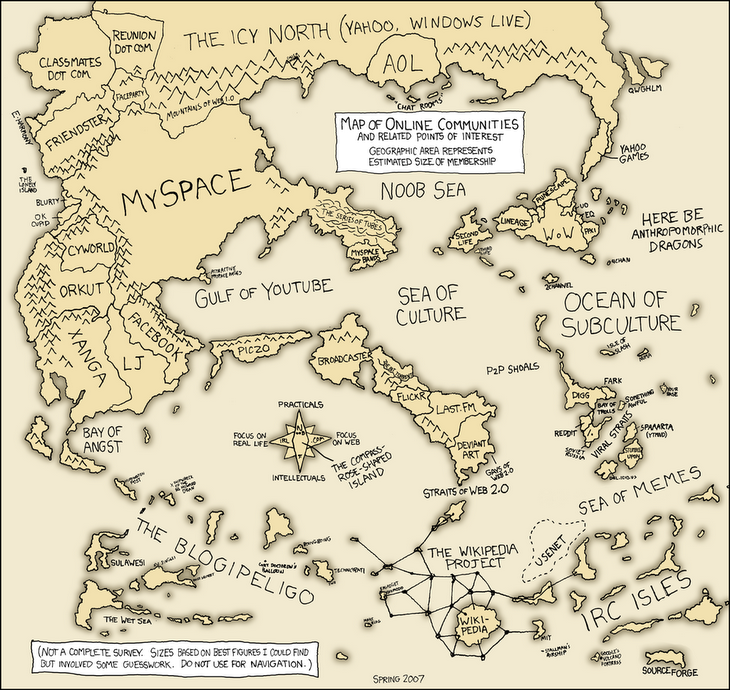
-Though academic institutions have been working to protect student identities, their work is increasingly being undermined by social networking communities (SNCs).
-The goals of this study were twofold: obtaining quantitative data about SNC participation on college campuses, and analyzing member attitudes pertaining to SNC participation and online identity sharing. This data was gathered from the perspective of an outsider to these communities.
-A random survey of 200 students (38 of whom responded) inquired about the specifics of their involvement in SNCs as well as their feelings regarding online identity sharing. The researcher then created a disclosure matrix for each participant by examining the data made available in their SNC profiles.
-Limitations: Small sample size, internet survey may be biased toward the tech-savvy, outsider status, lexical differences in coding identity elements of the SNCs (favorite movies, sexual orientation, academic status, etc;).
Findings
-71% involvement in SNCs: 90% of undergrads, 44% of grads.
-Most popular was Facebook (90% of undergrads), followed by Friendster and MySpace.
-Though participants expressed doubt that their identity information was protected online (2.66 on a 5-point Likert scale), they were nevertheless okay with friends accessing this information (4.55), but markedly less so with strangers (3.15).
-Information of particular interest: location, sexual orientation, political status
-Urges discussion of new identity disclosure threats posed by SNCs.
---
The very small sample size of this study makes it almost entirely worthless to review, but it is worth noting that academic institutions are working to protect the identities of their students. In another vein, the enormous discrepency between SNC participation by undergrads and that of graduate students suggest that the undergaduate community may possess certain qualities or needs that SNCs fulfill, such as maintaining high school ties.
Seeing as identity disclosure would seem to be a pertinent issue, it would be interesting to reassess users' feelings on the matter now that SNCs have become both mainstream and problematized by media discourse. How is "stalking" defined (it is a commonly used term in Facebook discourse)? What sort of activities and degree of involvement are deemed acceptable by today's norms?
Showing posts with label friendster. Show all posts
Showing posts with label friendster. Show all posts
May 2, 2007


March 6, 2007
Lit Review: Profiles as Conversation: Networked Identity Performance on Friendster, by danah boyd and Jeffrey Heer
o The Friendster profile represents not a static individual, but rather “a communicative body in conversation with other represented bodies.”
o Communication as multimodal; performance and interpretation.
o How are unknown audiences negotiated in light of such public-private technologies as blogs and photosharing communities such as Flickr?
Background
o Description of content/functions
o Visual example of a profile
o Purpose of site: initially, dating, but interpreted as presentation of self, playful network-building, competition & voyeurism.
o Audience: gay men, bloggers, Burners
o History: Since 2003, has rapidly declined in popularity amongst initial members.
o Methodology
o Ethnography: 9 mo. Participant-observation, interviews, surveys, focus groups; 200 participants; 1.5 million profiles
o Visualization: Egocentric & interactive
Context
o Internal homophily / homogeneity
o As with Facebook, the network grew in population and diversity and challenged conceptions of perceived audience
o Playfulness depicted by Fakesters, encouraging creative performance while also mocking serious networkers…
Conversing
o Exchanging information- from performance → conversation
o Semi-public (bulletin board) & private (messaging)
o Embodiment through profiles
• Markers: photos, relationship status, looking for,
o Cultural rules: when is friending appropriate? What are the deeper meanings beneath the various facets of the profile? Reciprocity of testimonials…
o Photosharing as conversation and reinforcement of social bonds
o Friendster vocabulary much like Facebook vocabulary- a “friendster” / “Facebook friend”
Frozen Performances
o Lack of updating profiles – frozen identities, “time capsules”…
o Future a digital graveyard of past identity performance?
o Confusion of public/private in the virtual realm- persistence
---
This study could serve as useful in comparative analyses- Friendster was one of the first online social networks to become popular, as well as one of the first to become unpopular for a host of reasons (namely, the impact of moderating that resulted in the "Facebook Genocide", a lack of network limitations, a lack of new interactive content- that is, until Facebook became popular). Will MySpace head in a similar direction? Same potential for Tribe if it sells out...
New forms of conversation through digital content, especially photosharing. Facebook's "photo tagging" function was key to its popularity boom. The ability to add content of any sort is essential for conversation.
MySpace: User's can edit their own profiles as well as the comments they leave others with HTML, granting users an enormous degree of agency. However, this can get messy when profiles take minutes to load content (often encounter blaring music, seizure-inducing videos, slow-loading photo galleries, inane ego-capsules).
Facebook: Much cleaner than MySpace, but also much less agency. Users can import blogs, create slick Event and Group pages and invite users, and share content from the web (including video and audio).
Tribe: Users can choose from a variety of profile templates and arrange the content blocks on those templates. Again, less agency, however users are given a great variety of easy fill-in-the-blank templates. Above all, Tribe is the least susceptible to media-overload- message board forums are still the principle tenet of groups (Tribes), and users can choose the hierarchy of the information they divulge about themselves.
o Communication as multimodal; performance and interpretation.
o How are unknown audiences negotiated in light of such public-private technologies as blogs and photosharing communities such as Flickr?
Background
o Description of content/functions
o Visual example of a profile
o Purpose of site: initially, dating, but interpreted as presentation of self, playful network-building, competition & voyeurism.
o Audience: gay men, bloggers, Burners
o History: Since 2003, has rapidly declined in popularity amongst initial members.
o Methodology
o Ethnography: 9 mo. Participant-observation, interviews, surveys, focus groups; 200 participants; 1.5 million profiles
o Visualization: Egocentric & interactive
Context
o Internal homophily / homogeneity
o As with Facebook, the network grew in population and diversity and challenged conceptions of perceived audience
o Playfulness depicted by Fakesters, encouraging creative performance while also mocking serious networkers…
Conversing
o Exchanging information- from performance → conversation
o Semi-public (bulletin board) & private (messaging)
o Embodiment through profiles
• Markers: photos, relationship status, looking for,
o Cultural rules: when is friending appropriate? What are the deeper meanings beneath the various facets of the profile? Reciprocity of testimonials…
o Photosharing as conversation and reinforcement of social bonds
o Friendster vocabulary much like Facebook vocabulary- a “friendster” / “Facebook friend”
Frozen Performances
o Lack of updating profiles – frozen identities, “time capsules”…
o Future a digital graveyard of past identity performance?
o Confusion of public/private in the virtual realm- persistence
---
This study could serve as useful in comparative analyses- Friendster was one of the first online social networks to become popular, as well as one of the first to become unpopular for a host of reasons (namely, the impact of moderating that resulted in the "Facebook Genocide", a lack of network limitations, a lack of new interactive content- that is, until Facebook became popular). Will MySpace head in a similar direction? Same potential for Tribe if it sells out...
New forms of conversation through digital content, especially photosharing. Facebook's "photo tagging" function was key to its popularity boom. The ability to add content of any sort is essential for conversation.
MySpace: User's can edit their own profiles as well as the comments they leave others with HTML, granting users an enormous degree of agency. However, this can get messy when profiles take minutes to load content (often encounter blaring music, seizure-inducing videos, slow-loading photo galleries, inane ego-capsules).
Facebook: Much cleaner than MySpace, but also much less agency. Users can import blogs, create slick Event and Group pages and invite users, and share content from the web (including video and audio).
Tribe: Users can choose from a variety of profile templates and arrange the content blocks on those templates. Again, less agency, however users are given a great variety of easy fill-in-the-blank templates. Above all, Tribe is the least susceptible to media-overload- message board forums are still the principle tenet of groups (Tribes), and users can choose the hierarchy of the information they divulge about themselves.
Subscribe to:
Posts (Atom)


 Posts
Posts