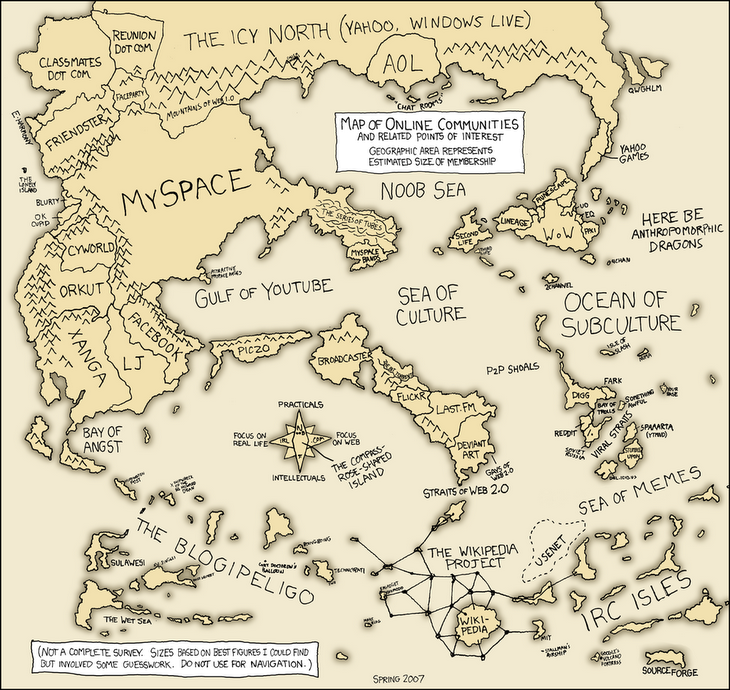
-Though academic institutions have been working to protect student identities, their work is increasingly being undermined by social networking communities (SNCs).
-The goals of this study were twofold: obtaining quantitative data about SNC participation on college campuses, and analyzing member attitudes pertaining to SNC participation and online identity sharing. This data was gathered from the perspective of an outsider to these communities.
-A random survey of 200 students (38 of whom responded) inquired about the specifics of their involvement in SNCs as well as their feelings regarding online identity sharing. The researcher then created a disclosure matrix for each participant by examining the data made available in their SNC profiles.
-Limitations: Small sample size, internet survey may be biased toward the tech-savvy, outsider status, lexical differences in coding identity elements of the SNCs (favorite movies, sexual orientation, academic status, etc;).
Findings
-71% involvement in SNCs: 90% of undergrads, 44% of grads.
-Most popular was Facebook (90% of undergrads), followed by Friendster and MySpace.
-Though participants expressed doubt that their identity information was protected online (2.66 on a 5-point Likert scale), they were nevertheless okay with friends accessing this information (4.55), but markedly less so with strangers (3.15).
-Information of particular interest: location, sexual orientation, political status
-Urges discussion of new identity disclosure threats posed by SNCs.
---
The very small sample size of this study makes it almost entirely worthless to review, but it is worth noting that academic institutions are working to protect the identities of their students. In another vein, the enormous discrepency between SNC participation by undergrads and that of graduate students suggest that the undergaduate community may possess certain qualities or needs that SNCs fulfill, such as maintaining high school ties.
Seeing as identity disclosure would seem to be a pertinent issue, it would be interesting to reassess users' feelings on the matter now that SNCs have become both mainstream and problematized by media discourse. How is "stalking" defined (it is a commonly used term in Facebook discourse)? What sort of activities and degree of involvement are deemed acceptable by today's norms?
Showing posts with label trust. Show all posts
Showing posts with label trust. Show all posts
May 2, 2007


May 1, 2007
Lit Review: Trust in Electronic Environments (Chopra & Wallace)
The article examines the widely dispersed literature on trust with regard to information technologies. Trust is considered a crucial element with regard to social capital, and exists on four levels: the individual (psychological), the interpersonal (one to another), the relational (social glue), and the societal (functioning). The authors put forth a unified definition of trust as "the willingness to rely on a specific other, based on confidence that one's trust will lead to positive outcomes (3)."
When an individual possesses uncertainty or vulnerability in a particular domain, she may seek a dependent relationship with that which one is confident can fulfill that particular need, and this often entails risk on the part of the vulnerable individual. Systems trust (and here we bring the Internet into play) necessitates the establishment of social norms shared by other trusting individuals.
Trustworthiness is defined along four dimensions: competence and credibility, positive intentions, ethics, and predictability/consistency.
There are multiple processes invoked in the development of trust:
-prediction based on past behavior.
-intentionality of the trustee.
-emotional bonding and reciprocity of trust.
-reputation or institutional trust established through the trust of others.
-identification with the trustee (shared goals/values)
Four domains of trust are important in virtual environments:
1. Trustworthiness of information on the Internet.
-Users in need of information place themselves at risk for potential inaccuracy of information viewed. Factors at work include accuracy, bias, methodology, stability (of website address, currency), and validity.
2. Trustworthiness of the information/computing systems themselves.
-This includes interpersonal trust in one's own system as well as societal trust in network structures. One's emotional attitude, or technological bias, toward technology (technophilia/technophobia) is a crucial factor.
3. Trustworthiness of the economic stability of e-commerce.
-Both the buyer and the seller take risks. Reputation hinders on offline reputation and/or online ratings.
4. Trustworthiness of the individuals with whom one interacts in virtual environments.
-Motivations include information, friendship, or simply entertainment, and the truster has the authority to sever the relationship in case of fraudulent identity, abuse, or harassment. One's propensity to trust in this situation is highly dependent on one's technological bias, disposition, referrals, and the context of the relationship.
Computer technology challenges traditional notions of personhood, as machines increasingly take on roles and duties once assigned to people. Thus, it is apparent that trust plays a role in the relationship between human and computer in much the same way as in interpersonal relationships.
---
Social capital will be a central issue of discussion in my ensuing ethnography, and trust (as well as reciprocity and shared values and norms) is a crucial element.
MySpace: Little trust amongst generations outside the MySpace generation (today's teenagers), however a great deal of trust within that generation due to established cultural norms of participation in the community. Trust on MySpace is diminished by the proliferation of fraudulant identities and predatorial behavior, the finicky nature of the site, censorship, and the popular reputation I have just summated.
Facebook: High degree of trust in other users in one's network, who are usually preexisting relationships. However, growing wariness in the corporation itself due to the enormous amount of data that is collected and recorded and legal reprecussions to naive assumptions of privacy. Its quickly evolving nature, as well as its mass popularization (thus losing its niche identity) have led many to become suspicious of the intentions of the site.
Tribe: Very high degree of trust due to Tribe's subcultural history (as evidenced by its enormous popularity in the San Francisco Bay area). A haven for free speech, Tribe is also locally-based. Furthermore, many of Tribe's users possess shared cultural and social values (such as neotribalism). Users form tribes that often extend to the offline world, and vice versa.
SoundClick: Very high degree of trust, though few strong ties. What ties do exist are based around common interests (such as music genre or production tools) as well as reputation (established through rankings, popularity, degree of involvement on the site). SoundClick's niche audience authenticates the site, gives it legitimacy, and its users are able to share information with disparate others interested in the same thing (shared values and goals... globalizing potential).
Subscribe to:
Posts (Atom)


 Posts