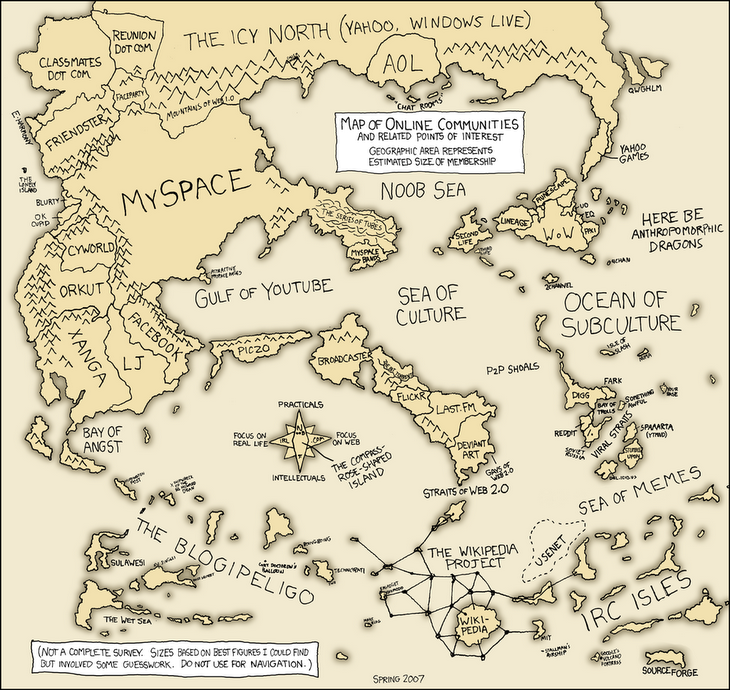
Asked to attempt a summation of the online social networking community known as tribe.net, I have taken to replying with the single phrase, "technoshamanism". It seems the word has not yet been taken up by many, so I'll attempt a definition here.
(For a little background information, you'd be keen to check out a term project I worked on for my Anthropology of Dance class, entitled "The Trance Dance Experience".)
A technoshaman is one who integrates modern technology into primordial practices in order to induce transcendent experiences. Now, such a description evokes remnants of that anthropological black mark- the noble savage- and thus I proceed with caution, unwilling to romanticize:
Technoshamanism seeks to rediscover the roots of human experience while utilizing modern tools. Such tools can range from repetitive electronic music, to synthetic drugs, to new technologies such as biofeedback. The states thus induced might range from supersensory to meditative. Modern "rave" culture (and I use this term with caution as well, for the rave scene has become inundated by the mainstream, thus necessitating an emergent subculture(s)) incorporates just such tools to achieve just such states, and where site and ideology merge, we have our subculture.
Regardless of terminology, the essence of such subcultures is the pursuit of the collective unconscious, consciously realized and enacted. When I say "neotribal," I refer to the tribal experience as it is recreated in the modern day. Safe spaces are created through collective artistic action; drugs consumed that serve to enhance feelings of empathy, community, clairvoyance, and/or transcendence; music played that serves to enhance said feelings and provide the collective pulse. This occurs with varying degrees of success, depending on whether individuals collaborate effectively to achieve the same goals.
The Internet is, quite naturally, one of those modern technologies that is utilized by technoshamans as a means of tapping into the collective neural network. As it exists apart (or, at the very least, disjointed) from time and space, the shape and texture of the Internet resembles that of technoshamanism itself. That's all I've got for now.
Showing posts with label folksonomy. Show all posts
Showing posts with label folksonomy. Show all posts
August 18, 2007


May 2, 2007
Lit Review: Unraveling the Taste Fabrics of Social Networks (Liu, Maes & Davenport)
-Sought to uncover a semantic fabric of taste derived from the language used in 100,000 social networking profiles, dubbed the social Semantic Web.
-First mapped users onto taste-spaces, then compared the taste-similarities of participants.
-Moving away from formal semantics toward implicit and emergent semantics that are organized from the bottom up- folksonomies that include taste neighborhoods, identity hubs, and taste cliques.
Theoretical Background
1. Authentic Identity and Aesthetic Closure
-Contemporary culture is marked by consumeption preferences of diverse demographic categories- a culture of plenitude, in which identities are described using the vocabulary of preferences (McCracken).
-Simmel: the individual is born as an unidentified contents that evolves into identified forms, a truly authentic identity.
-Lacan: the self is a mediated construction in the Other (supported by the Sapir-Whorf hypothesis and feminism)
-Csikszentmihalyi and Rochberg-Halton: consolidates the above two theories- an individual's "symbolic environment" both echoes and reinforces her identity. This is the framework from within which this study works.
-Aesthetic Closure: when an individual's interest can be regarded as unified, interconnected, sharing a common aethetic.
-Diderot Unity: the compulsion of consumers for consistency, to like that which we consume in a consistent and unified manner- provides support for aesthetic closure.
2. Upper Bounds on Theoretical Ideal
The above theory is problematized by a number of factors:
-Goffman's theory that performance is inherent in socialization- we all wear different masks depending on the social context. Identities are viewed as multiplicitous- online profiles provide only a single flat view.
-boyd's theory that, because profiles may be viewed by myriad social circles, the individual is forced to take such publicity in account, resulting in self-censorship.
-boyd also points out profiles are often abandoned over time, resulting in static representations/artifacts of past identity performance.
3. Identity Keywords vs. Interest Keywords
-Examined both broad interests as well as special interests (such as cultural identities).
-Special Interests are usually placed at the top of profiles, while more specific interests are listed later on. The former is used to place individuals into categories, while the latter serve as more detailed descriptors.
Weaving the Taste Fabric
-A single crawl of two SNCs mined information from 100,000 profiles.
-To preserve anonymity, only the text of descriptors was used.
-Because language fragments are often used in specific categories, 90% of them were successfully segmented.
-In the case of general interests, about 75% were successfully segmented, as they often contained more idiosyncratic speech.
-Descriptors were then coded in order to create a common language of categories using sources such as wikipedia's article on subcultures, IMDB, AllMusic, AllRecipes, etc;
-21,000 interest descriptors and 1,000 identity descriptors coded.
-Correlation analysis was then conducted via numeric strength of semantic relatedness.
-Identity Hubs: One's location in the fabric is described in terms of proximity to the various identity hubs, which serve as an index of identities.
-Taste Cliques: cliques of interest based on taste- for instance, "Soccer," "Manu Chao", "tapas" and "Samba Music" would be an example of a Latin taste clique.
-Taste Neighborhoods: larger, more permanent taste cohesions
What is a Taste Fabric Good For?
-InterestMap: taste-based recommendation system- an interactive map where users can input descriptors and receive recommendations based on a navigatable map of descriptors
-Ambient Semantics: facilitates interaction between two strangers who share taste.
-IdentityMirror: makes identity self-management possible
-A dynamic model of taste would take context into account- current events, location
---
One of the implications I derived from this article was the potential for the creation of true interest-based communities that are capable of a radical clarification and reconfiguration of the networked individual. How addictive it would be, I imagine, to have a system before you powerful enough to know what you like before you're even aware that you did. Oh yeah, check this out:
Pentagon to Merge Next-Gen Binoculars With Soldiers' Brains
'Sup, Big Bro?
-First mapped users onto taste-spaces, then compared the taste-similarities of participants.
-Moving away from formal semantics toward implicit and emergent semantics that are organized from the bottom up- folksonomies that include taste neighborhoods, identity hubs, and taste cliques.
Theoretical Background
1. Authentic Identity and Aesthetic Closure
-Contemporary culture is marked by consumeption preferences of diverse demographic categories- a culture of plenitude, in which identities are described using the vocabulary of preferences (McCracken).
-Simmel: the individual is born as an unidentified contents that evolves into identified forms, a truly authentic identity.
-Lacan: the self is a mediated construction in the Other (supported by the Sapir-Whorf hypothesis and feminism)
-Csikszentmihalyi and Rochberg-Halton: consolidates the above two theories- an individual's "symbolic environment" both echoes and reinforces her identity. This is the framework from within which this study works.
-Aesthetic Closure: when an individual's interest can be regarded as unified, interconnected, sharing a common aethetic.
-Diderot Unity: the compulsion of consumers for consistency, to like that which we consume in a consistent and unified manner- provides support for aesthetic closure.
2. Upper Bounds on Theoretical Ideal
The above theory is problematized by a number of factors:
-Goffman's theory that performance is inherent in socialization- we all wear different masks depending on the social context. Identities are viewed as multiplicitous- online profiles provide only a single flat view.
-boyd's theory that, because profiles may be viewed by myriad social circles, the individual is forced to take such publicity in account, resulting in self-censorship.
-boyd also points out profiles are often abandoned over time, resulting in static representations/artifacts of past identity performance.
3. Identity Keywords vs. Interest Keywords
-Examined both broad interests as well as special interests (such as cultural identities).
-Special Interests are usually placed at the top of profiles, while more specific interests are listed later on. The former is used to place individuals into categories, while the latter serve as more detailed descriptors.
Weaving the Taste Fabric
-A single crawl of two SNCs mined information from 100,000 profiles.
-To preserve anonymity, only the text of descriptors was used.
-Because language fragments are often used in specific categories, 90% of them were successfully segmented.
-In the case of general interests, about 75% were successfully segmented, as they often contained more idiosyncratic speech.
-Descriptors were then coded in order to create a common language of categories using sources such as wikipedia's article on subcultures, IMDB, AllMusic, AllRecipes, etc;
-21,000 interest descriptors and 1,000 identity descriptors coded.
-Correlation analysis was then conducted via numeric strength of semantic relatedness.
-Identity Hubs: One's location in the fabric is described in terms of proximity to the various identity hubs, which serve as an index of identities.
-Taste Cliques: cliques of interest based on taste- for instance, "Soccer," "Manu Chao", "tapas" and "Samba Music" would be an example of a Latin taste clique.
-Taste Neighborhoods: larger, more permanent taste cohesions
What is a Taste Fabric Good For?
-InterestMap: taste-based recommendation system- an interactive map where users can input descriptors and receive recommendations based on a navigatable map of descriptors
-Ambient Semantics: facilitates interaction between two strangers who share taste.
-IdentityMirror: makes identity self-management possible
-A dynamic model of taste would take context into account- current events, location
---
One of the implications I derived from this article was the potential for the creation of true interest-based communities that are capable of a radical clarification and reconfiguration of the networked individual. How addictive it would be, I imagine, to have a system before you powerful enough to know what you like before you're even aware that you did. Oh yeah, check this out:
Pentagon to Merge Next-Gen Binoculars With Soldiers' Brains
'Sup, Big Bro?
Subscribe to:
Posts (Atom)


 Posts
Posts