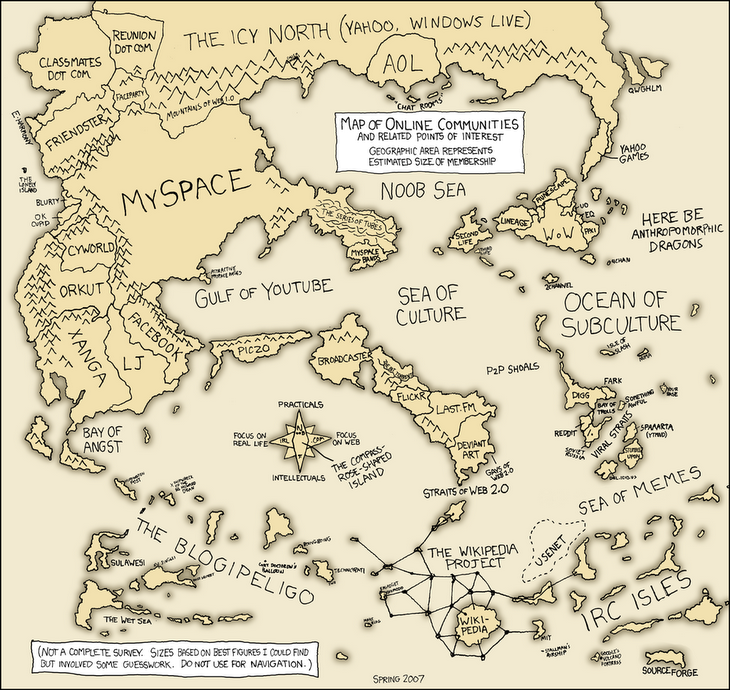
This is my final post on this blog, as I am excited to *finally* announce my transition to Wordpress on my own domain name- that would be JennyRyan.Net! Please update your bookmarks and your feed readers accordingly; the direct link to the blog is http://www.jennyryan.net/musings. I'm still in the process of manually copying posts over from this blog and my old iggli blog, due to inexplicable import failures, but I look forward to spending some time developing my website.
Future plans include:
-A cyberanthropologist's toolkit, replete with links to pertinent literature, blogs, academic programs and journals.
-Publishing some of my creative writing and poetry in hyperlinked-labyrinth form.
-Addendum chapters to my thesis, The Virtual Campfire, in which I will reflect upon: the uses of Facebook post-college; the role of Tribe.net in the formation and display of subcultural capital; and the role of social networking sites in the 2008 Presidential election.
-A collaborative web-based art project centered on connecting the art, music, and writing of talented friends and acquaintances, and potentially engendering new forms of creative expression in cyberspace.
I suppose it all still falls within the somewhat-undefined umbrella term "Webnography," but for now and as of late I have been merely musing. The only thing that ever remains the same, is my name.
Chameleon-ly Yours,
Jenny Ryan (.net!)
Showing posts with label internet culture. Show all posts
Showing posts with label internet culture. Show all posts
August 6, 2008


July 21, 2008
Remaking the Mirror
Perhaps it's but a personality trait, but I find myself decidedly undecided, residing in a constant state of indecision. For better or worse, I turn to the steady hum of the interweb for inspiration. Going out to dinner entails a lengthy perusal of online reviews (three cheers for yelp!). My life decisions, beginning most memorably with the college search since the advent of high school, are group decisions. This is not to say people have not always been composed of their collective interactions (read: culture), but that this process is occurring in new ways that have yet to be understood and categorically ordered into consciousness.
For as much as we are conduits of culture, we are also its composers. Being as it is the dawn of a new era of mediated communication, we are in prime position to create new memes for future generations. This is imperative, for as anyone tapped into the collective neural net knows (and that's everybody, to varying forms and degrees), the world is in a deep malaise that, while it may never be undone, must be remade. Degunk the junk and foster the funk.
Through the mirror, darkly sinister forms abound. The websites I have been researching glamorize "stupid spoiled whores," revel in misanthropy, and celebrate self-mutilation. This is the ugly underbelly of a jaded generation, saturated with the soulless machine of a media industry gone mad. Eventually, one would imagine, we will reach satiation and revolt against this funhouse mirror of our society. That is to say, we may and must remake the mirror.
Here we stand, poised at the precipice of a new era of information flow. The simple existence of these websites is telling: with the ever-evolving tools of the interweb, the ever-increasing population of the digitized can join the conversation. Little surprise it is that we converse online in the same way we converse offline: we gossip about others, consume media and talk about it, create representations of ourselves through performative acts, confess our darkest secrets and innermost longings in the sanctuary of like-minded others...
And, like in life, some clamber for soapbozes where they may espouse prolifically to a mostly unseen (but potentially vast) audience, while many lurk about, not wishing to be heard but willing to absorb. Though most of us be sheep, theories regarding the wisdom of the crowd contend that diluting and diversifying such a crowd will increase the chances of its survival.
In order to survive, we need to be critical producers of alternative points of view. This post was originally inspired by the research I'm conducting on pro-self harm websites; having sussed out the black-and-white, the extremes, I've moved on to the nuanced middle ground. In this space that is neither supportive of self-destruction nor condemning of such a perspective, there are emerging voices that seek to not only reflexively examine the issue as it stands, but to redefine the very definition of "pro-self harm." Not supportive of the disordered habits that are the coping mechanisms for our culture, but supportive of those who are clearly in need of support most of all. Effective support entails not only empathy and understanding, but strong voices (herders, if you will) with the capacity to critique our disorderly conduct and call new memes into being. So clamber on up, to the top of the search results, redefine the folksonomy, and remake that mirror (repetition numero tres).
Consider this a call to action.
Some inspiration:
mamaVISION: Highly controversial (read: popular) personal blog of a 30-something ex-model turned mother, dedicated to spreading awareness of our eating disordered society and empathetically communicating with the sufferers themselves.
We Bite Back: Post-pro-ana - Postmodernizing the discussion of eating disorders and encouraging recovery.
Suicide: Read This First: Another form of "pro-suicide"- offering empathetic understanding and resources.
Self-Injury: A Struggle: Longstanding site devoted to spreading awareness and cultivating a community of support for self-injurers, created by a fellow self-injurer.
For as much as we are conduits of culture, we are also its composers. Being as it is the dawn of a new era of mediated communication, we are in prime position to create new memes for future generations. This is imperative, for as anyone tapped into the collective neural net knows (and that's everybody, to varying forms and degrees), the world is in a deep malaise that, while it may never be undone, must be remade. Degunk the junk and foster the funk.
Through the mirror, darkly sinister forms abound. The websites I have been researching glamorize "stupid spoiled whores," revel in misanthropy, and celebrate self-mutilation. This is the ugly underbelly of a jaded generation, saturated with the soulless machine of a media industry gone mad. Eventually, one would imagine, we will reach satiation and revolt against this funhouse mirror of our society. That is to say, we may and must remake the mirror.
Here we stand, poised at the precipice of a new era of information flow. The simple existence of these websites is telling: with the ever-evolving tools of the interweb, the ever-increasing population of the digitized can join the conversation. Little surprise it is that we converse online in the same way we converse offline: we gossip about others, consume media and talk about it, create representations of ourselves through performative acts, confess our darkest secrets and innermost longings in the sanctuary of like-minded others...
And, like in life, some clamber for soapbozes where they may espouse prolifically to a mostly unseen (but potentially vast) audience, while many lurk about, not wishing to be heard but willing to absorb. Though most of us be sheep, theories regarding the wisdom of the crowd contend that diluting and diversifying such a crowd will increase the chances of its survival.
In order to survive, we need to be critical producers of alternative points of view. This post was originally inspired by the research I'm conducting on pro-self harm websites; having sussed out the black-and-white, the extremes, I've moved on to the nuanced middle ground. In this space that is neither supportive of self-destruction nor condemning of such a perspective, there are emerging voices that seek to not only reflexively examine the issue as it stands, but to redefine the very definition of "pro-self harm." Not supportive of the disordered habits that are the coping mechanisms for our culture, but supportive of those who are clearly in need of support most of all. Effective support entails not only empathy and understanding, but strong voices (herders, if you will) with the capacity to critique our disorderly conduct and call new memes into being. So clamber on up, to the top of the search results, redefine the folksonomy, and remake that mirror (repetition numero tres).
Consider this a call to action.
Some inspiration:
mamaVISION: Highly controversial (read: popular) personal blog of a 30-something ex-model turned mother, dedicated to spreading awareness of our eating disordered society and empathetically communicating with the sufferers themselves.
We Bite Back: Post-pro-ana - Postmodernizing the discussion of eating disorders and encouraging recovery.
Suicide: Read This First: Another form of "pro-suicide"- offering empathetic understanding and resources.
Self-Injury: A Struggle: Longstanding site devoted to spreading awareness and cultivating a community of support for self-injurers, created by a fellow self-injurer.
October 5, 2007
Musings on the Big Picture
I have been thinking of online social networks as pertinent examples of a generational trend, marked by the increasing appropriation of the media and proliferation of contextualized interpretations by disparate individuals, connected through shared taste fabrics that are founded, by and large, on mass media. The rise of Web 2.0 signifies a shift toward user-generated content in the form of blogs, photo albums, videos, music, niche communities, message board dialogue, playful interaction, computer media, and creative displays of identity (what I call the "mashup").
The locale of the hearth (that which is safe, secure) has shifted, from the family home theater clustered around the television to a dynamic mirror of ourselves as relational wholes, albeit individually fragmented. We have begun to bridge the gap between producers and consumers of media- increasing interactivity allows for a two-way dialogue as opposed to the directional nature of mass media.
However, all is not oral. New media is rather a hybrid of oral and written language- at once casual yet permanent, private yet public, intimate yet mediated. We are creating the media, but must not forgot the role of the media in inculcating our understandings of reality.
The locale of the hearth (that which is safe, secure) has shifted, from the family home theater clustered around the television to a dynamic mirror of ourselves as relational wholes, albeit individually fragmented. We have begun to bridge the gap between producers and consumers of media- increasing interactivity allows for a two-way dialogue as opposed to the directional nature of mass media.
However, all is not oral. New media is rather a hybrid of oral and written language- at once casual yet permanent, private yet public, intimate yet mediated. We are creating the media, but must not forgot the role of the media in inculcating our understandings of reality.
May 9, 2007
The Sociocultural Appropriation of Web 2.0?
I was notified via Tribe.net today of a new online startup by Daniel Pinchbeck (Technoshaman, Wesleyan dropout, and author of Breaking Open the Head and 2012: The Return of Quetzalcoatl), Reality Sandwich. The site is to begin as an online magazine dedicated to the "re-imagining" of an intentional, international community of new-age shamans and neo-hippies. It is planned to evolve into an extensive, global social networking site. Among the first articles can be found discussions of the "ethnosphere", an interview with Abbie Hoffman, 21st century shamans, a "recipe for happiness" and an article about the practical application of digital utopian ideals in Web 2.0 communities:
Pinchbeck is a controversial figure in New Age discourse, and has been described by many as a modern-day Timothy Leary, though Terence McKenna is a more appropriate comparison. His ambitious goals to evolve the global consciousness through the appropriation of technology and communication practices is reminiscent of Stewart Brand's Whole Earth Catalog (see From Counterculture to Cyberculture, part 1 and part 2).
Implications for Research
Is this a new stage in the rise of digital utopianism? Are we witnessing the rise of technoshamanism? How does this New Age subculture find strength in global, online communities (such as Tribe)?
My primary focus in blog will be the ongoing struggle to create an Internet that serves the public interest, one that incorporates the highest ideals that the evolution of web 2.0 points toward. I will watch the industry and I will watch the tech watchers and give you my honest perspective. I will tell you about companies that are doing good work and trying to improve things, and alert you to those that are being sneaky. In the same way as buying green produce supports and helps people make deeper changes in industry practices, we can vote with our on-line attention and dollars, giving our business to those online companies who put you in the middle of the picture.
Pinchbeck is a controversial figure in New Age discourse, and has been described by many as a modern-day Timothy Leary, though Terence McKenna is a more appropriate comparison. His ambitious goals to evolve the global consciousness through the appropriation of technology and communication practices is reminiscent of Stewart Brand's Whole Earth Catalog (see From Counterculture to Cyberculture, part 1 and part 2).
Implications for Research
Is this a new stage in the rise of digital utopianism? Are we witnessing the rise of technoshamanism? How does this New Age subculture find strength in global, online communities (such as Tribe)?
May 8, 2007
Lit Review: The Online Nomads of Cyberia
Based on fieldwork amongst a community of online gaming fans, Knorr argues that the field of anthropology is well-suited for the study of online communities as sites of sociocultural appropriation. The habitat of an online community is located within the Internet infrastructure, a dynamic space that utilizes multiple forms of mediated technology. Rather than limiting communication to the common shared interest, members of the group exchange gossip, create hierarchies, and establish new spaces for group interaction when older forms are obliterated. The community in question is described as a “nomadic tribe” that retains interpersonal structure regardless of geographic or even Internet space. The members of this community can best be described, not as consumers of technology, but as active creators of their online habitat. In this sense Internet communication technologies are reconstructed through a process of appropriation. So too are social networking communities appropriated as they are reworked to suit individual groups, as is the case in online activism and the geographical dispersion of subcultures.
May 2, 2007
Lit Review: Unraveling the Taste Fabrics of Social Networks (Liu, Maes & Davenport)
-Sought to uncover a semantic fabric of taste derived from the language used in 100,000 social networking profiles, dubbed the social Semantic Web.
-First mapped users onto taste-spaces, then compared the taste-similarities of participants.
-Moving away from formal semantics toward implicit and emergent semantics that are organized from the bottom up- folksonomies that include taste neighborhoods, identity hubs, and taste cliques.
Theoretical Background
1. Authentic Identity and Aesthetic Closure
-Contemporary culture is marked by consumeption preferences of diverse demographic categories- a culture of plenitude, in which identities are described using the vocabulary of preferences (McCracken).
-Simmel: the individual is born as an unidentified contents that evolves into identified forms, a truly authentic identity.
-Lacan: the self is a mediated construction in the Other (supported by the Sapir-Whorf hypothesis and feminism)
-Csikszentmihalyi and Rochberg-Halton: consolidates the above two theories- an individual's "symbolic environment" both echoes and reinforces her identity. This is the framework from within which this study works.
-Aesthetic Closure: when an individual's interest can be regarded as unified, interconnected, sharing a common aethetic.
-Diderot Unity: the compulsion of consumers for consistency, to like that which we consume in a consistent and unified manner- provides support for aesthetic closure.
2. Upper Bounds on Theoretical Ideal
The above theory is problematized by a number of factors:
-Goffman's theory that performance is inherent in socialization- we all wear different masks depending on the social context. Identities are viewed as multiplicitous- online profiles provide only a single flat view.
-boyd's theory that, because profiles may be viewed by myriad social circles, the individual is forced to take such publicity in account, resulting in self-censorship.
-boyd also points out profiles are often abandoned over time, resulting in static representations/artifacts of past identity performance.
3. Identity Keywords vs. Interest Keywords
-Examined both broad interests as well as special interests (such as cultural identities).
-Special Interests are usually placed at the top of profiles, while more specific interests are listed later on. The former is used to place individuals into categories, while the latter serve as more detailed descriptors.
Weaving the Taste Fabric
-A single crawl of two SNCs mined information from 100,000 profiles.
-To preserve anonymity, only the text of descriptors was used.
-Because language fragments are often used in specific categories, 90% of them were successfully segmented.
-In the case of general interests, about 75% were successfully segmented, as they often contained more idiosyncratic speech.
-Descriptors were then coded in order to create a common language of categories using sources such as wikipedia's article on subcultures, IMDB, AllMusic, AllRecipes, etc;
-21,000 interest descriptors and 1,000 identity descriptors coded.
-Correlation analysis was then conducted via numeric strength of semantic relatedness.
-Identity Hubs: One's location in the fabric is described in terms of proximity to the various identity hubs, which serve as an index of identities.
-Taste Cliques: cliques of interest based on taste- for instance, "Soccer," "Manu Chao", "tapas" and "Samba Music" would be an example of a Latin taste clique.
-Taste Neighborhoods: larger, more permanent taste cohesions
What is a Taste Fabric Good For?
-InterestMap: taste-based recommendation system- an interactive map where users can input descriptors and receive recommendations based on a navigatable map of descriptors
-Ambient Semantics: facilitates interaction between two strangers who share taste.
-IdentityMirror: makes identity self-management possible
-A dynamic model of taste would take context into account- current events, location
---
One of the implications I derived from this article was the potential for the creation of true interest-based communities that are capable of a radical clarification and reconfiguration of the networked individual. How addictive it would be, I imagine, to have a system before you powerful enough to know what you like before you're even aware that you did. Oh yeah, check this out:
Pentagon to Merge Next-Gen Binoculars With Soldiers' Brains
'Sup, Big Bro?
-First mapped users onto taste-spaces, then compared the taste-similarities of participants.
-Moving away from formal semantics toward implicit and emergent semantics that are organized from the bottom up- folksonomies that include taste neighborhoods, identity hubs, and taste cliques.
Theoretical Background
1. Authentic Identity and Aesthetic Closure
-Contemporary culture is marked by consumeption preferences of diverse demographic categories- a culture of plenitude, in which identities are described using the vocabulary of preferences (McCracken).
-Simmel: the individual is born as an unidentified contents that evolves into identified forms, a truly authentic identity.
-Lacan: the self is a mediated construction in the Other (supported by the Sapir-Whorf hypothesis and feminism)
-Csikszentmihalyi and Rochberg-Halton: consolidates the above two theories- an individual's "symbolic environment" both echoes and reinforces her identity. This is the framework from within which this study works.
-Aesthetic Closure: when an individual's interest can be regarded as unified, interconnected, sharing a common aethetic.
-Diderot Unity: the compulsion of consumers for consistency, to like that which we consume in a consistent and unified manner- provides support for aesthetic closure.
2. Upper Bounds on Theoretical Ideal
The above theory is problematized by a number of factors:
-Goffman's theory that performance is inherent in socialization- we all wear different masks depending on the social context. Identities are viewed as multiplicitous- online profiles provide only a single flat view.
-boyd's theory that, because profiles may be viewed by myriad social circles, the individual is forced to take such publicity in account, resulting in self-censorship.
-boyd also points out profiles are often abandoned over time, resulting in static representations/artifacts of past identity performance.
3. Identity Keywords vs. Interest Keywords
-Examined both broad interests as well as special interests (such as cultural identities).
-Special Interests are usually placed at the top of profiles, while more specific interests are listed later on. The former is used to place individuals into categories, while the latter serve as more detailed descriptors.
Weaving the Taste Fabric
-A single crawl of two SNCs mined information from 100,000 profiles.
-To preserve anonymity, only the text of descriptors was used.
-Because language fragments are often used in specific categories, 90% of them were successfully segmented.
-In the case of general interests, about 75% were successfully segmented, as they often contained more idiosyncratic speech.
-Descriptors were then coded in order to create a common language of categories using sources such as wikipedia's article on subcultures, IMDB, AllMusic, AllRecipes, etc;
-21,000 interest descriptors and 1,000 identity descriptors coded.
-Correlation analysis was then conducted via numeric strength of semantic relatedness.
-Identity Hubs: One's location in the fabric is described in terms of proximity to the various identity hubs, which serve as an index of identities.
-Taste Cliques: cliques of interest based on taste- for instance, "Soccer," "Manu Chao", "tapas" and "Samba Music" would be an example of a Latin taste clique.
-Taste Neighborhoods: larger, more permanent taste cohesions
What is a Taste Fabric Good For?
-InterestMap: taste-based recommendation system- an interactive map where users can input descriptors and receive recommendations based on a navigatable map of descriptors
-Ambient Semantics: facilitates interaction between two strangers who share taste.
-IdentityMirror: makes identity self-management possible
-A dynamic model of taste would take context into account- current events, location
---
One of the implications I derived from this article was the potential for the creation of true interest-based communities that are capable of a radical clarification and reconfiguration of the networked individual. How addictive it would be, I imagine, to have a system before you powerful enough to know what you like before you're even aware that you did. Oh yeah, check this out:
Pentagon to Merge Next-Gen Binoculars With Soldiers' Brains
'Sup, Big Bro?
April 28, 2007
The Rise of Digital Utopianism: Implications for Analysis
Barlow, an information technology journalist and pundit, was also once a lyricist for the Grateful Dead. Following an international summit in which the Communications Decency Act was passed, which sought to restrict pornography on the Internet, he crafted a treatise in defense of the independence of the Internet from bureaucratic attempts at regulation. This essay, which was posted and widely circulated on the Internet, suggested that the Internet allowed for the possibility of a social revolution. Barlow painted a picture of a world in which the oppressive forces of the government were replaced by the pursuit of individual enlightenment, communality, and collective consciousness.
Barlow’s work in collaboration with Wired magazine established a movement inspired by an ideology of digital utopianism. In what ways has this ideology integrated into the public consciousness? In my own research on online social networking communities, I would like to examine how these sites contribute to as well as diminish the creation of a “digital utopia”.
Cyberspace consists of transactions, relationships, and thought itself, arrayed like a standing wave in the web of our communications. Ours is a world that is both everywhere and nowhere, but it is not where bodies live.
We are creating a world that all may enter without privilege or prejudice accorded by race, economic power, military force, or station of birth.
We are creating a world where anyone, anywhere may express his or her beliefs, no matter how singular, without fear of being coerced into silence or conformity.
Your legal concepts of property, expression, identity, movement, and context do not apply to us. They are all based on matter, and there is no matter here.
Our identities have no bodies, so, unlike you, we cannot obtain order by physical coercion. We believe that from ethics, enlightened self-interest, and the commonweal, our governance will emerge . Our identities may be distributed across many of your jurisdictions. The only law that all our constituent cultures would generally recognize is the Golden Rule. We hope we will be able to build our particular solutions on that basis. But we cannot accept the solutions you are attempting to impose.
Barlow’s work in collaboration with Wired magazine established a movement inspired by an ideology of digital utopianism. In what ways has this ideology integrated into the public consciousness? In my own research on online social networking communities, I would like to examine how these sites contribute to as well as diminish the creation of a “digital utopia”.
April 26, 2007
Lit Review: From Counterculture to Cyberculture (Fred Turner)
Chapter 1: The Shifting Politics of the Computational Metaphor
-Sacio and the Free Speech Movement of the 60s opposed the mechanization of society through the guise of the university, the military, and information technologies.
-30 years later, what was once a threat was now a promise of liberation, expressed through the evolving personalization of the Internet.
-Barlow's Declaration of the Independence of Cyberspace in proclamation of the liberating nature of the Internet for overthrowing the bureaucracy. Social revolution?
-Esther Dyson believed that the Internet would become a digital marketplace that would allow consumers and corporations to negotiate equally, thus dissolving the tyranny of corporate hierarchies (Release 2.0: A Design for Living in the Digital Age).
-Kevin Kelly believed we were moving toward a "computational metaphor" in human understanding, in which the universe is a computer according to a new vocabulary that is now emerging.
-Disembodiment: dehumanization or equality?
The Forgotten Openness of the Closed World
-Post WWII era was dominated by a "closed world discourse", in which both the individual mind and the military were viewed as mechanized tools of control- cognitive psychology began utilizing the computational metaphor to describe the human brain, and in the military plans and operations were visually rendered through computer programming.
-Though this mechanization of society is exactly what students of the 60's rebelled against, at the time this discourse allowed for a quite flexible and creative style of research. This led to the rise of the military industrial complex and interdisciplinary collaboration.
-In the pursuit of military technology, scientists and researchers from many disciplines devised a new language with which to communicate.
-Humans and machines in collaboration within a larger, fluid socio-technical system- a "feedback system" that was then extended to human biology and society.
-This led to the deveopment of cybernetics (Norbert Wiener)- "the study of messages as a means of controlling machinery and society".
-In this frame, the media is viewed as a "servomechanism" that maintains the homeostasis of society through a feedback system of messages.
-Though computers threatened automation of people and society, they also brought hope for the possibility of a more democratic creation of order.
The Countercultural Embrace of Technology and Consciousness
-In the eyes of the left, the computational metaphor was one designed to create and maintain an unfeeling "technocracy" (Roszak).
-Lewis Mumford's The Myth of the Machine envisioned a world in which the technocratic elite are bent on designing man as an automaton whose proper functions will be controlled by the machine.
-In the postwar period, thanks in large part to research grants funded by the military, university enrollment exploded.
-Two forms of counterculture emerged in the 1960's: the New Left, which struggled for civil rights, free speech and voter registration (outward political action); and cold war-era culture marked by Zen Buddhism, Beat writings, action painting, and psychedelic drugs (inward consciousness and communalism).
-The New Communalists, contrary to the New Left, embraced the communal and egalitarian potential of cybernetics.
The New Left worked within the political structure in order to achieve their goals of establishing a true community and ending alienation. The New Communalists, however, believed political activism to be beside the point- that true community existed outside of traditional notions of chains of command. True community was to be found when transcendence from "the myth of objective consciousness" was achieved, and individual selves transformed.
-Charles Reich's The Greening of America detailed 3 historical stages of socioeconomic consciousness:
1. agriculture: farmers and small businessmen
2. industrial bureaucracies: society organized through complex organizations and new technologies of control and communication.
3. beaureaucratically levelled communities: harmonious collaborations working to end technocratic institutions.
-In this vein, if the mind is to be the source of change, then the sharing of information is a crucial step in that process- an "ebb and flow of communication".
---
This well explains the history of perceptions regarding information technologies. With this history in mind, it would be interesting to gauge the current perception of the Internet as it becomes increasingly a site for both interactivity/communication/community-building and corporate schemas, economically entrenched but intellectually dispersed.
On one end we have open source collaboration, but on the other we have the rise of a hegemonic Google institution. Somewhere in the middle lie social networking services such as Facebook and Myspace. In the ephemeral space of the Internet, however, time and power work together to allow for immediate collective awareness and consequent action. The trick is in the hook- for instance, Facebook alienated its users with the implementation of the News Feed, to the extent that its users collectively organized in protest. However, this collective organization would not have been possible WITHOUT Facebook, and in this way they are institutionalized. This happens when certain Internet systems become integrated in the daily functioning of individuals in society. To disengage from these systems would be to disengage with a symbolic structure of one's membership in her community.
If we are to examine Internet culture through the lens of Reich, it would seem we exist still in the second level of consciousness. If a counterculture exists on the Internet, it could do so in two ways: by utilizing the existing social institutions of the Internet to spread awareness and make political statements, or to abandon the existing institutions altogether in favor of a back-to-cyberspace approach of creating communal sites in which individuals work to raise their own consciousnesses and fulfill their human potentials.
-Sacio and the Free Speech Movement of the 60s opposed the mechanization of society through the guise of the university, the military, and information technologies.
-30 years later, what was once a threat was now a promise of liberation, expressed through the evolving personalization of the Internet.
-Barlow's Declaration of the Independence of Cyberspace in proclamation of the liberating nature of the Internet for overthrowing the bureaucracy. Social revolution?
-Esther Dyson believed that the Internet would become a digital marketplace that would allow consumers and corporations to negotiate equally, thus dissolving the tyranny of corporate hierarchies (Release 2.0: A Design for Living in the Digital Age).
-Kevin Kelly believed we were moving toward a "computational metaphor" in human understanding, in which the universe is a computer according to a new vocabulary that is now emerging.
-Disembodiment: dehumanization or equality?
The Forgotten Openness of the Closed World
-Post WWII era was dominated by a "closed world discourse", in which both the individual mind and the military were viewed as mechanized tools of control- cognitive psychology began utilizing the computational metaphor to describe the human brain, and in the military plans and operations were visually rendered through computer programming.
-Though this mechanization of society is exactly what students of the 60's rebelled against, at the time this discourse allowed for a quite flexible and creative style of research. This led to the rise of the military industrial complex and interdisciplinary collaboration.
-In the pursuit of military technology, scientists and researchers from many disciplines devised a new language with which to communicate.
-Humans and machines in collaboration within a larger, fluid socio-technical system- a "feedback system" that was then extended to human biology and society.
-This led to the deveopment of cybernetics (Norbert Wiener)- "the study of messages as a means of controlling machinery and society".
-In this frame, the media is viewed as a "servomechanism" that maintains the homeostasis of society through a feedback system of messages.
-Though computers threatened automation of people and society, they also brought hope for the possibility of a more democratic creation of order.
The Countercultural Embrace of Technology and Consciousness
-In the eyes of the left, the computational metaphor was one designed to create and maintain an unfeeling "technocracy" (Roszak).
-Lewis Mumford's The Myth of the Machine envisioned a world in which the technocratic elite are bent on designing man as an automaton whose proper functions will be controlled by the machine.
-In the postwar period, thanks in large part to research grants funded by the military, university enrollment exploded.
-Two forms of counterculture emerged in the 1960's: the New Left, which struggled for civil rights, free speech and voter registration (outward political action); and cold war-era culture marked by Zen Buddhism, Beat writings, action painting, and psychedelic drugs (inward consciousness and communalism).
-The New Communalists, contrary to the New Left, embraced the communal and egalitarian potential of cybernetics.
The New Left worked within the political structure in order to achieve their goals of establishing a true community and ending alienation. The New Communalists, however, believed political activism to be beside the point- that true community existed outside of traditional notions of chains of command. True community was to be found when transcendence from "the myth of objective consciousness" was achieved, and individual selves transformed.
-Charles Reich's The Greening of America detailed 3 historical stages of socioeconomic consciousness:
1. agriculture: farmers and small businessmen
2. industrial bureaucracies: society organized through complex organizations and new technologies of control and communication.
3. beaureaucratically levelled communities: harmonious collaborations working to end technocratic institutions.
-In this vein, if the mind is to be the source of change, then the sharing of information is a crucial step in that process- an "ebb and flow of communication".
---
This well explains the history of perceptions regarding information technologies. With this history in mind, it would be interesting to gauge the current perception of the Internet as it becomes increasingly a site for both interactivity/communication/community-building and corporate schemas, economically entrenched but intellectually dispersed.
On one end we have open source collaboration, but on the other we have the rise of a hegemonic Google institution. Somewhere in the middle lie social networking services such as Facebook and Myspace. In the ephemeral space of the Internet, however, time and power work together to allow for immediate collective awareness and consequent action. The trick is in the hook- for instance, Facebook alienated its users with the implementation of the News Feed, to the extent that its users collectively organized in protest. However, this collective organization would not have been possible WITHOUT Facebook, and in this way they are institutionalized. This happens when certain Internet systems become integrated in the daily functioning of individuals in society. To disengage from these systems would be to disengage with a symbolic structure of one's membership in her community.
If we are to examine Internet culture through the lens of Reich, it would seem we exist still in the second level of consciousness. If a counterculture exists on the Internet, it could do so in two ways: by utilizing the existing social institutions of the Internet to spread awareness and make political statements, or to abandon the existing institutions altogether in favor of a back-to-cyberspace approach of creating communal sites in which individuals work to raise their own consciousnesses and fulfill their human potentials.
April 17, 2007
Lit Review: Technological Environments and the Evolution of Social Research Methods (Christians & Chen)
-From Newton --> Shannon and Weaver's The Mathematical Theory of Communication
-Carl Couch: Audio and video recording of human interactions.
Internet Research Pros:
-24-hour, instantaneous access.
-Massive sampling possibilities.
-Ability to pinpoint special interest groups
-Logs of conversations.
Issues in Internet Research:
-the bias of technology: what are the optimum qualities, and in what cases is the Internet less advantageous than other media?
-the technological imperative: tendency to allow Internet technology to monopolize other forms, yet this technology could not exist with the others.
-Marshall McLuhan
-organic communities: electronic culture dislocats us from space and history. Lacking acoustical symbols, assured markers of identity, and its dependence on the offline world, the online "world" cannot be one of its own making, per se.
--
I would argue that online environments can indeed be historically situated, and that we are in the midst of crafting a virtual world that will come to allow for extensive and imaginative identity play. However, what is often observed online is not the creation but rather the extension of real-world phenomena. In what ways are new forms of communication and community-building being created in virtual environments (cultural appropriation, network-bridging, etc;)?
-Carl Couch: Audio and video recording of human interactions.
Internet Research Pros:
-24-hour, instantaneous access.
-Massive sampling possibilities.
-Ability to pinpoint special interest groups
-Logs of conversations.
Issues in Internet Research:
-the bias of technology: what are the optimum qualities, and in what cases is the Internet less advantageous than other media?
-the technological imperative: tendency to allow Internet technology to monopolize other forms, yet this technology could not exist with the others.
Media of communication are vast social metaphors that not only transmit information but determine what is knowledge, that not only orient us to the world but tell us what kind of world exists.
-Marshall McLuhan
-organic communities: electronic culture dislocats us from space and history. Lacking acoustical symbols, assured markers of identity, and its dependence on the offline world, the online "world" cannot be one of its own making, per se.
--
I would argue that online environments can indeed be historically situated, and that we are in the midst of crafting a virtual world that will come to allow for extensive and imaginative identity play. However, what is often observed online is not the creation but rather the extension of real-world phenomena. In what ways are new forms of communication and community-building being created in virtual environments (cultural appropriation, network-bridging, etc;)?
April 5, 2007
Lit Review: Using Empirical Research Data to Reason about Internet Research Ethics
• The Internet blurs notions of public vs. private, published vs. unpublished, and identified vs. anonymous individuals.
Reasonable Expectations of Privacy
• How do we know when individuals expect privacy on the internet?
• If membership is unrestricted, some researchers declare it a public space. Others argue that the ephemeral nature of online conversations creates the expectation that they will not be recorded.
• The disinhibiting nature of online environments creates a false illusion of privacy.
A Need For Empirical Work
• Knowing what people do does not inform us on what they should do; we need to know how subjects feel.
• How much do users object when they know they are being studied in a public online environment?
• Empirical study of chatroom responses to 4 conditions of declaring research intent conducted- 4 times more likely to be kicked out of the chatroom if the researchers said anything about recording.
• The requirement of informed consent can be waived if there is little risk to the subjects, there is no other way to conduct the research, and subjects will be debriefed following their participation in the study.
Discussions
• Only one individual expressed interest in learning more about the study.
• Reasons to believe in privacy online: ephemerality of text, invisibility of audience, feelings of anonymity.
• It could be argued that violating a person's right to consent to a study constitutes harm, even if they remain unaware.
• Must convince an IRB to issue a formal waiver of consent.
• Individuals filling out surveys on the computer reveal much more than they would on paper surveys (Greist et al, 1973; Weisband & Kiesler, 1996).
• Power hierarchies in f2f environments disappear in online discussions (Sproull & Kiesler, 1991)
• Shy students have no problem interacting online (Bruce et al, 1993; Hudson & Bruckman, 2002, 2004a)
• Polite people get into flame wars online (Dery, 1993)
• Novice bloggers are not concerned about privacy (Nardi et al, 2004) despite problems of unintended audiences (Hart, 2005)
Beyond the US
• Notions of privacy are culture-specific- online research risks involving populations from other cultures.
• Like countries, online communities develop their own cultural norms.
While this study makes a good case for the potentially negative reprecussions of asking consent of participants in online environments, I personally have had the opposite response. I've found that the anonymity of the Internet has a positive effect on participant response and willingness to engage with the subject matter.
Chatroom environments have a more intimate and ephemeral nature, as opposed to message-board style online social networks such as Tribe. Especially pertaining to intimate matters (see my work on LiveJournal and OpenDiary eating disorder communities), seeking connection and empathic understanding should take precedence.
Literature to Look Into:
• Bassett, E. H., & O'Riordan, K. (2002). Ethics of Internet Research: Contesting the Human Subjects Research Model. Ethics and Information Technology, 4(3).
• Boehlefeld, S. P. (1996). Doing the Right Thing: Ethical Cyberspace Research. The Information Society, 12(2), 141 - 152.
• Bruckman, A. (2002). Studying the Amateur Artist: A Perspective on Disguising Data Collected in Human Subjects Research on the Internet. Ethics and Information Technology, 4(3), 217- 231.
• Danet, B.
• Ess, C. (2002). Ethical Decision-Making and Internet Research: Recommendations from the AoIR Ethics Working Committee
• Eysenbach, G., & Till, J. E. (2001, 10 November). Ethical Issues in Qualitative Research on Internet Communities. BMJ, 323, 1103-1105.
• Herring, S. (1996a). Linguistic and Critical Analysis of Computer-Mediated Communication: Some Ethical and Scholarly Considerations. The Information Society, 12(2), 153 - 168.
• Herring, S. C. (Ed.). (1996b). Computer-Mediated Communication: Linguistic, Social and Cross-Cultural Perspectives.
• Joinson, A. N.
• Keller, H. E., & Lee, S. (2003). Ethical Issues Surrounding Human Participants Research Using the Internet. Ethics and Behavior, 13(3), 211 - 219.
• Nonnecke, B., & Preece, J. (2000). Lurker Demographics: Counting the Silent. In Preedeedings of the 2000 Conference on Human Factors in Computing Systems (CHI) (pp. 73-80).
Reasonable Expectations of Privacy
• How do we know when individuals expect privacy on the internet?
• If membership is unrestricted, some researchers declare it a public space. Others argue that the ephemeral nature of online conversations creates the expectation that they will not be recorded.
• The disinhibiting nature of online environments creates a false illusion of privacy.
A Need For Empirical Work
• Knowing what people do does not inform us on what they should do; we need to know how subjects feel.
• How much do users object when they know they are being studied in a public online environment?
• Empirical study of chatroom responses to 4 conditions of declaring research intent conducted- 4 times more likely to be kicked out of the chatroom if the researchers said anything about recording.
• The requirement of informed consent can be waived if there is little risk to the subjects, there is no other way to conduct the research, and subjects will be debriefed following their participation in the study.
Discussions
• Only one individual expressed interest in learning more about the study.
• Reasons to believe in privacy online: ephemerality of text, invisibility of audience, feelings of anonymity.
• It could be argued that violating a person's right to consent to a study constitutes harm, even if they remain unaware.
• Must convince an IRB to issue a formal waiver of consent.
• Individuals filling out surveys on the computer reveal much more than they would on paper surveys (Greist et al, 1973; Weisband & Kiesler, 1996).
• Power hierarchies in f2f environments disappear in online discussions (Sproull & Kiesler, 1991)
• Shy students have no problem interacting online (Bruce et al, 1993; Hudson & Bruckman, 2002, 2004a)
• Polite people get into flame wars online (Dery, 1993)
• Novice bloggers are not concerned about privacy (Nardi et al, 2004) despite problems of unintended audiences (Hart, 2005)
Beyond the US
• Notions of privacy are culture-specific- online research risks involving populations from other cultures.
• Like countries, online communities develop their own cultural norms.
While this study makes a good case for the potentially negative reprecussions of asking consent of participants in online environments, I personally have had the opposite response. I've found that the anonymity of the Internet has a positive effect on participant response and willingness to engage with the subject matter.
Chatroom environments have a more intimate and ephemeral nature, as opposed to message-board style online social networks such as Tribe. Especially pertaining to intimate matters (see my work on LiveJournal and OpenDiary eating disorder communities), seeking connection and empathic understanding should take precedence.
Literature to Look Into:
• Bassett, E. H., & O'Riordan, K. (2002). Ethics of Internet Research: Contesting the Human Subjects Research Model. Ethics and Information Technology, 4(3).
• Boehlefeld, S. P. (1996). Doing the Right Thing: Ethical Cyberspace Research. The Information Society, 12(2), 141 - 152.
• Bruckman, A. (2002). Studying the Amateur Artist: A Perspective on Disguising Data Collected in Human Subjects Research on the Internet. Ethics and Information Technology, 4(3), 217- 231.
• Danet, B.
• Ess, C. (2002). Ethical Decision-Making and Internet Research: Recommendations from the AoIR Ethics Working Committee
• Eysenbach, G., & Till, J. E. (2001, 10 November). Ethical Issues in Qualitative Research on Internet Communities. BMJ, 323, 1103-1105.
• Herring, S. (1996a). Linguistic and Critical Analysis of Computer-Mediated Communication: Some Ethical and Scholarly Considerations. The Information Society, 12(2), 153 - 168.
• Herring, S. C. (Ed.). (1996b). Computer-Mediated Communication: Linguistic, Social and Cross-Cultural Perspectives.
• Joinson, A. N.
• Keller, H. E., & Lee, S. (2003). Ethical Issues Surrounding Human Participants Research Using the Internet. Ethics and Behavior, 13(3), 211 - 219.
• Nonnecke, B., & Preece, J. (2000). Lurker Demographics: Counting the Silent. In Preedeedings of the 2000 Conference on Human Factors in Computing Systems (CHI) (pp. 73-80).
March 3, 2007
Research Proposal
Introduction
In the past 20 years, the Internet has become increasingly populated by a variety of new sorts of communities and forms of communication. This phenomenon has resulted in the formation of groups of dispersed peoples coming together on the basis of common interests, agendas, and the exchange of information. Through participant-observation, case study, textual/linguistic analysis, and interview methods, I will be examining the experiences of those involved in these communities, including my own involvement. In particular, I am interested in how these communities define themselves, if they are indeed communities (or something else altogether), and how individuals represent their identities and exhibit social and cultural capital within the virtual arena coined “cyberspace”. Furthermore, I am drawn to investigate the implications of online communities for contextualized identities, as well as the influence of cultural and linguistic differences in online interactions.
Background
Virtual communities are represented in myriad ways, and I plan to make the following my main sites of research: online social networking sites, in particular MySpace, the Facebook, and Tribe.net, and online blogging communities such as LiveJournal and Blogspot. I am seeking to explore these communities as cultural products, enriched through new and underresearched communication practices and identity representations. However, the advent of social networking sites such as MySpace and Facebook, as well as new social media (such as photo- and video-sharing tools) has resulted in a mainstreaming of virtual community membership that is increasingly tied to daily life. This is further complicated by the ever-increasing visibility of corporations and consumerism in popular sites, particularly MySpace. The sociocultural impact of these technologies on everyday life will be examined, as well as the blurred line between functional and social uses of Internet communities. Furthermore, how does access to these social technologies, and the status symbols conveyed by their possession, contribute to social and cultural capital? While popular conceptions and trends concerning online communities will be explored, I am particularly interested in the ways in which marginal groups are formed and sustained online, and how status is construed.
The development of online social networking has allowed for the creation of virtual communities that transcend spatial and physical limitations, often in creative and uninhibited ways. How do virtual environments allow for these types of spontaneous community creation? Victor Turner discussed how the flexibility and mobility of modern industrial culture increases the chances for spontaneous community formation that can occur “both in and out of time”. In this state of liminality, then, people are freed from their ordinary social roles, allowing for new and emergent states of knowing and being known. How others negotiate this freedom from physical markers of identity is a key area of my research. Turner’s notions of liminality in the context of Internet communities are to be complicated by the tendency to archive social information, as exhibited through the popularization of visual media and blogging in the online communities I will be investigating.
Some studies have shown that Internet use is positively correlated with feelings of social alienation (Kim & Kim; Wellman et al.). Howard Rheingold, who coined the term “virtual community” in 1993, sought to debunk the critique that virtual communities are alienating and superficial through a discussion of the merits of both strong and weak social ties in the formation of identity and knowledge. While strong familial and friendship relationships are important for emotional support and self-identity, a network of more superficial relationships serves to increase one’s social capital and capacity to get things done. A study by Wellman and Haythornthwaite found that those who were active offline were also more active online, further contesting the hypothesis that Internet use has a causal relationship to introversion and social alienation. I seek to complicate this issue through exploring the ways in which virtual communities are changing the nature of communication in everyday life, granting new forms of agency to the individual user at the expense of publicizing social information.
Mobile communication as a modern phenomenon extends beyond the Internet. In a collection of essays titled Perpetual Contact: Mobile Communication, Private Talk, Public Performance, Kenneth Gergen discussed the “challenge of absent presence” in the context of new mobile communication technologies. He emphasized the power of monologic technologies that provide information but cannot be directly spoken with. I seek to understand this problem through investigation into the role of the Internet in providing new ways for users to engage in dialogue about information. How has technology affected the ways in which people understand time and their ability to control (or be rendered powerless in the face of) the consumption of information? Much of my past research has reflected a desire of individuals for creating and controlling “safe spaces” and personal niches within the virtual arena, thus weeding out irrelevant information. It is evident that deeper investigation into the psychological, social and cultural effects of modern social technologies is warranted, given the problematic discourse that arises from these phenomena.
Method
Multiple forms of ethnography will be explored in this research. Throughout the course of the next year, I will be immersing myself in the online communities previously mentioned, while also recording and engaging with the everyday discourse concerning virtual communication. In exploring the immensely popular social networking site MySpace, a case study analysis of an informant deeply absorbed in the community will illuminate the complex emotional nature of mediated communication as one individual’s foundation of social interaction. This informant has engaged with MySpace as a primary mode of social interaction for the past five years, and can thus provide insight into the evolution of virtual communication.
With regard to the Facebook, I will be exploring its social impact on the Wesleyan community through in-depth, face-to-face interviews and participant-observation, allowing me to also analyze the role this site plays in community gossip and group affiliation. As one interviewee described, “you don’t exist if you’re not on the Facebook”. I seek to understand the Facebook through the ways in which people attach particular values to various qualities pertinent to individual and group identities, ways of communicating, and the myriad ways in which Facebook users project their own identities through the use of irony, playfulness, and the flaunting of cultural capital.
Tribe.net is a fascinating setting for exploring the globalizing nature of online social networks. Thus far, I have befriended a dozen individuals from across the globe: Romania, Morocco, Brazil, and Spain (to name a few). How do individuals from so many different cultures find common ground through computer-mediated communication? Research by R.D. Laing points out the fact that the United States constitutes over 50% of the Internet user population. How is virtual communication conceptualized in other cultures? Another point of interest is the concept of neo-tribalism prevalent amongst Tribe members. As a response to the perceived “society of strangers” propagated by modern industrial societies, some believe that it is necessary to establish a global network of connected tribes that interact cooperatively, and see Tribe.net as one means of establishing a “neo-tribal” society. Participant observation, e-mail correspondence, and online interviews will be my primary methods of inquiry, as well as promoting dialogue on group message boards.
Online diary communities will be textually analyzed, and it is here that I seek to further engage with issues of language and self-presentation. Motivations for publicizing the private will be examined using both in-person and online interview methods. Also of interest is the nature of anonymity within the context of online diary communities, such as the Wesleyan Anonymous Confession Board, and how anonymous social gossip is interpreted and analyzed in everyday discourse. The allure of gossip obtained anonymously through the often concealed practice of Internet surveillance will be explored through in-person interviews with various members of the Wesleyan community.
Ethics
On a final note, the practice of online ethnography raises ethical issues that must be confronted in the process of my research. A common concern is the fact that some Internet users perceive some publically accessible spaces as private. Also of issue is the rapidly evolving nature of the Internet, which renders much of observed data transient. In confronting these issues, every effort will be made to protect the anonymity of participants through paraphrasing and pseudonyms. In some cases, such as data garnered through online diary sites, consent from the participant will be requested. With consideration to the transient nature of virtual discourse, this ethnographic study will be situated in time and with respect to changing conditions within the sites and as portrayed through popular media. I am seeking to tell the stories of and explore the issues and concerns raised by my research participants. Above all, the autonomy of the individuals portrayed in this ethnography will be acknowledged with empathy and care.
In the past 20 years, the Internet has become increasingly populated by a variety of new sorts of communities and forms of communication. This phenomenon has resulted in the formation of groups of dispersed peoples coming together on the basis of common interests, agendas, and the exchange of information. Through participant-observation, case study, textual/linguistic analysis, and interview methods, I will be examining the experiences of those involved in these communities, including my own involvement. In particular, I am interested in how these communities define themselves, if they are indeed communities (or something else altogether), and how individuals represent their identities and exhibit social and cultural capital within the virtual arena coined “cyberspace”. Furthermore, I am drawn to investigate the implications of online communities for contextualized identities, as well as the influence of cultural and linguistic differences in online interactions.
Background
Virtual communities are represented in myriad ways, and I plan to make the following my main sites of research: online social networking sites, in particular MySpace, the Facebook, and Tribe.net, and online blogging communities such as LiveJournal and Blogspot. I am seeking to explore these communities as cultural products, enriched through new and underresearched communication practices and identity representations. However, the advent of social networking sites such as MySpace and Facebook, as well as new social media (such as photo- and video-sharing tools) has resulted in a mainstreaming of virtual community membership that is increasingly tied to daily life. This is further complicated by the ever-increasing visibility of corporations and consumerism in popular sites, particularly MySpace. The sociocultural impact of these technologies on everyday life will be examined, as well as the blurred line between functional and social uses of Internet communities. Furthermore, how does access to these social technologies, and the status symbols conveyed by their possession, contribute to social and cultural capital? While popular conceptions and trends concerning online communities will be explored, I am particularly interested in the ways in which marginal groups are formed and sustained online, and how status is construed.
The development of online social networking has allowed for the creation of virtual communities that transcend spatial and physical limitations, often in creative and uninhibited ways. How do virtual environments allow for these types of spontaneous community creation? Victor Turner discussed how the flexibility and mobility of modern industrial culture increases the chances for spontaneous community formation that can occur “both in and out of time”. In this state of liminality, then, people are freed from their ordinary social roles, allowing for new and emergent states of knowing and being known. How others negotiate this freedom from physical markers of identity is a key area of my research. Turner’s notions of liminality in the context of Internet communities are to be complicated by the tendency to archive social information, as exhibited through the popularization of visual media and blogging in the online communities I will be investigating.
Some studies have shown that Internet use is positively correlated with feelings of social alienation (Kim & Kim; Wellman et al.). Howard Rheingold, who coined the term “virtual community” in 1993, sought to debunk the critique that virtual communities are alienating and superficial through a discussion of the merits of both strong and weak social ties in the formation of identity and knowledge. While strong familial and friendship relationships are important for emotional support and self-identity, a network of more superficial relationships serves to increase one’s social capital and capacity to get things done. A study by Wellman and Haythornthwaite found that those who were active offline were also more active online, further contesting the hypothesis that Internet use has a causal relationship to introversion and social alienation. I seek to complicate this issue through exploring the ways in which virtual communities are changing the nature of communication in everyday life, granting new forms of agency to the individual user at the expense of publicizing social information.
Mobile communication as a modern phenomenon extends beyond the Internet. In a collection of essays titled Perpetual Contact: Mobile Communication, Private Talk, Public Performance, Kenneth Gergen discussed the “challenge of absent presence” in the context of new mobile communication technologies. He emphasized the power of monologic technologies that provide information but cannot be directly spoken with. I seek to understand this problem through investigation into the role of the Internet in providing new ways for users to engage in dialogue about information. How has technology affected the ways in which people understand time and their ability to control (or be rendered powerless in the face of) the consumption of information? Much of my past research has reflected a desire of individuals for creating and controlling “safe spaces” and personal niches within the virtual arena, thus weeding out irrelevant information. It is evident that deeper investigation into the psychological, social and cultural effects of modern social technologies is warranted, given the problematic discourse that arises from these phenomena.
Method
Multiple forms of ethnography will be explored in this research. Throughout the course of the next year, I will be immersing myself in the online communities previously mentioned, while also recording and engaging with the everyday discourse concerning virtual communication. In exploring the immensely popular social networking site MySpace, a case study analysis of an informant deeply absorbed in the community will illuminate the complex emotional nature of mediated communication as one individual’s foundation of social interaction. This informant has engaged with MySpace as a primary mode of social interaction for the past five years, and can thus provide insight into the evolution of virtual communication.
With regard to the Facebook, I will be exploring its social impact on the Wesleyan community through in-depth, face-to-face interviews and participant-observation, allowing me to also analyze the role this site plays in community gossip and group affiliation. As one interviewee described, “you don’t exist if you’re not on the Facebook”. I seek to understand the Facebook through the ways in which people attach particular values to various qualities pertinent to individual and group identities, ways of communicating, and the myriad ways in which Facebook users project their own identities through the use of irony, playfulness, and the flaunting of cultural capital.
Tribe.net is a fascinating setting for exploring the globalizing nature of online social networks. Thus far, I have befriended a dozen individuals from across the globe: Romania, Morocco, Brazil, and Spain (to name a few). How do individuals from so many different cultures find common ground through computer-mediated communication? Research by R.D. Laing points out the fact that the United States constitutes over 50% of the Internet user population. How is virtual communication conceptualized in other cultures? Another point of interest is the concept of neo-tribalism prevalent amongst Tribe members. As a response to the perceived “society of strangers” propagated by modern industrial societies, some believe that it is necessary to establish a global network of connected tribes that interact cooperatively, and see Tribe.net as one means of establishing a “neo-tribal” society. Participant observation, e-mail correspondence, and online interviews will be my primary methods of inquiry, as well as promoting dialogue on group message boards.
Online diary communities will be textually analyzed, and it is here that I seek to further engage with issues of language and self-presentation. Motivations for publicizing the private will be examined using both in-person and online interview methods. Also of interest is the nature of anonymity within the context of online diary communities, such as the Wesleyan Anonymous Confession Board, and how anonymous social gossip is interpreted and analyzed in everyday discourse. The allure of gossip obtained anonymously through the often concealed practice of Internet surveillance will be explored through in-person interviews with various members of the Wesleyan community.
Ethics
On a final note, the practice of online ethnography raises ethical issues that must be confronted in the process of my research. A common concern is the fact that some Internet users perceive some publically accessible spaces as private. Also of issue is the rapidly evolving nature of the Internet, which renders much of observed data transient. In confronting these issues, every effort will be made to protect the anonymity of participants through paraphrasing and pseudonyms. In some cases, such as data garnered through online diary sites, consent from the participant will be requested. With consideration to the transient nature of virtual discourse, this ethnographic study will be situated in time and with respect to changing conditions within the sites and as portrayed through popular media. I am seeking to tell the stories of and explore the issues and concerns raised by my research participants. Above all, the autonomy of the individuals portrayed in this ethnography will be acknowledged with empathy and care.
Subscribe to:
Posts (Atom)


 Posts
Posts