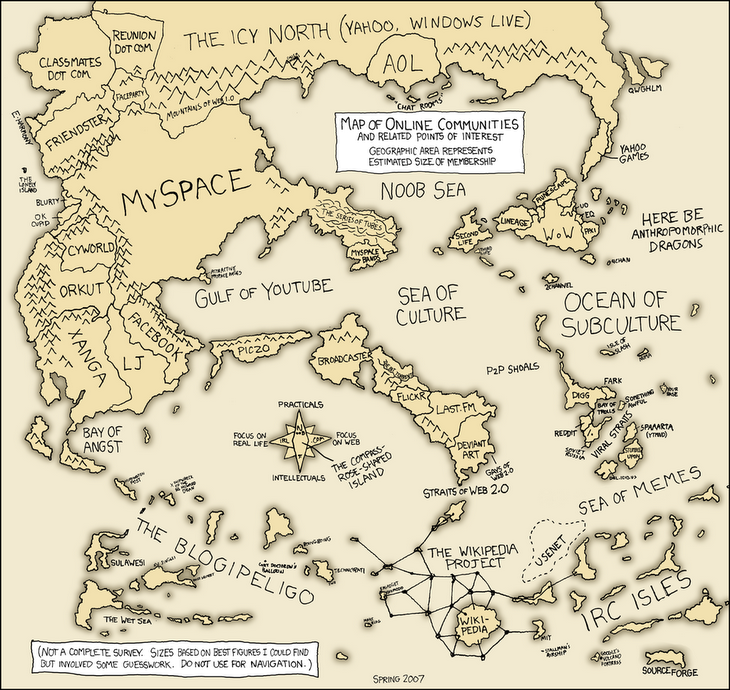
It has become clear to me that the value of this ethnography lies not in my description of experiences, but rather in elucidating the myriad shifting possibilities that emerge in the highly intersubjective field of discourses. As my research has deepened, the one thread that ties these discourses together is the pervasive feelings of anxiety evoked by the blurred boundaries between subject and object, voyeur and exhibitionist, human and machine, reality and imagination. All technologies extend the possibilities of humankind, and in turn, they become humanized and embedded in everyday experiences. However, at times technologies may seem alien and incomprehensible, instigating fear and a sense of powerlessness. The sense of agency felt as one “types oneself into being” through the creation of a publicly viewable online profile can quickly be negated by the discovery that this personal freedom comes with the cost of possible persecution by unintended audiences, such as potential employers and legal authorities. What occurs is a split of selfhood, a temporal shift of identity from intentional author to victimized object of the gaze.
Despite the existential anxieties that arise frequently in everyday discourse, many celebrate the Internet for its potential to democratize information. The perceptual difference between the democratization of information and the invasion of personal privacy lies in the degree of power individuals perceive themselves as having over the medium, as well as the extent to which they feel the medium has power over them. A common way of regaining control and agency when confronting one’s own powerlessness is with words and thoughts, projecting apathy or distaste and finding affirmation through others. Feeling a loss of connection, my friend described her adolescent brother as “consumed by MySpace, his gaze never turning from the computer screen”. For her brother, it is likely that MySpace conveniently fulfills his youthful desire to hang out in a space safe, away from the judging gaze of his family. To reject or criticize is to reclaim one’s subjectivity, or at least portray oneself as the author of one’s own meanings.
Years ago, I endeavored to learn Swahili and travel to Zanzibar for fieldwork. As I became engaged with the actual practice of writing ethnography, however, it became clear to me that writing the “other” would always feel somewhat wrong, condescending. When I wrote my first paper on Facebook back in the spring of 2006, I was struck by the way in which my own experiences resonated in my writing, how the words of others challenged and complicated my perspective with layers of meaning. In other words, I realized the ethnographic authority in my own position as a “native” of an emergent “other”. Eventually, the real struggle became that of subverting such a perceived authority in pursuit of deep listening- of practicing empathetic, temporal re-interpretations of my interpretations. It is easy to say in theory, but difficult to show in practice. As such, I have concocted plans for a website that would ideally bring to life the co-constructive nature of this project by enabling further co-authorship in the form of a wiki . Rather than simply purporting a “native” interpretation, such an ethnography incorporates the voices of “other natives” as well as “others”. As for now? I no longer have a working title. That, too, must emerge out of the thematic coalescence of the many stories and experiences that demand still further interpretation.
Showing posts with label discourse. Show all posts
Showing posts with label discourse. Show all posts
December 13, 2007


August 10, 2007
Reflections on Methodology
Even the acknowledgment, as requisite as it is in the field of anthropology, of the problematic nature of representing the "other" (ethnocentrism, racism, colonialism, imperialism, etc;) has become tired, stationary, and ultimately beleaguered by jargon. I seek the active creation of an ethnography both by and for the people- accessible as an inspired, collaborative story-telling. Such an endeavor thus expands the reach of information, rather than folding in upon itself in the mobius strip of academia.
Have I simply made a case for irresponsible, decontextualized ethnogaphy? The feminist concern with being "spoken for" by the dominant underlies my desire to closely examine a cultural form I can safely call my own. My autoethnography is, or so I hope, supplemented and lent legitimacy in the sharing of it, and in the incorporation of myriad perspectives.
Your comments would be much appreciated.
May 2, 2007
Lit Review: Personal Relationships: On and Off the Internet (Boase & Wellman)
From Computer-Mediated Small Groups to the Internet
-The authors surmise that we are experiencing an era of "networked individualism", shifting from tight-knit, geographically local communities to dispersed, sparsely-knit personal networks.
-Past research on computer-mediated communication (CMC) failed to situate CMC within broader social contexts.
-Past research demonstrates that, thus far, the Internet has had no salient destructive or radical effect on society.
The Social Affordances of the Internet
-supports a greater number of geographically dispersed interactions.
-asynchronous: these interactions can occur between those with very different temporal rhythms.
-rapidity: increased velocity of interpersonal exchange.
-reduced social presence may lessen commitment, complexity, and/or strength of virtual bonds.
-textuality: reduces image-based hierarchies, such as race and class.
-absence of direct feedback --> increased likelihood for flaming.
-societal connectivity: transitive, indirect contact facilitated in a manner that often crosses group boundaries.
-mass messaging: allows contact with multiple social circles.
-HOWEVER, often social networks do not interact, and information diffuses quickly.
Utopianism and Dystopianism
-Utopianism represented by the transformative ideals of Barlow, McLuhan, and others.
-Dystopians warned of the isolating and alienating potential of the Internet, warning ominously of societal decline (Kroker & Weinstein, Stoll) and fractured identities (Turkle).
-Both views are overly simplistic, lacking ethnographic and empirical data.
-Technological Determinism: Attributing causal effects to the technology rather than the way in which people choose to utilize it. For instance, the Internet was the effect rather than the cause of the desire for distant communication.
Contact With Friends and Family- Online and Off
-Though early findings demonstrated negative effects of Internet use, later findings uncovered that Internet use is inextricably tied to one's preexisting personality characteristics (Kraut).
-Other studies used time diaries to examine the everyday practices and effects of Internet use in comparison to offline interaction and found little to no causal relationship (various studies by Katz).
-Evidence exists that demonstrates the correlation between using the Internet to meet new people and decreased TV watching (Kraut, Kiesler, Boneva, & Shklovski).
-The needs of the individual must be examined as causally affecting the everyday usages of the Internet.
Forming Relationships Online
-Research has shown that only a very small percentage of Internet users have formed new relationships online (Katz).
-The Internet serves as an important tool for forming relationships for those who are physically or psychologically disadvantaged, including those with very low self-image (McKenna).
-Often, most users who form relationships online eventually express the desire to meet offline.
Neighboring and the Internet
-A study by Hampton and Wellman on a networked Toronto suburb, "Netville" demonstrated an increase in neighborhood contact, offline visits, and neighborhood ties. Furthermore, the networked residents showed an increase in contact with geographically distant social bonds. The combination of these two effects is defined by the researcher as "glocalization".
Towards a Theory of Networked Individualism
-Since the Industrial Revolution and the rise of mass transit and telecommunications, there has been a shift in social relations that Wellman coins "networked individualism".
-Networked Individualism:
1. Both local and long distance relationships:
Most likely, individuals virtually interact with those they are close to, but just far away from that it is inconvenient to visit.
2. Sparsely-knit personal networks that include densely-knit groups:
Ease in coordinating group events through mass messaging; direct and autonomous nature of the Internet helps one to maintain a large network of contacts with relatively little work.
3. Relationships more easily formed and abandoned:
In this era of mobility and frequent change in environment, CMC helps people stay in touch with those they've left behind. Additionally, the Internet may aid the sociality of those who have trouble forming relationships offline. It also aids in neighborhood connectivity, as demonstrated by the Netville study.
4. Many relationships with people from different social backgrounds:
Devoid of many of the social cues implicit in offline interactions, the Internet facilitates the formation of relationships between individuals of differing backgrounds.
5. Few strong ties and many weak ones:
The asynchronous nature of the Internet means that interactions need not take place in the same space at the same time. This can be an asset in everyday activities (such as shopping) that involve coordination with strong ties, for communicating in a way that lacks intrusion or disruption. Weak ties can be more easily maintained as well, allowing for affirmation of a connection to even the most geographically distant acquaintance.
In conclusion, the authors point to a need to examine the psychological effects of networked individualism, such as information overload and dissatisfaction or, more positively, cognitive flexibility, social tolerance, and increased knowledge.
---
This paper was published in 2004, around the time online social networking services were becoming mainstream in popularity, and before the advent of social media services such as YouTube. It focuses primarily on e-mail as a form of CMC. Examining society's relationship to the Internet in general, the authors are a bit too empirical and generalistic for my taste.
In developing surveys regarding interaction in online social networks, it would be interesting to examine a subpopulation of those who have recently transitioned into a new environment (such as college alumni) and their use of these tools in maintaining important social ties. How useful and satisfying is this medium? Furthermore, does the Internet actually facilitate group formation, or are these group memberships illusory in nature (serving the purpose of identity development and performance)?
April 26, 2007
Lit Review: From Counterculture to Cyberculture (Fred Turner)
Chapter 1: The Shifting Politics of the Computational Metaphor
-Sacio and the Free Speech Movement of the 60s opposed the mechanization of society through the guise of the university, the military, and information technologies.
-30 years later, what was once a threat was now a promise of liberation, expressed through the evolving personalization of the Internet.
-Barlow's Declaration of the Independence of Cyberspace in proclamation of the liberating nature of the Internet for overthrowing the bureaucracy. Social revolution?
-Esther Dyson believed that the Internet would become a digital marketplace that would allow consumers and corporations to negotiate equally, thus dissolving the tyranny of corporate hierarchies (Release 2.0: A Design for Living in the Digital Age).
-Kevin Kelly believed we were moving toward a "computational metaphor" in human understanding, in which the universe is a computer according to a new vocabulary that is now emerging.
-Disembodiment: dehumanization or equality?
The Forgotten Openness of the Closed World
-Post WWII era was dominated by a "closed world discourse", in which both the individual mind and the military were viewed as mechanized tools of control- cognitive psychology began utilizing the computational metaphor to describe the human brain, and in the military plans and operations were visually rendered through computer programming.
-Though this mechanization of society is exactly what students of the 60's rebelled against, at the time this discourse allowed for a quite flexible and creative style of research. This led to the rise of the military industrial complex and interdisciplinary collaboration.
-In the pursuit of military technology, scientists and researchers from many disciplines devised a new language with which to communicate.
-Humans and machines in collaboration within a larger, fluid socio-technical system- a "feedback system" that was then extended to human biology and society.
-This led to the deveopment of cybernetics (Norbert Wiener)- "the study of messages as a means of controlling machinery and society".
-In this frame, the media is viewed as a "servomechanism" that maintains the homeostasis of society through a feedback system of messages.
-Though computers threatened automation of people and society, they also brought hope for the possibility of a more democratic creation of order.
The Countercultural Embrace of Technology and Consciousness
-In the eyes of the left, the computational metaphor was one designed to create and maintain an unfeeling "technocracy" (Roszak).
-Lewis Mumford's The Myth of the Machine envisioned a world in which the technocratic elite are bent on designing man as an automaton whose proper functions will be controlled by the machine.
-In the postwar period, thanks in large part to research grants funded by the military, university enrollment exploded.
-Two forms of counterculture emerged in the 1960's: the New Left, which struggled for civil rights, free speech and voter registration (outward political action); and cold war-era culture marked by Zen Buddhism, Beat writings, action painting, and psychedelic drugs (inward consciousness and communalism).
-The New Communalists, contrary to the New Left, embraced the communal and egalitarian potential of cybernetics.
The New Left worked within the political structure in order to achieve their goals of establishing a true community and ending alienation. The New Communalists, however, believed political activism to be beside the point- that true community existed outside of traditional notions of chains of command. True community was to be found when transcendence from "the myth of objective consciousness" was achieved, and individual selves transformed.
-Charles Reich's The Greening of America detailed 3 historical stages of socioeconomic consciousness:
1. agriculture: farmers and small businessmen
2. industrial bureaucracies: society organized through complex organizations and new technologies of control and communication.
3. beaureaucratically levelled communities: harmonious collaborations working to end technocratic institutions.
-In this vein, if the mind is to be the source of change, then the sharing of information is a crucial step in that process- an "ebb and flow of communication".
---
This well explains the history of perceptions regarding information technologies. With this history in mind, it would be interesting to gauge the current perception of the Internet as it becomes increasingly a site for both interactivity/communication/community-building and corporate schemas, economically entrenched but intellectually dispersed.
On one end we have open source collaboration, but on the other we have the rise of a hegemonic Google institution. Somewhere in the middle lie social networking services such as Facebook and Myspace. In the ephemeral space of the Internet, however, time and power work together to allow for immediate collective awareness and consequent action. The trick is in the hook- for instance, Facebook alienated its users with the implementation of the News Feed, to the extent that its users collectively organized in protest. However, this collective organization would not have been possible WITHOUT Facebook, and in this way they are institutionalized. This happens when certain Internet systems become integrated in the daily functioning of individuals in society. To disengage from these systems would be to disengage with a symbolic structure of one's membership in her community.
If we are to examine Internet culture through the lens of Reich, it would seem we exist still in the second level of consciousness. If a counterculture exists on the Internet, it could do so in two ways: by utilizing the existing social institutions of the Internet to spread awareness and make political statements, or to abandon the existing institutions altogether in favor of a back-to-cyberspace approach of creating communal sites in which individuals work to raise their own consciousnesses and fulfill their human potentials.
April 15, 2007
Lit Review: "Seeing and Sensing" Online Interaction: An Interpretive Interactionist Approach to USENET Support Group Research (Walstrom)
A third-person observation cannot uncover the invisible bonds of connection that motivate people to interact with and feel responsible toward one another, particularly in sensitive cases in which anonymity can provide the comfort needed to become uninhibited with others, such as support groups. Traditional ethnographic methods may work for some online groups, but an interpretive interactive approach of forming an emotional connection to the participant may be essential to understanding her processes of sense-making.
In this study, the researcher was obliged to also have undergone the experiences of those in specific support groups, allowing both a third- and second-person position (analyst and participant-experiencer). Her own participation in an eating disorders support group yielded three central tenets: the formation of a public, group narrative to serve as a collective resource, discursive practices such as politeness to serve as protection of individual/group face, and the co-construction of eating disorder identities.
Social Constructionism: "the self-other dimension of interaction"- all cultural meanings are co-constructed.
Rhetorical-responsive Approach: Seeking understandings of "living utterances"
Interpretive Interactionism: Attending to the everyday experiences (feelings, actions, meanings) of interacting individuals.
-Researchers must make interpretive processes as public as they can, as well as the multiple methods employed.
-Micro-level: Local meanings to illuminate the inner lives of partipcipants.
-Macro-level: Connecting these micro-lvel findings to the poicies or institutions that can affect them.
-Rejects generalizations, positivism
In this study, the mainstream discourse of objectifying, pathologizing, and trivializing the experience of those suffering from eating disorders is problematized by fully representing the visceral experiences, competencies, and emotions through an interpretive interactionist approach. The approach was also feminist in nature, contesting the scientific discourse for its inability to recognize the authority of women in describing their own experiences. This merging of methodological approaches enhances the rigor by expanding the scope of inquiry into shared experiences.
Grounded Theory: Locating a core category for organizing the vast numbers of responses generated by a group and coding the actions and experiences in written accounts. For example- a category used in this study was the frequent and systematic tendency to personify the eating disorders ("the monster within"). This tendency can be invoked in a variety of situations, which were also coded (eg; introduction, ephiphany, cry for help). Can reveal much about the co-construction of identity.
Conversational Analysis: Noting what is displayed as salient in the structure of one's talk. Some things that are examined are the rules governing turn-taking, normative responses, use of genre (public narrative)
Discourse Analysis: Includes critical discourse analysis- critique of the hegemonic and institutional forces at work in local interactions. Also self-other positionings, responses to emotionally-charged displays.
Online Interpretive Interactionist Approach
-Self-presentation at introduction of link to group, sharing the dilemma/discourse.
-A feminist communitarian approach reflects the researcher's shared emotionality with paritcipants, research that will make a difference.
-Benefits: 1. representing participants' own voices validated their perspective, 2. thick description of shared problematic experiences enhances self-understandings, 3. critique of dominant discourses that affect the participants' potential for change.
----
Unlike this study, I am not seeking to uncover particularly sensitive issues. I am interested, however, in the formation of relationships with participants in order to understand more empathically, as well as challenge dominant discourses (such as predator threats, grand delusions of privacy, inability for computer-mediated communication to evoke tangible responses/form true social bonds, meeting of strangers, etc;). It will be important to examine the priority that individuals themselves place on online interactions, thus the first segment of my methodology will involve asking participants to articulate their own experiences in written accounts (through internet-based surveys). The accumulation of a large quantity of written data will serve my aim in categorizing experiences through the lens of public narratives and shared emotional displays.
Also, rather than "recruiting" subjects, I will be posting information about the study, as well as a link to the online survey(s) on public message forums, through which individuals will be self-motivated to participate. In addition, I will be evoking an interactionist approach through engagement with others in public dialogue spaces, such as message boards and group forums.
March 5, 2007
Lit. Review: Participatory Genre, by Thomas Erickson
• Problematizes the notion of “virtual communities,” defending instead the position that digital communication is a participatory genre.
• Genre: purpose of the communication, regularities of form and substance, and the institutional, social, and technological forces which underlie those regularities.
• What is unique to online communication is its highly participative and rapidly evolving nature.
• Community:
o Membership: Can be open or closed, links people together based on commonalities.
o Relationships: A community is partially overlapping networks of relationships- some strong, some weak, some
nonexistent.
o Commitment and reciprocity.
o Shared values and practices.
o Collective goods.
o Duration: Expected to have a long existence.
• What does seem of importance is the creation of a shared informational artifact that is brought about through virtual discourse- whether or not personal relationships are formed.
• Genres evolve over time through reciprocal interaction between institutionalized practices and individual human action- the Internet works to speed up this evolutionary process.
• Method: Restricted attention to about 6 conferences within the online community Café Utne.
• A linguistic analysis of the Cafe's conversations, in message board format, and the ways in which participants engage with one another, considering the dearth of social pressure to respond. This dearth is also compensated for through extensive jokes and wordplay.
• Properties of the discourse medium: sequentiality is preserved, all participants see the same thing, newcomers can read the whole conversation before they participate.
With the advent of this age of "egocasting", virtual discourse is increasingly tied to the personal profiles of participants, thus decreasing the need for introductory posts. What struck me as a particularly interesting point in this article was the discussion of how the discourse medium shapes participation. A quick glance at a message board thread will supply the user with an arsenal of information needed to assess the conversational rhythm, the audience, the content and the length of the average response. There is a considerable lack of social pressure to engage in the discourse itself- a marked difference from face-to-face interactions. "Lurking", in 'net geek terminology, is the common practice of following virtual conversations without actually participating. Lurking is acceptable in the virtual realm because it goes entirely undetected- however, in the physical realm such a practice would be labeled as spying or eavesdropping.
This article is quite dated (1997), and centered on old-school message board communities. Where and how does group discourse occur in the communities I am exploring?
1. Myspace: 22 general forums. Each poster's profile icon appears next to their username, age, location and gender. Respondants can quote a previous post, or simply reply to it. If message boards are too lifeless, a user also has the option of visiting chat rooms designated for each forum.
2. Facebook: Users can post publicly visible messages for groups they are members of, events they are interested in, posted photos and shared items, as well as "notes" (Facebook blogs) and individual profiles. However, they are not traditional message boards, but rather time-stamped, individual comments that are centered more on the group/event/photo/item/person in question, rather than a coherent "conversation".
3. Tribe: Each Tribe has as its focal point a traditional message board, but membership is necessary in order to post. Many Tribes have open membership, while some tribes require permission from the tribe administrator in order to join.
Subscribe to:
Posts (Atom)


 Posts