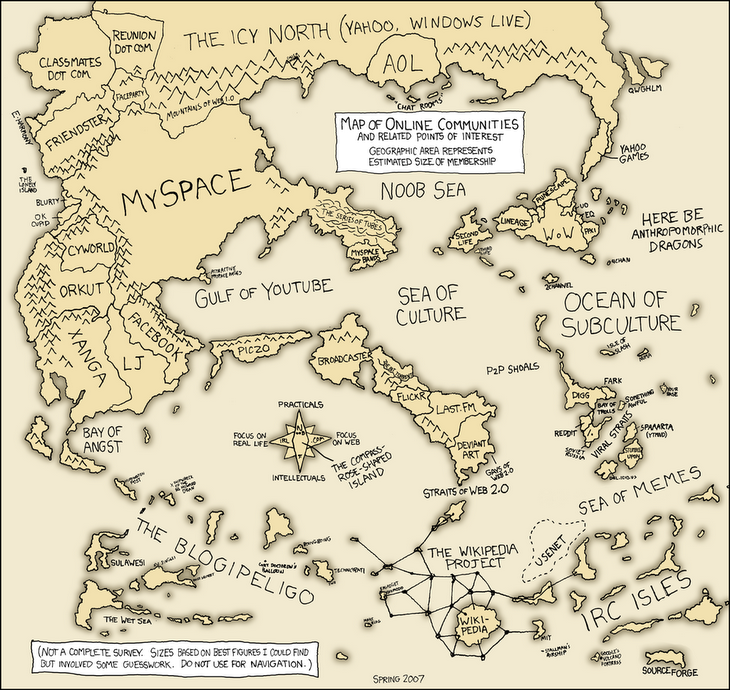
I ran across an interesting thread on Tribe.net yesterday entitled "What is Technoshamanism?" You can read it here, but in a nutshell, the respondees described technoshamanism as a means of uniting the past and the present, or the spiritual and the technological. From dancing around a bonfire to the beat of the drums, to dancing all night long to electronic trance music, the end goal is a spiritual connection to the universe that dates back to the beginning of humankind's time on this planet.
I have to simply marvel, at times, how meticulously the system of Facebook is run. Nothing is deleted, all is stored. Upon deleting my Facebook account, I learned that the moment I logged in again, my entire account- the photos, the messages, the wall posts- would be rekindled from my momentary lapse of Facebook identity, as if I had taken a vacation... which, admittedly, I had.
The new frontier for individualism, the virtual frontier, is at this point still an open one. However, as this sphere becomes increasingly dominated by large corporate networks, understanding the illusory nature of agency is critical. John Barlow's Declaration for the Independence of Cyberspace has never been more poignant.
Showing posts with label public/private. Show all posts
Showing posts with label public/private. Show all posts
August 27, 2007


August 13, 2007
My Dad's Checked Me Out on Facebook, GAH!
It was bound to happen eventually. Last week, I received a Facebook friend request from my dad. When I followed the link, however, the friend request had disappeared. Apparently my father wised up pretty quickly- it was much easier to log into my sister's account (she uses his laptop all the time), and check me out from the inside. Last night, my sister was showing me some pictures on Facebook- we showed one to my dad, who commented, "oh, I've seen those." We looked up, startled. "Oh, what's the matter? There's nothing bad on there," he recovered quickly. We stared at one another for a long minute.
Later that night, relaxing in our nifty new hot tub, I broached the subject once more. "So, I got a friend request from you last week, but you'd disappeared. I guess you caught on to the personal nature of Facebook?" He nodded imperceptibly. "So, tell me if this is what happened- you joined the site, realized you couldn't simply view people's profiles without adding them as friends, and decided to stalk us through Kelly's account instead?" He smiled sheepishly, confirming my suspicions. I felt, and not for the first time, worried and exposed. But only for a moment... with relief I remembered that both my brother and sister have access only to my Limited Profile, which prevents them from viewing my "Friends Only" photo albums. Three cheers for conscientiousness!
Later that night, relaxing in our nifty new hot tub, I broached the subject once more. "So, I got a friend request from you last week, but you'd disappeared. I guess you caught on to the personal nature of Facebook?" He nodded imperceptibly. "So, tell me if this is what happened- you joined the site, realized you couldn't simply view people's profiles without adding them as friends, and decided to stalk us through Kelly's account instead?" He smiled sheepishly, confirming my suspicions. I felt, and not for the first time, worried and exposed. But only for a moment... with relief I remembered that both my brother and sister have access only to my Limited Profile, which prevents them from viewing my "Friends Only" photo albums. Three cheers for conscientiousness!
May 3, 2007
Lit Review: Information Revelation and Privacy in Online Social Networks (The Facebook Case) (Gross & Acquisti)
The researchers conducted an analysis of over 4,000 college students using Facebook at Carnegie Mellon, utilizing the lens of information revelation and related privacy implications.
-Sought to examine the openness of individuals in revealing information (such as contact information, political and sexual orientation, and intimate details of one's personal life) freely posted in the public realm of the Internet.
-Collected actual field data, rather than surveys or experiments.
Information Revelation and Online Social Networking
1. Identifiability
-Varies according to the nature of the site, though most encourage identifiable photos.
2. Types of information elicited
-range from the semi-public to the private to entirely open-ended (diary communities).
3. Visibility of information
-Can be viewed by all members or limited to one's personal network.
-Anecdotal evidence reveals an utter willingness of members to reveal private information.
-Social Network Theory and Privacy: Discussions center on the complex nature of one's propensity to disclose personal information, the importance of weak ties in the formation of social capital, and expectations of privacy.
-In the offline world, relationships are dynamic and can exist at multiple levels of intimacy. Online, relationships are reduced to simply "friend or not".
-Though not necessarily supportive of strong ties, the Internet facilitates the formation of a large and dispersed network of weak ties.
-Situating the Internet as a vast network of rather weak ties, it has been described by some as an imagined community (Anderson), and thus the meaning of trust must be renegotiated, as well as the meaning of intimacy.
-The Internet slightly facilitates meaningful interaction while greatly enhancing the ability of others to access your information.
-Privacy Implications: Photos, demographic data, unique tastes may lead to a re-identification of an individual belonging to more than one SNC. This occurs either through recognition of a pseudonymous user by searching for this information, or knowledge of unknown characteristics of an identified subject on another site.
-Members are often not fully aware of a hosting site's privacy policies concerning information disclosure, or the magnitude of the site's user population and/or data archival.
-Risks include identity theft, stalking, embarrassment and blackmailing.
-Factors in information revelation include peer pressure, perceived benefits outweighing potential harm, casual attitudes regarding privacy, lack of awareness of threat, trust in the service and its members, or the SNC interface itself.
TheFacebook.com
-College-oriented SNCs are often based on a shared real space that is extended to a bounded virtual domain.
-Increased sense of trust and intimacy, however outsider access and rapid network expansion quickly challenge the "realness" of the community and expectations of privacy.
-Photo: 91%; Birthday: 87.8%; Phone: 39.9%; Residence: 50.8%; Dating Preferences, Relationship Status, Religious and Political Views
-Facebook encourages validity of information and a valid e-mail address.
-->89% real names, 8% fake names, 3% first name only
-->91% provide images: 61% directly identifiable, 80% useful for identification, 12% unrelated - in comparison to Friendster: 23% joke images, 55% directly identifiable
-->CMU students average 78.2 friends at CMU and 54.9 at other schools
Data Visibility and Privacy Preferences: Default settings allow everyone at same institution to view full profile, and full name/institution/status/photo show up in any general search. However, visibility and searchability are able to be defined by the individual user. Less than 3% of users alter their privacy settings.
Privacy Implications
-Facebook users appear generally unconcerned about information disclosure and potential ramifications.
1. Stalking: Physical presence can be determined based on location and class schedule; AIM (listed by 77.7% of users).
2. Re-Identification: the linkage of non-explicit information (name, address) with explicit information (common attributes). This can be based on demographics (all one needs is zip code, gender, and birthdate- provided by 44.3% of users), face (provided by 55.4%), social security number and identity theft (birthdate, residence, phone number)
3. Building a Digital Dossier: Sensitive data revealed in college, such as sexual orientation and political reviews, is archived and can potentially be mined in the future.
4. Fragile Privacy Protection: Social networks can be hacked! E-mail addresses can be hacked, manipulation of users (when 250,000 users were sent a friend request, 30% were willing to make all of their information available by accepting), advanced search features are available to anyone in the network looking to search for someone at any college
---
This article is slightly dated (2005), and concerns over privacy on the Internet have since grown exponentially due to media dramatization and new features implemented by Facebook (namely, the News Feed, which encouraged many to finally implement some of the privacy options made available to users). A simple survey tapping into perceived privacy, protective behaviors, and perceived audience would be easy to implement- Facebook does make recruiting participants a lot easier! Also, Facebook has since updated their privacy policy- a little highlighted review:
-Sought to examine the openness of individuals in revealing information (such as contact information, political and sexual orientation, and intimate details of one's personal life) freely posted in the public realm of the Internet.
-Collected actual field data, rather than surveys or experiments.
Information Revelation and Online Social Networking
1. Identifiability
-Varies according to the nature of the site, though most encourage identifiable photos.
2. Types of information elicited
-range from the semi-public to the private to entirely open-ended (diary communities).
3. Visibility of information
-Can be viewed by all members or limited to one's personal network.
-Anecdotal evidence reveals an utter willingness of members to reveal private information.
-Social Network Theory and Privacy: Discussions center on the complex nature of one's propensity to disclose personal information, the importance of weak ties in the formation of social capital, and expectations of privacy.
-In the offline world, relationships are dynamic and can exist at multiple levels of intimacy. Online, relationships are reduced to simply "friend or not".
-Though not necessarily supportive of strong ties, the Internet facilitates the formation of a large and dispersed network of weak ties.
-Situating the Internet as a vast network of rather weak ties, it has been described by some as an imagined community (Anderson), and thus the meaning of trust must be renegotiated, as well as the meaning of intimacy.
-The Internet slightly facilitates meaningful interaction while greatly enhancing the ability of others to access your information.
-Privacy Implications: Photos, demographic data, unique tastes may lead to a re-identification of an individual belonging to more than one SNC. This occurs either through recognition of a pseudonymous user by searching for this information, or knowledge of unknown characteristics of an identified subject on another site.
-Members are often not fully aware of a hosting site's privacy policies concerning information disclosure, or the magnitude of the site's user population and/or data archival.
-Risks include identity theft, stalking, embarrassment and blackmailing.
-Factors in information revelation include peer pressure, perceived benefits outweighing potential harm, casual attitudes regarding privacy, lack of awareness of threat, trust in the service and its members, or the SNC interface itself.
TheFacebook.com
-College-oriented SNCs are often based on a shared real space that is extended to a bounded virtual domain.
-Increased sense of trust and intimacy, however outsider access and rapid network expansion quickly challenge the "realness" of the community and expectations of privacy.
-Photo: 91%; Birthday: 87.8%; Phone: 39.9%; Residence: 50.8%; Dating Preferences, Relationship Status, Religious and Political Views
-Facebook encourages validity of information and a valid e-mail address.
-->89% real names, 8% fake names, 3% first name only
-->91% provide images: 61% directly identifiable, 80% useful for identification, 12% unrelated - in comparison to Friendster: 23% joke images, 55% directly identifiable
-->CMU students average 78.2 friends at CMU and 54.9 at other schools
Data Visibility and Privacy Preferences: Default settings allow everyone at same institution to view full profile, and full name/institution/status/photo show up in any general search. However, visibility and searchability are able to be defined by the individual user. Less than 3% of users alter their privacy settings.
Privacy Implications
-Facebook users appear generally unconcerned about information disclosure and potential ramifications.
1. Stalking: Physical presence can be determined based on location and class schedule; AIM (listed by 77.7% of users).
2. Re-Identification: the linkage of non-explicit information (name, address) with explicit information (common attributes). This can be based on demographics (all one needs is zip code, gender, and birthdate- provided by 44.3% of users), face (provided by 55.4%), social security number and identity theft (birthdate, residence, phone number)
3. Building a Digital Dossier: Sensitive data revealed in college, such as sexual orientation and political reviews, is archived and can potentially be mined in the future.
4. Fragile Privacy Protection: Social networks can be hacked! E-mail addresses can be hacked, manipulation of users (when 250,000 users were sent a friend request, 30% were willing to make all of their information available by accepting), advanced search features are available to anyone in the network looking to search for someone at any college
---
This article is slightly dated (2005), and concerns over privacy on the Internet have since grown exponentially due to media dramatization and new features implemented by Facebook (namely, the News Feed, which encouraged many to finally implement some of the privacy options made available to users). A simple survey tapping into perceived privacy, protective behaviors, and perceived audience would be easy to implement- Facebook does make recruiting participants a lot easier! Also, Facebook has since updated their privacy policy- a little highlighted review:
We may use information about you that we collect from other sources, including but not limited to newspapers and Internet sources such as blogs, instant messaging services and other users of Facebook, to supplement your profile. Where such information is used, we generally allow you to specify in your privacy settings that you do not want this to be done or to take other actions that limit the connection of this information to your profile (e.g., removing photo tag links).
We do not provide contact information to third party marketers without your permission. We share your information with third parties only in limited circumstances where we believe such sharing is 1) reasonably necessary to offer the service, 2) legally required or, 3) permitted by you.
We may be required to disclose user information pursuant to lawful requests, such as subpoenas or court orders, or in compliance with applicable laws. We do not reveal information until we have a good faith belief that an information request by law enforcement or private litigants meets applicable legal standards. Additionally, we may share account or other information when we believe it is necessary to comply with law, to protect our interests or property, to prevent fraud or other illegal activity perpetrated through the Facebook service or using the Facebook name, or to prevent imminent bodily harm. This may include sharing information with other companies, lawyers, agents or government agencies.
If the ownership of all or substantially all of the Facebook business, or individual business units owned by Facebook, Inc., were to change, your user information may be transferred to the new owner so the service can continue operations.
Individuals who wish to deactivate their Facebook account may do so on the My Account page. Removed information may persist in backup copies for a reasonable period of time but will not be generally available to members of Facebook.
May 2, 2007
Lit Review: An Evaluation of Identity-Sharing Behavior in Social Network Communities (Stutzman)
-Though academic institutions have been working to protect student identities, their work is increasingly being undermined by social networking communities (SNCs).
-The goals of this study were twofold: obtaining quantitative data about SNC participation on college campuses, and analyzing member attitudes pertaining to SNC participation and online identity sharing. This data was gathered from the perspective of an outsider to these communities.
-A random survey of 200 students (38 of whom responded) inquired about the specifics of their involvement in SNCs as well as their feelings regarding online identity sharing. The researcher then created a disclosure matrix for each participant by examining the data made available in their SNC profiles.
-Limitations: Small sample size, internet survey may be biased toward the tech-savvy, outsider status, lexical differences in coding identity elements of the SNCs (favorite movies, sexual orientation, academic status, etc;).
Findings
-71% involvement in SNCs: 90% of undergrads, 44% of grads.
-Most popular was Facebook (90% of undergrads), followed by Friendster and MySpace.
-Though participants expressed doubt that their identity information was protected online (2.66 on a 5-point Likert scale), they were nevertheless okay with friends accessing this information (4.55), but markedly less so with strangers (3.15).
-Information of particular interest: location, sexual orientation, political status
-Urges discussion of new identity disclosure threats posed by SNCs.
---
The very small sample size of this study makes it almost entirely worthless to review, but it is worth noting that academic institutions are working to protect the identities of their students. In another vein, the enormous discrepency between SNC participation by undergrads and that of graduate students suggest that the undergaduate community may possess certain qualities or needs that SNCs fulfill, such as maintaining high school ties.
Seeing as identity disclosure would seem to be a pertinent issue, it would be interesting to reassess users' feelings on the matter now that SNCs have become both mainstream and problematized by media discourse. How is "stalking" defined (it is a commonly used term in Facebook discourse)? What sort of activities and degree of involvement are deemed acceptable by today's norms?
-The goals of this study were twofold: obtaining quantitative data about SNC participation on college campuses, and analyzing member attitudes pertaining to SNC participation and online identity sharing. This data was gathered from the perspective of an outsider to these communities.
-A random survey of 200 students (38 of whom responded) inquired about the specifics of their involvement in SNCs as well as their feelings regarding online identity sharing. The researcher then created a disclosure matrix for each participant by examining the data made available in their SNC profiles.
-Limitations: Small sample size, internet survey may be biased toward the tech-savvy, outsider status, lexical differences in coding identity elements of the SNCs (favorite movies, sexual orientation, academic status, etc;).
Findings
-71% involvement in SNCs: 90% of undergrads, 44% of grads.
-Most popular was Facebook (90% of undergrads), followed by Friendster and MySpace.
-Though participants expressed doubt that their identity information was protected online (2.66 on a 5-point Likert scale), they were nevertheless okay with friends accessing this information (4.55), but markedly less so with strangers (3.15).
-Information of particular interest: location, sexual orientation, political status
-Urges discussion of new identity disclosure threats posed by SNCs.
---
The very small sample size of this study makes it almost entirely worthless to review, but it is worth noting that academic institutions are working to protect the identities of their students. In another vein, the enormous discrepency between SNC participation by undergrads and that of graduate students suggest that the undergaduate community may possess certain qualities or needs that SNCs fulfill, such as maintaining high school ties.
Seeing as identity disclosure would seem to be a pertinent issue, it would be interesting to reassess users' feelings on the matter now that SNCs have become both mainstream and problematized by media discourse. How is "stalking" defined (it is a commonly used term in Facebook discourse)? What sort of activities and degree of involvement are deemed acceptable by today's norms?
Lit Review: Digital Relationships in the ‘MySpace’ Generation: Results From a Qualitative Study (Dwyer)
A qualitative study of online social networking sites and instant messaging.
Background
-CMC reduces the exchange of social context cues, affecting perceptions of truthfulness, interpretation and response to messages, and the formation of impressions.
--Social Information Processing Model (Walther): CMC relies on paralinguistics, slowing the rate at which social cues are received.
-Impression Management (Goffman): The subtle process of controlling another's perception of something by managing the information exchanged in a social interaction. When that something is one's own identity, it is referred to as self-presentation. We interpret others through inference of their roles, derived from the information they or others present to us.
-Social-Technical Gap: The space between what technology can support and what actually happens in the social world.
The Study
-Examined the use of technology to manage relationships, and the ways in which these technologies mediate behaviors pertaining to the management of these relationships.
-The semi-structured interview designed inquired about self-presentation/impression management, pros and cons of these systems, usage and dependency for social communication. It also probed participants for information on how they used the tools provided by this systems in developing new relationships, restricting access, and responding to negative events. Expectations of privacy were also investigated, pertaining to what individuals felt comfortable with sharing and why.
-Interviews were conducted by 6 undergraduates, who interviewed a total of 19 college-aged participants. The transcripts were content-analyzed and coded.
-Participants reported heavy use of communication technologies, heralding their low cost, entertainment value, and convenience.
-Profiles provide the opportunity for impression management. Authenticity plays a large role here- profiles that appear (or are known to be) false or contrived trigger a very negative impression. However, they also discussed the need to create a "cool" persona and intense awareness of how others would perceive their self-presentations. Nevertheless, the act of constructing one's profile was generally considered a fun, entertaining activity.
-As one participant put it, "The defining characteristic of social networking sites is extreme impersonality. The people that one talks to on these sites are not treated as other human beings. They appear more like characters in a story."
-Though privacy concerns have been well-documented, the participants expressed general apathy, countering that they as members are responsible for the content and management of their virtual personas.
-Acknowledged that relationships formed online are superficial in nature.
-General enjoyment of these systems' ability to maintain bonds with those one doesn't see every day, as well as reunite one with old friends.
-Instant Messenger Away Messages: A user is able to monitor others while behind the "barrier" of the away message.
-Comfort level increased as the degree of their own anonymity rose, decreased with the anonymity of others.
Framework
Communication technology features (profile, visibility, and identity management) enable interpersonal relationship management (forming new relationships, maintaining existing relationships), which is in turn influenced by individual attitudes (impression management, concern for information privacy).
Questions Raised
How is impression management carried out within CMC?
How to explain the apparent contradiction between privacy concerns and the overwhelming popularity of social networking sites?
---
Individuals are fluid, not static, and in the act of creating a profile of the self one undergoes a strangely simplified process of impression management. I would like to examine the paralanguage of Internet communities, the ways in which social cues are subtly communicated, as well as the complex ways in which impression management is enacted.
Background
-CMC reduces the exchange of social context cues, affecting perceptions of truthfulness, interpretation and response to messages, and the formation of impressions.
--Social Information Processing Model (Walther): CMC relies on paralinguistics, slowing the rate at which social cues are received.
-Impression Management (Goffman): The subtle process of controlling another's perception of something by managing the information exchanged in a social interaction. When that something is one's own identity, it is referred to as self-presentation. We interpret others through inference of their roles, derived from the information they or others present to us.
-Social-Technical Gap: The space between what technology can support and what actually happens in the social world.
The Study
-Examined the use of technology to manage relationships, and the ways in which these technologies mediate behaviors pertaining to the management of these relationships.
-The semi-structured interview designed inquired about self-presentation/impression management, pros and cons of these systems, usage and dependency for social communication. It also probed participants for information on how they used the tools provided by this systems in developing new relationships, restricting access, and responding to negative events. Expectations of privacy were also investigated, pertaining to what individuals felt comfortable with sharing and why.
-Interviews were conducted by 6 undergraduates, who interviewed a total of 19 college-aged participants. The transcripts were content-analyzed and coded.
-Participants reported heavy use of communication technologies, heralding their low cost, entertainment value, and convenience.
-Profiles provide the opportunity for impression management. Authenticity plays a large role here- profiles that appear (or are known to be) false or contrived trigger a very negative impression. However, they also discussed the need to create a "cool" persona and intense awareness of how others would perceive their self-presentations. Nevertheless, the act of constructing one's profile was generally considered a fun, entertaining activity.
-As one participant put it, "The defining characteristic of social networking sites is extreme impersonality. The people that one talks to on these sites are not treated as other human beings. They appear more like characters in a story."
-Though privacy concerns have been well-documented, the participants expressed general apathy, countering that they as members are responsible for the content and management of their virtual personas.
-Acknowledged that relationships formed online are superficial in nature.
-General enjoyment of these systems' ability to maintain bonds with those one doesn't see every day, as well as reunite one with old friends.
-Instant Messenger Away Messages: A user is able to monitor others while behind the "barrier" of the away message.
-Comfort level increased as the degree of their own anonymity rose, decreased with the anonymity of others.
Framework
Communication technology features (profile, visibility, and identity management) enable interpersonal relationship management (forming new relationships, maintaining existing relationships), which is in turn influenced by individual attitudes (impression management, concern for information privacy).
Questions Raised
How is impression management carried out within CMC?
How to explain the apparent contradiction between privacy concerns and the overwhelming popularity of social networking sites?
---
Individuals are fluid, not static, and in the act of creating a profile of the self one undergoes a strangely simplified process of impression management. I would like to examine the paralanguage of Internet communities, the ways in which social cues are subtly communicated, as well as the complex ways in which impression management is enacted.
March 6, 2007
Lit Review: Profiles as Conversation: Networked Identity Performance on Friendster, by danah boyd and Jeffrey Heer
o The Friendster profile represents not a static individual, but rather “a communicative body in conversation with other represented bodies.”
o Communication as multimodal; performance and interpretation.
o How are unknown audiences negotiated in light of such public-private technologies as blogs and photosharing communities such as Flickr?
Background
o Description of content/functions
o Visual example of a profile
o Purpose of site: initially, dating, but interpreted as presentation of self, playful network-building, competition & voyeurism.
o Audience: gay men, bloggers, Burners
o History: Since 2003, has rapidly declined in popularity amongst initial members.
o Methodology
o Ethnography: 9 mo. Participant-observation, interviews, surveys, focus groups; 200 participants; 1.5 million profiles
o Visualization: Egocentric & interactive
Context
o Internal homophily / homogeneity
o As with Facebook, the network grew in population and diversity and challenged conceptions of perceived audience
o Playfulness depicted by Fakesters, encouraging creative performance while also mocking serious networkers…
Conversing
o Exchanging information- from performance → conversation
o Semi-public (bulletin board) & private (messaging)
o Embodiment through profiles
• Markers: photos, relationship status, looking for,
o Cultural rules: when is friending appropriate? What are the deeper meanings beneath the various facets of the profile? Reciprocity of testimonials…
o Photosharing as conversation and reinforcement of social bonds
o Friendster vocabulary much like Facebook vocabulary- a “friendster” / “Facebook friend”
Frozen Performances
o Lack of updating profiles – frozen identities, “time capsules”…
o Future a digital graveyard of past identity performance?
o Confusion of public/private in the virtual realm- persistence
---
This study could serve as useful in comparative analyses- Friendster was one of the first online social networks to become popular, as well as one of the first to become unpopular for a host of reasons (namely, the impact of moderating that resulted in the "Facebook Genocide", a lack of network limitations, a lack of new interactive content- that is, until Facebook became popular). Will MySpace head in a similar direction? Same potential for Tribe if it sells out...
New forms of conversation through digital content, especially photosharing. Facebook's "photo tagging" function was key to its popularity boom. The ability to add content of any sort is essential for conversation.
MySpace: User's can edit their own profiles as well as the comments they leave others with HTML, granting users an enormous degree of agency. However, this can get messy when profiles take minutes to load content (often encounter blaring music, seizure-inducing videos, slow-loading photo galleries, inane ego-capsules).
Facebook: Much cleaner than MySpace, but also much less agency. Users can import blogs, create slick Event and Group pages and invite users, and share content from the web (including video and audio).
Tribe: Users can choose from a variety of profile templates and arrange the content blocks on those templates. Again, less agency, however users are given a great variety of easy fill-in-the-blank templates. Above all, Tribe is the least susceptible to media-overload- message board forums are still the principle tenet of groups (Tribes), and users can choose the hierarchy of the information they divulge about themselves.
o Communication as multimodal; performance and interpretation.
o How are unknown audiences negotiated in light of such public-private technologies as blogs and photosharing communities such as Flickr?
Background
o Description of content/functions
o Visual example of a profile
o Purpose of site: initially, dating, but interpreted as presentation of self, playful network-building, competition & voyeurism.
o Audience: gay men, bloggers, Burners
o History: Since 2003, has rapidly declined in popularity amongst initial members.
o Methodology
o Ethnography: 9 mo. Participant-observation, interviews, surveys, focus groups; 200 participants; 1.5 million profiles
o Visualization: Egocentric & interactive
Context
o Internal homophily / homogeneity
o As with Facebook, the network grew in population and diversity and challenged conceptions of perceived audience
o Playfulness depicted by Fakesters, encouraging creative performance while also mocking serious networkers…
Conversing
o Exchanging information- from performance → conversation
o Semi-public (bulletin board) & private (messaging)
o Embodiment through profiles
• Markers: photos, relationship status, looking for,
o Cultural rules: when is friending appropriate? What are the deeper meanings beneath the various facets of the profile? Reciprocity of testimonials…
o Photosharing as conversation and reinforcement of social bonds
o Friendster vocabulary much like Facebook vocabulary- a “friendster” / “Facebook friend”
Frozen Performances
o Lack of updating profiles – frozen identities, “time capsules”…
o Future a digital graveyard of past identity performance?
o Confusion of public/private in the virtual realm- persistence
---
This study could serve as useful in comparative analyses- Friendster was one of the first online social networks to become popular, as well as one of the first to become unpopular for a host of reasons (namely, the impact of moderating that resulted in the "Facebook Genocide", a lack of network limitations, a lack of new interactive content- that is, until Facebook became popular). Will MySpace head in a similar direction? Same potential for Tribe if it sells out...
New forms of conversation through digital content, especially photosharing. Facebook's "photo tagging" function was key to its popularity boom. The ability to add content of any sort is essential for conversation.
MySpace: User's can edit their own profiles as well as the comments they leave others with HTML, granting users an enormous degree of agency. However, this can get messy when profiles take minutes to load content (often encounter blaring music, seizure-inducing videos, slow-loading photo galleries, inane ego-capsules).
Facebook: Much cleaner than MySpace, but also much less agency. Users can import blogs, create slick Event and Group pages and invite users, and share content from the web (including video and audio).
Tribe: Users can choose from a variety of profile templates and arrange the content blocks on those templates. Again, less agency, however users are given a great variety of easy fill-in-the-blank templates. Above all, Tribe is the least susceptible to media-overload- message board forums are still the principle tenet of groups (Tribes), and users can choose the hierarchy of the information they divulge about themselves.
Subscribe to:
Posts (Atom)


 Posts
Posts