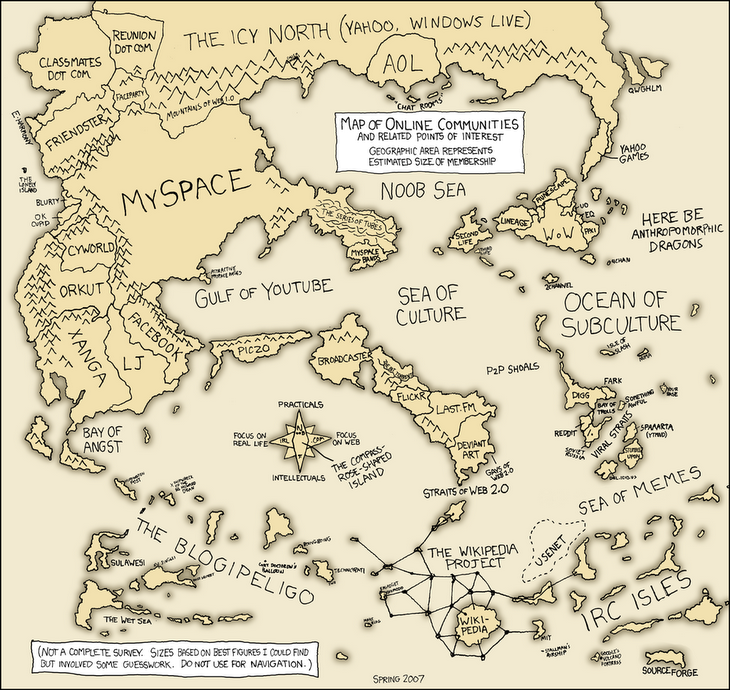
This is my final post on this blog, as I am excited to *finally* announce my transition to Wordpress on my own domain name- that would be JennyRyan.Net! Please update your bookmarks and your feed readers accordingly; the direct link to the blog is http://www.jennyryan.net/musings. I'm still in the process of manually copying posts over from this blog and my old iggli blog, due to inexplicable import failures, but I look forward to spending some time developing my website.
Future plans include:
-A cyberanthropologist's toolkit, replete with links to pertinent literature, blogs, academic programs and journals.
-Publishing some of my creative writing and poetry in hyperlinked-labyrinth form.
-Addendum chapters to my thesis, The Virtual Campfire, in which I will reflect upon: the uses of Facebook post-college; the role of Tribe.net in the formation and display of subcultural capital; and the role of social networking sites in the 2008 Presidential election.
-A collaborative web-based art project centered on connecting the art, music, and writing of talented friends and acquaintances, and potentially engendering new forms of creative expression in cyberspace.
I suppose it all still falls within the somewhat-undefined umbrella term "Webnography," but for now and as of late I have been merely musing. The only thing that ever remains the same, is my name.
Chameleon-ly Yours,
Jenny Ryan (.net!)
Showing posts with label personal. Show all posts
Showing posts with label personal. Show all posts
August 6, 2008


June 9, 2008
Pressing the Reset Button
I am writing from my new home in Bushwick, Brooklyn, NYC. It is a crazy little den here, but I do cherish my little office nook by the window:

Liberated from the demands of academia, I can finally feel my mind slowly unwind. Someone was describing to me how they've felt like they produced a lot more than they took in/experienced this past year, and I couldn't agree more. Gotta live life to have anything to write about in the first place.
I'm down for that.
My reading list for summer:
The Dumbest Generation: How the Digital Age Stupefies Young Americans and Jeopardizes Our Future (Or, Don't Trust Anyone Under 30), by Mark Baurelein - Someone recently told me I should "know my enemy" and therefore read The Cult of the Amateur. While it's probably true that I should get a handle on the arguments of the technophobes, it's hard for me to read a description like this without wincing:
Black and white thinkers always lose in the end, but I guess they make for good headlines. In case it needed to be said: the ways in which my generation acquires knowledge and information have changed. I'm looking into the Transliteracies program at UCSB that examines these changes in information-gathering behaviors, toward a process of aggregation, organization, hyperlink-hopping, public posting, and personal bookmarking.
Okay, so I'm probably not ever going to think about that book again, much less read it. But I thought I would at least shame the author publicly in the blogosphere for being such a propagandistic sellout. Straight from the mouths of the dumbest babes.
Speaking of "the dumbest generation," not to make this an ageist or political debate, but I did receive this little gem through virtue of my Facebook newsfeed. Top-quality filtering, right here:
The Soft Edge: A Natural History and Future of the Information Revolution, by Paul Levinson.
A brilliant science fiction writer and pop media pundit, Levinson's book Digital McLuhan has been one of the most influential references in my research. The Soft Edge looks to be a fascinating take on the role of communication technologies in shaping the history of man. Paul Levinson embodies everything that I hope to draw out in my own career as a writer: as intelligent as he is witty, his work as fun to read as it is thought-provoking, as prone to citing Habermas and McLuhan as he is to quote Battleatar Galactica.
Everything on the syllabus for a course by Kristen Scott called Literature and the Culture of Cyberspace, which includes James Joyce, HG Wells, William Gibson, Jorge Borges, Neal Stephenoson, and Ursula LeGuin.

Liberated from the demands of academia, I can finally feel my mind slowly unwind. Someone was describing to me how they've felt like they produced a lot more than they took in/experienced this past year, and I couldn't agree more. Gotta live life to have anything to write about in the first place.
I'm down for that.
My reading list for summer:
The Dumbest Generation: How the Digital Age Stupefies Young Americans and Jeopardizes Our Future (Or, Don't Trust Anyone Under 30), by Mark Baurelein - Someone recently told me I should "know my enemy" and therefore read The Cult of the Amateur. While it's probably true that I should get a handle on the arguments of the technophobes, it's hard for me to read a description like this without wincing:
According to recent reports, most young people in the United States do not read literature, visit museums, or vote. They cannot explain basic scientific methods, recount basic American history, name their local political representatives, or locate Iraq or Israel on a map. The Dumbest Generation is a startling examination of the intellectual life of young adults and a timely warning of its consequences for American culture and democracy.
Black and white thinkers always lose in the end, but I guess they make for good headlines. In case it needed to be said: the ways in which my generation acquires knowledge and information have changed. I'm looking into the Transliteracies program at UCSB that examines these changes in information-gathering behaviors, toward a process of aggregation, organization, hyperlink-hopping, public posting, and personal bookmarking.
Okay, so I'm probably not ever going to think about that book again, much less read it. But I thought I would at least shame the author publicly in the blogosphere for being such a propagandistic sellout. Straight from the mouths of the dumbest babes.
Speaking of "the dumbest generation," not to make this an ageist or political debate, but I did receive this little gem through virtue of my Facebook newsfeed. Top-quality filtering, right here:
The Soft Edge: A Natural History and Future of the Information Revolution, by Paul Levinson.
A brilliant science fiction writer and pop media pundit, Levinson's book Digital McLuhan has been one of the most influential references in my research. The Soft Edge looks to be a fascinating take on the role of communication technologies in shaping the history of man. Paul Levinson embodies everything that I hope to draw out in my own career as a writer: as intelligent as he is witty, his work as fun to read as it is thought-provoking, as prone to citing Habermas and McLuhan as he is to quote Battleatar Galactica.
Everything on the syllabus for a course by Kristen Scott called Literature and the Culture of Cyberspace, which includes James Joyce, HG Wells, William Gibson, Jorge Borges, Neal Stephenoson, and Ursula LeGuin.
February 7, 2008
Hibernation and the Pursuit of Brilliance
This past month, I've sought to nourish myself through what is, for me, the most difficult period of the year. January. And I made it! I'm okay! And I've written a lot of things.
In fact, I was recently hired to join a team of bloggers, helping to create the "meat" of a pre-beta social networking site, iggli. You can check out my blog here, or by clicking on the title of this post. It's where I've been writing regularly these days. Original writing, at that.
Having shaken myself free from the noxious syndrome of reading "research" and creating headers beneath which I can conveniently categorize the perspectives of others into "anxieties" and "utopias", I have now reached what will be the butter on the bread of my thesis. That is, that which makes the dry foundation delicious. Not that ethnography is ever dry. My first chapters are rife with the stories, anecdotes, personalities, ideas that propelled me to do this research in the first place.
But now, allow me to be indulgent. I embark on a chapter I've hesitantly entitled "A Phenomenological Exploration of Online Social Networking." This is where I tell my own story, where I deeply investigate my own integration of anxieties toward and utopic visions of the Internet and its potentials and failures.
And everything else.
The past week has consisted of moving into a new apartment (where I will no longer bother touchy neighbors with my entirely nocturnal rhythm and proclivity toward human interaction and [god forbid!] music), sleeping 10-12 hours a night, and battling the obvious onset of ill health with my finest vegetarian cooking, isolation, and relaxation.
I sit before the screen now resolved to put forth a testimony founded on inner truths, desires, sadnesses, attempts to bridge the increasing divide I see between individuals and community. The Internet, for me, is the "final frontier" in which we may remake ourselves, and in so doing, contribute to the remaking of this severely damaged world.
Though, as severely damaged as it is, it is because of my overwhelming love of the stories, personalities, and lives of others that I have become so enamored with the potential for anthropological research to promote human understanding, empathy, and that elusive yet all-empowering ultimate pursuit: community, connection, the sense of belonging and the extension of selfhood.
This has been a manifesto.
In fact, I was recently hired to join a team of bloggers, helping to create the "meat" of a pre-beta social networking site, iggli. You can check out my blog here, or by clicking on the title of this post. It's where I've been writing regularly these days. Original writing, at that.
Having shaken myself free from the noxious syndrome of reading "research" and creating headers beneath which I can conveniently categorize the perspectives of others into "anxieties" and "utopias", I have now reached what will be the butter on the bread of my thesis. That is, that which makes the dry foundation delicious. Not that ethnography is ever dry. My first chapters are rife with the stories, anecdotes, personalities, ideas that propelled me to do this research in the first place.
But now, allow me to be indulgent. I embark on a chapter I've hesitantly entitled "A Phenomenological Exploration of Online Social Networking." This is where I tell my own story, where I deeply investigate my own integration of anxieties toward and utopic visions of the Internet and its potentials and failures.
And everything else.
The past week has consisted of moving into a new apartment (where I will no longer bother touchy neighbors with my entirely nocturnal rhythm and proclivity toward human interaction and [god forbid!] music), sleeping 10-12 hours a night, and battling the obvious onset of ill health with my finest vegetarian cooking, isolation, and relaxation.
I sit before the screen now resolved to put forth a testimony founded on inner truths, desires, sadnesses, attempts to bridge the increasing divide I see between individuals and community. The Internet, for me, is the "final frontier" in which we may remake ourselves, and in so doing, contribute to the remaking of this severely damaged world.
Though, as severely damaged as it is, it is because of my overwhelming love of the stories, personalities, and lives of others that I have become so enamored with the potential for anthropological research to promote human understanding, empathy, and that elusive yet all-empowering ultimate pursuit: community, connection, the sense of belonging and the extension of selfhood.
This has been a manifesto.
September 2, 2007
Log the Third
Today, after my sister expressed her love for me on my Facebook wall (as she is wont to do), I recorded my first video wall post. Unfortunately, I'm unable to "repost" the video here, but I will say it was quite simple, and rather successful! Facebook recently implemented a variety of options on what was once a user "wall" constrained to text alone. Now, one can record video, post a link, post a band (one needs to first register their band at ReverbNation and upload a few songs, which can then be posted on one's profile, or linked to on another's wall), send a randomly-generated fortune cookie, give a "zombie hug", send a cookie, give a daisy, or post a popular song (when I clicked on this, there was a search bar, as well as 3 popular songs listed: Avril Lavigne, 50 Cent, and Death Cab for Cutie).
I also spent a solid 15 minutes taking screen captures of my friend's MySpace profile. I made myself stop at 50 shots, that's how long his profile page is. Lots of links, artistic images, poetry, politically-oriented buttons and banners, the usual favorite books and movies and such, a long introduction (that is prefaced with:
"TOTALLY NOT INTERESTED IN THE FOLLOWING:
your band (unless your organic/synthetic spiritual sounds and presentation could totally wow me, DON'T EVEN BOTHER)
Promoters of any kind!(go away)
spiders, crawlers, spammers, etc go away i don't like you!
people...who freak me out. (it's pretty hard to accomplish)
and now! on to the good stuff!"
His comments were nearly as fun to sift through as the profile itself. Beautiful images, replete with some animated sparkles or color shifts, adorned his walls. The requisite "Thanks for the add!" comment was also a strong presence. The majority of the content was "New Age" in nature- faeries, Alex Grey, and my favorite:

I also spent a solid 15 minutes taking screen captures of my friend's MySpace profile. I made myself stop at 50 shots, that's how long his profile page is. Lots of links, artistic images, poetry, politically-oriented buttons and banners, the usual favorite books and movies and such, a long introduction (that is prefaced with:
"TOTALLY NOT INTERESTED IN THE FOLLOWING:
your band (unless your organic/synthetic spiritual sounds and presentation could totally wow me, DON'T EVEN BOTHER)
Promoters of any kind!(go away)
spiders, crawlers, spammers, etc go away i don't like you!
people...who freak me out. (it's pretty hard to accomplish)
and now! on to the good stuff!"
His comments were nearly as fun to sift through as the profile itself. Beautiful images, replete with some animated sparkles or color shifts, adorned his walls. The requisite "Thanks for the add!" comment was also a strong presence. The majority of the content was "New Age" in nature- faeries, Alex Grey, and my favorite:

August 27, 2007
Log the Second
I ran across an interesting thread on Tribe.net yesterday entitled "What is Technoshamanism?" You can read it here, but in a nutshell, the respondees described technoshamanism as a means of uniting the past and the present, or the spiritual and the technological. From dancing around a bonfire to the beat of the drums, to dancing all night long to electronic trance music, the end goal is a spiritual connection to the universe that dates back to the beginning of humankind's time on this planet.
I have to simply marvel, at times, how meticulously the system of Facebook is run. Nothing is deleted, all is stored. Upon deleting my Facebook account, I learned that the moment I logged in again, my entire account- the photos, the messages, the wall posts- would be rekindled from my momentary lapse of Facebook identity, as if I had taken a vacation... which, admittedly, I had.
The new frontier for individualism, the virtual frontier, is at this point still an open one. However, as this sphere becomes increasingly dominated by large corporate networks, understanding the illusory nature of agency is critical. John Barlow's Declaration for the Independence of Cyberspace has never been more poignant.
I have to simply marvel, at times, how meticulously the system of Facebook is run. Nothing is deleted, all is stored. Upon deleting my Facebook account, I learned that the moment I logged in again, my entire account- the photos, the messages, the wall posts- would be rekindled from my momentary lapse of Facebook identity, as if I had taken a vacation... which, admittedly, I had.
The new frontier for individualism, the virtual frontier, is at this point still an open one. However, as this sphere becomes increasingly dominated by large corporate networks, understanding the illusory nature of agency is critical. John Barlow's Declaration for the Independence of Cyberspace has never been more poignant.
August 13, 2007
My Dad's Checked Me Out on Facebook, GAH!
It was bound to happen eventually. Last week, I received a Facebook friend request from my dad. When I followed the link, however, the friend request had disappeared. Apparently my father wised up pretty quickly- it was much easier to log into my sister's account (she uses his laptop all the time), and check me out from the inside. Last night, my sister was showing me some pictures on Facebook- we showed one to my dad, who commented, "oh, I've seen those." We looked up, startled. "Oh, what's the matter? There's nothing bad on there," he recovered quickly. We stared at one another for a long minute.
Later that night, relaxing in our nifty new hot tub, I broached the subject once more. "So, I got a friend request from you last week, but you'd disappeared. I guess you caught on to the personal nature of Facebook?" He nodded imperceptibly. "So, tell me if this is what happened- you joined the site, realized you couldn't simply view people's profiles without adding them as friends, and decided to stalk us through Kelly's account instead?" He smiled sheepishly, confirming my suspicions. I felt, and not for the first time, worried and exposed. But only for a moment... with relief I remembered that both my brother and sister have access only to my Limited Profile, which prevents them from viewing my "Friends Only" photo albums. Three cheers for conscientiousness!
Later that night, relaxing in our nifty new hot tub, I broached the subject once more. "So, I got a friend request from you last week, but you'd disappeared. I guess you caught on to the personal nature of Facebook?" He nodded imperceptibly. "So, tell me if this is what happened- you joined the site, realized you couldn't simply view people's profiles without adding them as friends, and decided to stalk us through Kelly's account instead?" He smiled sheepishly, confirming my suspicions. I felt, and not for the first time, worried and exposed. But only for a moment... with relief I remembered that both my brother and sister have access only to my Limited Profile, which prevents them from viewing my "Friends Only" photo albums. Three cheers for conscientiousness!
July 6, 2007
My Personal SNC History
I've been a member of MySpace since December 2004 when I was a college sophomore, about a year after the site launched. I was skeptical. Over the past two and a half years I've acquired exactly 75 friends. I rarely searched for people, preferring to accept or (more often) reject friend requests. I emphasize the rejection bit in tandem with the aforementioned skepticism- the vast majority of friend requests I received were from emo boys with bands or men attempting to woo me. MySpace took on an identity, in my mind, of a virtual "meat market". Rather than meat, however, what is being consumed seems to primarily consist of young women, CPU-heavy (not to mention gaudy) profile pages, and a seemingly infinite number of musicians. The friend requests from artists quite frequently piqued my interest, and musicians and bands make up nearly half of my MySpace friends.
I never made much of an effort on MySpace to accumulate friends, and my profile is somewhat "pimped out" only after a friend told me how lame it was. The *real" social networking service, the one all my friends used and that didn't bombard me with crappy music and headache-inducing graphics, was Facebook. Simple, clean, neat- I didn't have to worry that my parents would find me there, and practically everyone I knew at school used it (thus, for instance, it was highly likely I could find not only kids in my classes, but a phone number or screenname if I had a question about a paper). I have 350 friends on Facebook, and nearly every one is someone I've met face to face.
Last summer I lived in Boston, fell in love with psytrance, and discovered a new way in which I could communicate and solidify the casual friendships I made on the dance floor: tribe.net. Though I have a mere 40 friends on Tribe, what matters is not so much my own collection of friends and spiffy personal profile, but rather the groups ("tribes") I'm a part of. The history of tribe.net is imbued with the sounds and styles of neo-hippies, as evidenced by its popularity amongst Burners (those who attend the annual Burning Man gathering) in the San Francisco Bay area. Activity on Tribe is quite unique from most SNCs I've been a member of: when someone adds you as a friend, they almost always include a personal message; I have several friends from around the globe who share things in common with me; each "tribe" consists primarily of topical forums (less a *badge* than a way to actually share information about a subject with others in the know).
I will continue to expand on this internet autobiography as the months progress, there are many good stories I should definitely get written down! To those readers I know are out there: feel free to share your own experiences... no, encouraged!
I never made much of an effort on MySpace to accumulate friends, and my profile is somewhat "pimped out" only after a friend told me how lame it was. The *real" social networking service, the one all my friends used and that didn't bombard me with crappy music and headache-inducing graphics, was Facebook. Simple, clean, neat- I didn't have to worry that my parents would find me there, and practically everyone I knew at school used it (thus, for instance, it was highly likely I could find not only kids in my classes, but a phone number or screenname if I had a question about a paper). I have 350 friends on Facebook, and nearly every one is someone I've met face to face.
Last summer I lived in Boston, fell in love with psytrance, and discovered a new way in which I could communicate and solidify the casual friendships I made on the dance floor: tribe.net. Though I have a mere 40 friends on Tribe, what matters is not so much my own collection of friends and spiffy personal profile, but rather the groups ("tribes") I'm a part of. The history of tribe.net is imbued with the sounds and styles of neo-hippies, as evidenced by its popularity amongst Burners (those who attend the annual Burning Man gathering) in the San Francisco Bay area. Activity on Tribe is quite unique from most SNCs I've been a member of: when someone adds you as a friend, they almost always include a personal message; I have several friends from around the globe who share things in common with me; each "tribe" consists primarily of topical forums (less a *badge* than a way to actually share information about a subject with others in the know).
I will continue to expand on this internet autobiography as the months progress, there are many good stories I should definitely get written down! To those readers I know are out there: feel free to share your own experiences... no, encouraged!
May 15, 2007
The Age of Egocasting?
Rosen, a technology journalist, discusses emerging online community practices in terms of a modern-day process she has coined “egocasting”. She documents the recent history of communicative technologies, which allow individuals to control with increasing precision the information they consume. Popular contraptions such as TiVo and the iPod allow individuals the capacity to avoid the sounds, images, and ideas we don’t agree with. She warns of the potential of this power for crafting a culture that is profoundly impatient and critical of all that does not align with their ideologies of choice.
The parallels to online communities are cutting. Though our culture frequently heralds the globalizing force of technology, there are darker implications that this technology may allow use to blind ourselves entirely to ideas and information that contest our beliefs and challenge our comfortable notions of ourselves, others, and the world at large.
TiVos and iPods will never destroy us. But our romance with technologies of personalization has partially fulfilled Krutch’s prediction. We haven’t become more like machines. We’ve made the machines more like us. In the process we are encouraging the flourishing of some of our less attractive human tendencies: for passive spectacle; for constant, escapist fantasy; for excesses of consumption. These impulses are age-old, of course, but they are now fantastically easy to satisfy. Instead of attending a bear-baiting, we can TiVo the wrestling match. From the remote control to TiVo and iPod, we have crafted technologies that are superbly capable of giving us what we want. Our pleasure at exercising control over what we hear, what we see, and what we read is not intrinsically dangerous. But an unwillingness to recognize the potential excesses of this power—egocasting, fetishization, a vast cultural impatience, and the triumph of individual choice over all critical standards—is perilous indeed.
The parallels to online communities are cutting. Though our culture frequently heralds the globalizing force of technology, there are darker implications that this technology may allow use to blind ourselves entirely to ideas and information that contest our beliefs and challenge our comfortable notions of ourselves, others, and the world at large.
April 18, 2007
Facebook Play
From allusions to illusions, fakery to forgery, Facebook is an arena for social performative play. One would do well to ensure the secrecy of one's password and to log out with consistency, because you (yes you!) could be the next victim of identity appropriation and warping of the most embarassing variety.
This subject comes to mind in light of today's Facebook experiences: a high school friend of mine had suddenly become a black lesbian. Also, it was apparently her birthday, and in the hour or two it took for her to realize what had occurred, several friends had posted somewhat confused birthday greetings on her wall.
This is not the first time I have witnessed this particular form of public humiliation. You have been warned.
It could happen to you.
This subject comes to mind in light of today's Facebook experiences: a high school friend of mine had suddenly become a black lesbian. Also, it was apparently her birthday, and in the hour or two it took for her to realize what had occurred, several friends had posted somewhat confused birthday greetings on her wall.
This is not the first time I have witnessed this particular form of public humiliation. You have been warned.
It could happen to you.
March 15, 2007
Aside: Come Together
Last night, I walked into my family living room to find my dad on the couch, listening intently to his cellphone. He looked up at me excitedly and said, "Jenny, listen, your whole family is on the phone!" He pressed speakerphone, and I could hear several of my uncles and aunts speaking to my grandmother, lying in a hospital bed hours away at a holistic care facility. A few weeks ago, my grandmother was terminally diagnosed with cancer. She is mother to 14 children, ten of whom were currently connected to her via conference call. She told us she'd had a rough day, and that she would return home in a week. Starting with the oldest, each of my aunts and uncles told her they loved her and believed in her, that they were praying for her. Tears came to my eyes as the sheer beauty of their collective engagement hit me.
She couldn't talk much, but the rest of my family stayed on the line long after she left to rest. The conversation was lively, though occasionally confusing, and my Uncle Jack took the lead in going through a list of tasks to be independently assigned. Their goal: to recreate the healing environment that had been helping her so much in the past week. They were working in perfect symbiosis: insurance matters handled by Mary (who works in insurance), medicinal supplies questions answered by Joe (who runs a medicinal supplies store), my mother providing medical advice, and Mike discussing the specifics of hiring aides. Faced with the enormous challenge of organizing a schedule for care, I offered to find a calender wiki they could all have access to. "You can do that?" they asked. 'Modern technology can do that," I responded. I wanted badly to offer something, anything to help. They seemed not to realize how potently they had just exemplified the power of technology to bring people closer, to bridge the gaps of time and space and provide a means for communication to flow quickly and easily.
It took me all of ten minutes to find said wiki (30boxes.com). Users can share calendars as well as to-do lists, which are easily viewable either by themselves or integrated onto a virtual desktop (your "Webtop"). However, 30Boxes is still rather individuated, so I did a search for "group calendar wiki" and found that PBWiki had integrated the 30Boxes application- and PBWiki was exactly what I needed. I was able to easily create a wiki-site complete with a calendar, a to-do list, a blog, an address book, and a photo album. It will be interesting to watch the site evolve- who catches on, how many people lose interest, how they use the site. etc;
She couldn't talk much, but the rest of my family stayed on the line long after she left to rest. The conversation was lively, though occasionally confusing, and my Uncle Jack took the lead in going through a list of tasks to be independently assigned. Their goal: to recreate the healing environment that had been helping her so much in the past week. They were working in perfect symbiosis: insurance matters handled by Mary (who works in insurance), medicinal supplies questions answered by Joe (who runs a medicinal supplies store), my mother providing medical advice, and Mike discussing the specifics of hiring aides. Faced with the enormous challenge of organizing a schedule for care, I offered to find a calender wiki they could all have access to. "You can do that?" they asked. 'Modern technology can do that," I responded. I wanted badly to offer something, anything to help. They seemed not to realize how potently they had just exemplified the power of technology to bring people closer, to bridge the gaps of time and space and provide a means for communication to flow quickly and easily.
It took me all of ten minutes to find said wiki (30boxes.com). Users can share calendars as well as to-do lists, which are easily viewable either by themselves or integrated onto a virtual desktop (your "Webtop"). However, 30Boxes is still rather individuated, so I did a search for "group calendar wiki" and found that PBWiki had integrated the 30Boxes application- and PBWiki was exactly what I needed. I was able to easily create a wiki-site complete with a calendar, a to-do list, a blog, an address book, and a photo album. It will be interesting to watch the site evolve- who catches on, how many people lose interest, how they use the site. etc;
Subscribe to:
Posts (Atom)


 Posts
Posts