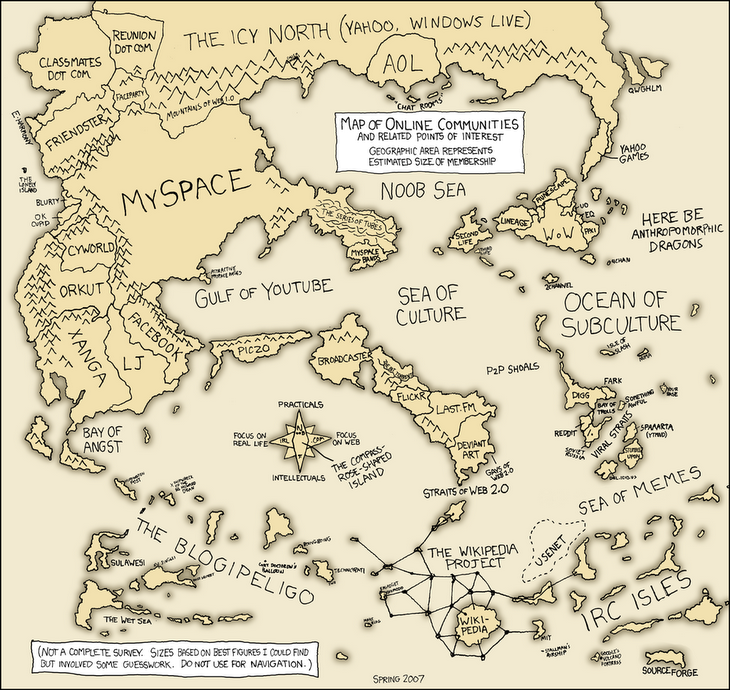
This is my final post on this blog, as I am excited to *finally* announce my transition to Wordpress on my own domain name- that would be JennyRyan.Net! Please update your bookmarks and your feed readers accordingly; the direct link to the blog is http://www.jennyryan.net/musings. I'm still in the process of manually copying posts over from this blog and my old iggli blog, due to inexplicable import failures, but I look forward to spending some time developing my website.
Future plans include:
-A cyberanthropologist's toolkit, replete with links to pertinent literature, blogs, academic programs and journals.
-Publishing some of my creative writing and poetry in hyperlinked-labyrinth form.
-Addendum chapters to my thesis, The Virtual Campfire, in which I will reflect upon: the uses of Facebook post-college; the role of Tribe.net in the formation and display of subcultural capital; and the role of social networking sites in the 2008 Presidential election.
-A collaborative web-based art project centered on connecting the art, music, and writing of talented friends and acquaintances, and potentially engendering new forms of creative expression in cyberspace.
I suppose it all still falls within the somewhat-undefined umbrella term "Webnography," but for now and as of late I have been merely musing. The only thing that ever remains the same, is my name.
Chameleon-ly Yours,
Jenny Ryan (.net!)
Showing posts with label cyberanthropology. Show all posts
Showing posts with label cyberanthropology. Show all posts
August 6, 2008


July 4, 2008
In Pursuit of the Bonfire
From the mid-19th century California Gold Rush to the turn-of-the-20th century cinematic fame of Hollywood, the furthest-west segment of the United States has inherited the legacy of the New Frontier. Today, the San Francisco Bay Area serves as the nexus of American utopianism, home of Silicon Valley and the dot-com frenzy, haven for hippies new and old.
I seek not to conclude my research of online social networking, but to extend its implications and apply it toward understanding the interconnected mysteries that keep me captivated by anthropology. The literature of cyberspace has quite literally predicted the future now within which we are currently living. The first step, then, is to become familiar with this literature, ranging from science fiction books and films to new ways of crafting contemporary folklore through the use of modern media technologies.
I've been chatting with James Curcio, author of Join My Cult! and, more recently, Fallen Nation. They're also on my summer reading list, and fit quite neatly into the literature I'm looking to submerge myself in (indeed, our chats have been a substantial part of the inspiration behind this post). I'm hoping to contribute to one of his new projects, Mythos Media, which seeks to produce contemporary myths in new ways through the use of new media. Thus, the second step is my own active participation in storycrafting, immersing myself in the mythology of the future-now and constructing parables utilizing new technologies.
From the open source culture of the Internet to the gift culture found at Burning Man and psytrance parties, the mythological legacy of California depicts all the essential dramaturgical elements: a paradisiacal land of angels and devils replete with struggles for power, legitimacy, and authenticity in an age where the world stands poised on the brink of apocalypse, anxiously awaiting salvation in the form of a charismatic prophet, a new world order, scientology, etc;
Or global consciousness.
The third and simultaneous step is a paper I am currently writing for an edited collection on psytrance culture, entitled Weaving the Underground Web: Neotribalism and Psytrance on Tribe.net.
Essentially, I'm building on the segments of my thesis that dealt with Tribe.net and subcultural capital theory, discussing the ways in which members of Tribe.net utilize the site as a facilitator of local scenes as well as a conduit for the spread of a global subculture.
The culture of the New Age (defined by Steven Sutcliffe [2003] as "a diffuse collectivity of questing individuals") circulates through the intersection of a wide array of beliefs and lifestyles that coalesce with the aid of such liminal spaces as the internet and international psytrance gatherings. Today, this mythology pervades in American popular media, which circulates readily on a global scale. Proper experience of this "global underground" is thus twofold, entailing both online ethnography of Tribe.net as well as adventures around the world- but that will probably have to wait until I find a Ph.D program suitable for this project. That would be step four.
Comments, suggestions, conversation welcome and encouraged.
I seek not to conclude my research of online social networking, but to extend its implications and apply it toward understanding the interconnected mysteries that keep me captivated by anthropology. The literature of cyberspace has quite literally predicted the future now within which we are currently living. The first step, then, is to become familiar with this literature, ranging from science fiction books and films to new ways of crafting contemporary folklore through the use of modern media technologies.
I've been chatting with James Curcio, author of Join My Cult! and, more recently, Fallen Nation. They're also on my summer reading list, and fit quite neatly into the literature I'm looking to submerge myself in (indeed, our chats have been a substantial part of the inspiration behind this post). I'm hoping to contribute to one of his new projects, Mythos Media, which seeks to produce contemporary myths in new ways through the use of new media. Thus, the second step is my own active participation in storycrafting, immersing myself in the mythology of the future-now and constructing parables utilizing new technologies.
From the open source culture of the Internet to the gift culture found at Burning Man and psytrance parties, the mythological legacy of California depicts all the essential dramaturgical elements: a paradisiacal land of angels and devils replete with struggles for power, legitimacy, and authenticity in an age where the world stands poised on the brink of apocalypse, anxiously awaiting salvation in the form of a charismatic prophet, a new world order, scientology, etc;
Or global consciousness.
The third and simultaneous step is a paper I am currently writing for an edited collection on psytrance culture, entitled Weaving the Underground Web: Neotribalism and Psytrance on Tribe.net.
Essentially, I'm building on the segments of my thesis that dealt with Tribe.net and subcultural capital theory, discussing the ways in which members of Tribe.net utilize the site as a facilitator of local scenes as well as a conduit for the spread of a global subculture.
The culture of the New Age (defined by Steven Sutcliffe [2003] as "a diffuse collectivity of questing individuals") circulates through the intersection of a wide array of beliefs and lifestyles that coalesce with the aid of such liminal spaces as the internet and international psytrance gatherings. Today, this mythology pervades in American popular media, which circulates readily on a global scale. Proper experience of this "global underground" is thus twofold, entailing both online ethnography of Tribe.net as well as adventures around the world- but that will probably have to wait until I find a Ph.D program suitable for this project. That would be step four.
Comments, suggestions, conversation welcome and encouraged.
May 20, 2008
The Virtual Campfire: An Ethnography of Online Social Networking [online]
I've been a bad blogger recently, and hardly a functional human being- this state of total liminality is both extraordinarily liberating and incredibly frustrating. I graduate on Sunday. If you would like to experience the fruits of my yearlong labors, I encourage you to check out the electronic version of my thesis, which I plan to add interactive features to in the future (I'm thinking more along the lines of a wiki than this rather average website). If you do read it, drop me a line and let me know what you think! I'm always eager to hear fresh perspectives and related stories.

A thesis submitted to the Faculty of Wesleyan University in partial fulfillment of the requirements for the degree of Master of Arts in Anthropology.
Based on five years of participant-observation on the social networking sites MySpace, Facebook, and Tribe.net, The Virtual Campfire explores the increasingly blurred boundaries between human and machine, public and private, voyeurism and exhibitionism, the history of media and our digitized future. Woven throughout are the stories and experiences of those who engage with these sites regularly and ritualistically, the generation of "digital natives" whose tales attest to the often strange and uncomfortable ways online social networking sites have come to be embedded in the everyday lives of American youth.
February 7, 2008
Hibernation and the Pursuit of Brilliance
This past month, I've sought to nourish myself through what is, for me, the most difficult period of the year. January. And I made it! I'm okay! And I've written a lot of things.
In fact, I was recently hired to join a team of bloggers, helping to create the "meat" of a pre-beta social networking site, iggli. You can check out my blog here, or by clicking on the title of this post. It's where I've been writing regularly these days. Original writing, at that.
Having shaken myself free from the noxious syndrome of reading "research" and creating headers beneath which I can conveniently categorize the perspectives of others into "anxieties" and "utopias", I have now reached what will be the butter on the bread of my thesis. That is, that which makes the dry foundation delicious. Not that ethnography is ever dry. My first chapters are rife with the stories, anecdotes, personalities, ideas that propelled me to do this research in the first place.
But now, allow me to be indulgent. I embark on a chapter I've hesitantly entitled "A Phenomenological Exploration of Online Social Networking." This is where I tell my own story, where I deeply investigate my own integration of anxieties toward and utopic visions of the Internet and its potentials and failures.
And everything else.
The past week has consisted of moving into a new apartment (where I will no longer bother touchy neighbors with my entirely nocturnal rhythm and proclivity toward human interaction and [god forbid!] music), sleeping 10-12 hours a night, and battling the obvious onset of ill health with my finest vegetarian cooking, isolation, and relaxation.
I sit before the screen now resolved to put forth a testimony founded on inner truths, desires, sadnesses, attempts to bridge the increasing divide I see between individuals and community. The Internet, for me, is the "final frontier" in which we may remake ourselves, and in so doing, contribute to the remaking of this severely damaged world.
Though, as severely damaged as it is, it is because of my overwhelming love of the stories, personalities, and lives of others that I have become so enamored with the potential for anthropological research to promote human understanding, empathy, and that elusive yet all-empowering ultimate pursuit: community, connection, the sense of belonging and the extension of selfhood.
This has been a manifesto.
In fact, I was recently hired to join a team of bloggers, helping to create the "meat" of a pre-beta social networking site, iggli. You can check out my blog here, or by clicking on the title of this post. It's where I've been writing regularly these days. Original writing, at that.
Having shaken myself free from the noxious syndrome of reading "research" and creating headers beneath which I can conveniently categorize the perspectives of others into "anxieties" and "utopias", I have now reached what will be the butter on the bread of my thesis. That is, that which makes the dry foundation delicious. Not that ethnography is ever dry. My first chapters are rife with the stories, anecdotes, personalities, ideas that propelled me to do this research in the first place.
But now, allow me to be indulgent. I embark on a chapter I've hesitantly entitled "A Phenomenological Exploration of Online Social Networking." This is where I tell my own story, where I deeply investigate my own integration of anxieties toward and utopic visions of the Internet and its potentials and failures.
And everything else.
The past week has consisted of moving into a new apartment (where I will no longer bother touchy neighbors with my entirely nocturnal rhythm and proclivity toward human interaction and [god forbid!] music), sleeping 10-12 hours a night, and battling the obvious onset of ill health with my finest vegetarian cooking, isolation, and relaxation.
I sit before the screen now resolved to put forth a testimony founded on inner truths, desires, sadnesses, attempts to bridge the increasing divide I see between individuals and community. The Internet, for me, is the "final frontier" in which we may remake ourselves, and in so doing, contribute to the remaking of this severely damaged world.
Though, as severely damaged as it is, it is because of my overwhelming love of the stories, personalities, and lives of others that I have become so enamored with the potential for anthropological research to promote human understanding, empathy, and that elusive yet all-empowering ultimate pursuit: community, connection, the sense of belonging and the extension of selfhood.
This has been a manifesto.
August 18, 2007
On Technoshamans and the Rise of Neotribalism
Asked to attempt a summation of the online social networking community known as tribe.net, I have taken to replying with the single phrase, "technoshamanism". It seems the word has not yet been taken up by many, so I'll attempt a definition here.
(For a little background information, you'd be keen to check out a term project I worked on for my Anthropology of Dance class, entitled "The Trance Dance Experience".)
A technoshaman is one who integrates modern technology into primordial practices in order to induce transcendent experiences. Now, such a description evokes remnants of that anthropological black mark- the noble savage- and thus I proceed with caution, unwilling to romanticize:
Technoshamanism seeks to rediscover the roots of human experience while utilizing modern tools. Such tools can range from repetitive electronic music, to synthetic drugs, to new technologies such as biofeedback. The states thus induced might range from supersensory to meditative. Modern "rave" culture (and I use this term with caution as well, for the rave scene has become inundated by the mainstream, thus necessitating an emergent subculture(s)) incorporates just such tools to achieve just such states, and where site and ideology merge, we have our subculture.
Regardless of terminology, the essence of such subcultures is the pursuit of the collective unconscious, consciously realized and enacted. When I say "neotribal," I refer to the tribal experience as it is recreated in the modern day. Safe spaces are created through collective artistic action; drugs consumed that serve to enhance feelings of empathy, community, clairvoyance, and/or transcendence; music played that serves to enhance said feelings and provide the collective pulse. This occurs with varying degrees of success, depending on whether individuals collaborate effectively to achieve the same goals.
The Internet is, quite naturally, one of those modern technologies that is utilized by technoshamans as a means of tapping into the collective neural network. As it exists apart (or, at the very least, disjointed) from time and space, the shape and texture of the Internet resembles that of technoshamanism itself. That's all I've got for now.
(For a little background information, you'd be keen to check out a term project I worked on for my Anthropology of Dance class, entitled "The Trance Dance Experience".)
A technoshaman is one who integrates modern technology into primordial practices in order to induce transcendent experiences. Now, such a description evokes remnants of that anthropological black mark- the noble savage- and thus I proceed with caution, unwilling to romanticize:
Technoshamanism seeks to rediscover the roots of human experience while utilizing modern tools. Such tools can range from repetitive electronic music, to synthetic drugs, to new technologies such as biofeedback. The states thus induced might range from supersensory to meditative. Modern "rave" culture (and I use this term with caution as well, for the rave scene has become inundated by the mainstream, thus necessitating an emergent subculture(s)) incorporates just such tools to achieve just such states, and where site and ideology merge, we have our subculture.
Regardless of terminology, the essence of such subcultures is the pursuit of the collective unconscious, consciously realized and enacted. When I say "neotribal," I refer to the tribal experience as it is recreated in the modern day. Safe spaces are created through collective artistic action; drugs consumed that serve to enhance feelings of empathy, community, clairvoyance, and/or transcendence; music played that serves to enhance said feelings and provide the collective pulse. This occurs with varying degrees of success, depending on whether individuals collaborate effectively to achieve the same goals.
The Internet is, quite naturally, one of those modern technologies that is utilized by technoshamans as a means of tapping into the collective neural network. As it exists apart (or, at the very least, disjointed) from time and space, the shape and texture of the Internet resembles that of technoshamanism itself. That's all I've got for now.
March 3, 2007
Research Proposal
Introduction
In the past 20 years, the Internet has become increasingly populated by a variety of new sorts of communities and forms of communication. This phenomenon has resulted in the formation of groups of dispersed peoples coming together on the basis of common interests, agendas, and the exchange of information. Through participant-observation, case study, textual/linguistic analysis, and interview methods, I will be examining the experiences of those involved in these communities, including my own involvement. In particular, I am interested in how these communities define themselves, if they are indeed communities (or something else altogether), and how individuals represent their identities and exhibit social and cultural capital within the virtual arena coined “cyberspace”. Furthermore, I am drawn to investigate the implications of online communities for contextualized identities, as well as the influence of cultural and linguistic differences in online interactions.
Background
Virtual communities are represented in myriad ways, and I plan to make the following my main sites of research: online social networking sites, in particular MySpace, the Facebook, and Tribe.net, and online blogging communities such as LiveJournal and Blogspot. I am seeking to explore these communities as cultural products, enriched through new and underresearched communication practices and identity representations. However, the advent of social networking sites such as MySpace and Facebook, as well as new social media (such as photo- and video-sharing tools) has resulted in a mainstreaming of virtual community membership that is increasingly tied to daily life. This is further complicated by the ever-increasing visibility of corporations and consumerism in popular sites, particularly MySpace. The sociocultural impact of these technologies on everyday life will be examined, as well as the blurred line between functional and social uses of Internet communities. Furthermore, how does access to these social technologies, and the status symbols conveyed by their possession, contribute to social and cultural capital? While popular conceptions and trends concerning online communities will be explored, I am particularly interested in the ways in which marginal groups are formed and sustained online, and how status is construed.
The development of online social networking has allowed for the creation of virtual communities that transcend spatial and physical limitations, often in creative and uninhibited ways. How do virtual environments allow for these types of spontaneous community creation? Victor Turner discussed how the flexibility and mobility of modern industrial culture increases the chances for spontaneous community formation that can occur “both in and out of time”. In this state of liminality, then, people are freed from their ordinary social roles, allowing for new and emergent states of knowing and being known. How others negotiate this freedom from physical markers of identity is a key area of my research. Turner’s notions of liminality in the context of Internet communities are to be complicated by the tendency to archive social information, as exhibited through the popularization of visual media and blogging in the online communities I will be investigating.
Some studies have shown that Internet use is positively correlated with feelings of social alienation (Kim & Kim; Wellman et al.). Howard Rheingold, who coined the term “virtual community” in 1993, sought to debunk the critique that virtual communities are alienating and superficial through a discussion of the merits of both strong and weak social ties in the formation of identity and knowledge. While strong familial and friendship relationships are important for emotional support and self-identity, a network of more superficial relationships serves to increase one’s social capital and capacity to get things done. A study by Wellman and Haythornthwaite found that those who were active offline were also more active online, further contesting the hypothesis that Internet use has a causal relationship to introversion and social alienation. I seek to complicate this issue through exploring the ways in which virtual communities are changing the nature of communication in everyday life, granting new forms of agency to the individual user at the expense of publicizing social information.
Mobile communication as a modern phenomenon extends beyond the Internet. In a collection of essays titled Perpetual Contact: Mobile Communication, Private Talk, Public Performance, Kenneth Gergen discussed the “challenge of absent presence” in the context of new mobile communication technologies. He emphasized the power of monologic technologies that provide information but cannot be directly spoken with. I seek to understand this problem through investigation into the role of the Internet in providing new ways for users to engage in dialogue about information. How has technology affected the ways in which people understand time and their ability to control (or be rendered powerless in the face of) the consumption of information? Much of my past research has reflected a desire of individuals for creating and controlling “safe spaces” and personal niches within the virtual arena, thus weeding out irrelevant information. It is evident that deeper investigation into the psychological, social and cultural effects of modern social technologies is warranted, given the problematic discourse that arises from these phenomena.
Method
Multiple forms of ethnography will be explored in this research. Throughout the course of the next year, I will be immersing myself in the online communities previously mentioned, while also recording and engaging with the everyday discourse concerning virtual communication. In exploring the immensely popular social networking site MySpace, a case study analysis of an informant deeply absorbed in the community will illuminate the complex emotional nature of mediated communication as one individual’s foundation of social interaction. This informant has engaged with MySpace as a primary mode of social interaction for the past five years, and can thus provide insight into the evolution of virtual communication.
With regard to the Facebook, I will be exploring its social impact on the Wesleyan community through in-depth, face-to-face interviews and participant-observation, allowing me to also analyze the role this site plays in community gossip and group affiliation. As one interviewee described, “you don’t exist if you’re not on the Facebook”. I seek to understand the Facebook through the ways in which people attach particular values to various qualities pertinent to individual and group identities, ways of communicating, and the myriad ways in which Facebook users project their own identities through the use of irony, playfulness, and the flaunting of cultural capital.
Tribe.net is a fascinating setting for exploring the globalizing nature of online social networks. Thus far, I have befriended a dozen individuals from across the globe: Romania, Morocco, Brazil, and Spain (to name a few). How do individuals from so many different cultures find common ground through computer-mediated communication? Research by R.D. Laing points out the fact that the United States constitutes over 50% of the Internet user population. How is virtual communication conceptualized in other cultures? Another point of interest is the concept of neo-tribalism prevalent amongst Tribe members. As a response to the perceived “society of strangers” propagated by modern industrial societies, some believe that it is necessary to establish a global network of connected tribes that interact cooperatively, and see Tribe.net as one means of establishing a “neo-tribal” society. Participant observation, e-mail correspondence, and online interviews will be my primary methods of inquiry, as well as promoting dialogue on group message boards.
Online diary communities will be textually analyzed, and it is here that I seek to further engage with issues of language and self-presentation. Motivations for publicizing the private will be examined using both in-person and online interview methods. Also of interest is the nature of anonymity within the context of online diary communities, such as the Wesleyan Anonymous Confession Board, and how anonymous social gossip is interpreted and analyzed in everyday discourse. The allure of gossip obtained anonymously through the often concealed practice of Internet surveillance will be explored through in-person interviews with various members of the Wesleyan community.
Ethics
On a final note, the practice of online ethnography raises ethical issues that must be confronted in the process of my research. A common concern is the fact that some Internet users perceive some publically accessible spaces as private. Also of issue is the rapidly evolving nature of the Internet, which renders much of observed data transient. In confronting these issues, every effort will be made to protect the anonymity of participants through paraphrasing and pseudonyms. In some cases, such as data garnered through online diary sites, consent from the participant will be requested. With consideration to the transient nature of virtual discourse, this ethnographic study will be situated in time and with respect to changing conditions within the sites and as portrayed through popular media. I am seeking to tell the stories of and explore the issues and concerns raised by my research participants. Above all, the autonomy of the individuals portrayed in this ethnography will be acknowledged with empathy and care.
In the past 20 years, the Internet has become increasingly populated by a variety of new sorts of communities and forms of communication. This phenomenon has resulted in the formation of groups of dispersed peoples coming together on the basis of common interests, agendas, and the exchange of information. Through participant-observation, case study, textual/linguistic analysis, and interview methods, I will be examining the experiences of those involved in these communities, including my own involvement. In particular, I am interested in how these communities define themselves, if they are indeed communities (or something else altogether), and how individuals represent their identities and exhibit social and cultural capital within the virtual arena coined “cyberspace”. Furthermore, I am drawn to investigate the implications of online communities for contextualized identities, as well as the influence of cultural and linguistic differences in online interactions.
Background
Virtual communities are represented in myriad ways, and I plan to make the following my main sites of research: online social networking sites, in particular MySpace, the Facebook, and Tribe.net, and online blogging communities such as LiveJournal and Blogspot. I am seeking to explore these communities as cultural products, enriched through new and underresearched communication practices and identity representations. However, the advent of social networking sites such as MySpace and Facebook, as well as new social media (such as photo- and video-sharing tools) has resulted in a mainstreaming of virtual community membership that is increasingly tied to daily life. This is further complicated by the ever-increasing visibility of corporations and consumerism in popular sites, particularly MySpace. The sociocultural impact of these technologies on everyday life will be examined, as well as the blurred line between functional and social uses of Internet communities. Furthermore, how does access to these social technologies, and the status symbols conveyed by their possession, contribute to social and cultural capital? While popular conceptions and trends concerning online communities will be explored, I am particularly interested in the ways in which marginal groups are formed and sustained online, and how status is construed.
The development of online social networking has allowed for the creation of virtual communities that transcend spatial and physical limitations, often in creative and uninhibited ways. How do virtual environments allow for these types of spontaneous community creation? Victor Turner discussed how the flexibility and mobility of modern industrial culture increases the chances for spontaneous community formation that can occur “both in and out of time”. In this state of liminality, then, people are freed from their ordinary social roles, allowing for new and emergent states of knowing and being known. How others negotiate this freedom from physical markers of identity is a key area of my research. Turner’s notions of liminality in the context of Internet communities are to be complicated by the tendency to archive social information, as exhibited through the popularization of visual media and blogging in the online communities I will be investigating.
Some studies have shown that Internet use is positively correlated with feelings of social alienation (Kim & Kim; Wellman et al.). Howard Rheingold, who coined the term “virtual community” in 1993, sought to debunk the critique that virtual communities are alienating and superficial through a discussion of the merits of both strong and weak social ties in the formation of identity and knowledge. While strong familial and friendship relationships are important for emotional support and self-identity, a network of more superficial relationships serves to increase one’s social capital and capacity to get things done. A study by Wellman and Haythornthwaite found that those who were active offline were also more active online, further contesting the hypothesis that Internet use has a causal relationship to introversion and social alienation. I seek to complicate this issue through exploring the ways in which virtual communities are changing the nature of communication in everyday life, granting new forms of agency to the individual user at the expense of publicizing social information.
Mobile communication as a modern phenomenon extends beyond the Internet. In a collection of essays titled Perpetual Contact: Mobile Communication, Private Talk, Public Performance, Kenneth Gergen discussed the “challenge of absent presence” in the context of new mobile communication technologies. He emphasized the power of monologic technologies that provide information but cannot be directly spoken with. I seek to understand this problem through investigation into the role of the Internet in providing new ways for users to engage in dialogue about information. How has technology affected the ways in which people understand time and their ability to control (or be rendered powerless in the face of) the consumption of information? Much of my past research has reflected a desire of individuals for creating and controlling “safe spaces” and personal niches within the virtual arena, thus weeding out irrelevant information. It is evident that deeper investigation into the psychological, social and cultural effects of modern social technologies is warranted, given the problematic discourse that arises from these phenomena.
Method
Multiple forms of ethnography will be explored in this research. Throughout the course of the next year, I will be immersing myself in the online communities previously mentioned, while also recording and engaging with the everyday discourse concerning virtual communication. In exploring the immensely popular social networking site MySpace, a case study analysis of an informant deeply absorbed in the community will illuminate the complex emotional nature of mediated communication as one individual’s foundation of social interaction. This informant has engaged with MySpace as a primary mode of social interaction for the past five years, and can thus provide insight into the evolution of virtual communication.
With regard to the Facebook, I will be exploring its social impact on the Wesleyan community through in-depth, face-to-face interviews and participant-observation, allowing me to also analyze the role this site plays in community gossip and group affiliation. As one interviewee described, “you don’t exist if you’re not on the Facebook”. I seek to understand the Facebook through the ways in which people attach particular values to various qualities pertinent to individual and group identities, ways of communicating, and the myriad ways in which Facebook users project their own identities through the use of irony, playfulness, and the flaunting of cultural capital.
Tribe.net is a fascinating setting for exploring the globalizing nature of online social networks. Thus far, I have befriended a dozen individuals from across the globe: Romania, Morocco, Brazil, and Spain (to name a few). How do individuals from so many different cultures find common ground through computer-mediated communication? Research by R.D. Laing points out the fact that the United States constitutes over 50% of the Internet user population. How is virtual communication conceptualized in other cultures? Another point of interest is the concept of neo-tribalism prevalent amongst Tribe members. As a response to the perceived “society of strangers” propagated by modern industrial societies, some believe that it is necessary to establish a global network of connected tribes that interact cooperatively, and see Tribe.net as one means of establishing a “neo-tribal” society. Participant observation, e-mail correspondence, and online interviews will be my primary methods of inquiry, as well as promoting dialogue on group message boards.
Online diary communities will be textually analyzed, and it is here that I seek to further engage with issues of language and self-presentation. Motivations for publicizing the private will be examined using both in-person and online interview methods. Also of interest is the nature of anonymity within the context of online diary communities, such as the Wesleyan Anonymous Confession Board, and how anonymous social gossip is interpreted and analyzed in everyday discourse. The allure of gossip obtained anonymously through the often concealed practice of Internet surveillance will be explored through in-person interviews with various members of the Wesleyan community.
Ethics
On a final note, the practice of online ethnography raises ethical issues that must be confronted in the process of my research. A common concern is the fact that some Internet users perceive some publically accessible spaces as private. Also of issue is the rapidly evolving nature of the Internet, which renders much of observed data transient. In confronting these issues, every effort will be made to protect the anonymity of participants through paraphrasing and pseudonyms. In some cases, such as data garnered through online diary sites, consent from the participant will be requested. With consideration to the transient nature of virtual discourse, this ethnographic study will be situated in time and with respect to changing conditions within the sites and as portrayed through popular media. I am seeking to tell the stories of and explore the issues and concerns raised by my research participants. Above all, the autonomy of the individuals portrayed in this ethnography will be acknowledged with empathy and care.
Subscribe to:
Posts (Atom)


 Posts
Posts