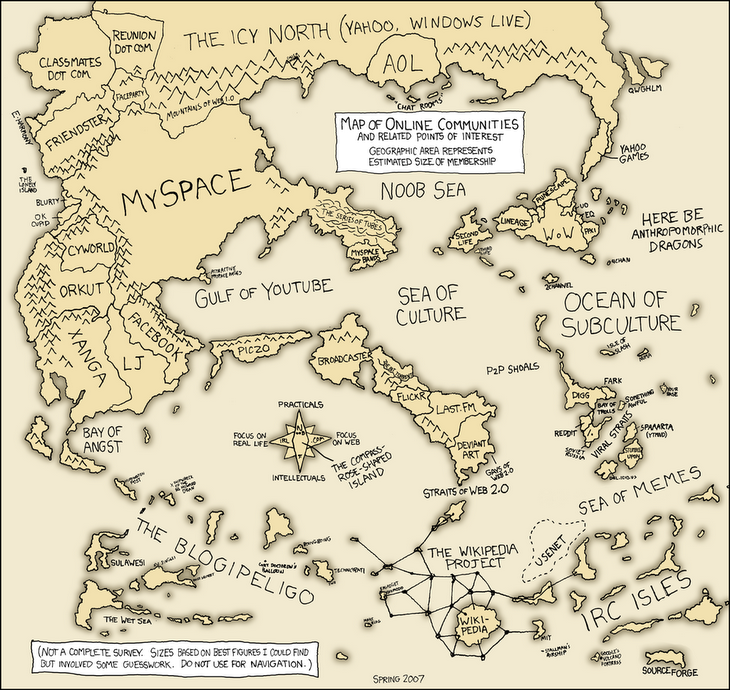
From the mid-19th century California Gold Rush to the turn-of-the-20th century cinematic fame of Hollywood, the furthest-west segment of the United States has inherited the legacy of the New Frontier. Today, the San Francisco Bay Area serves as the nexus of American utopianism, home of Silicon Valley and the dot-com frenzy, haven for hippies new and old.
I seek not to conclude my research of online social networking, but to extend its implications and apply it toward understanding the interconnected mysteries that keep me captivated by anthropology. The literature of cyberspace has quite literally predicted the future now within which we are currently living. The first step, then, is to become familiar with this literature, ranging from science fiction books and films to new ways of crafting contemporary folklore through the use of modern media technologies.
I've been chatting with James Curcio, author of Join My Cult! and, more recently, Fallen Nation. They're also on my summer reading list, and fit quite neatly into the literature I'm looking to submerge myself in (indeed, our chats have been a substantial part of the inspiration behind this post). I'm hoping to contribute to one of his new projects, Mythos Media, which seeks to produce contemporary myths in new ways through the use of new media. Thus, the second step is my own active participation in storycrafting, immersing myself in the mythology of the future-now and constructing parables utilizing new technologies.
From the open source culture of the Internet to the gift culture found at Burning Man and psytrance parties, the mythological legacy of California depicts all the essential dramaturgical elements: a paradisiacal land of angels and devils replete with struggles for power, legitimacy, and authenticity in an age where the world stands poised on the brink of apocalypse, anxiously awaiting salvation in the form of a charismatic prophet, a new world order, scientology, etc;
Or global consciousness.
The third and simultaneous step is a paper I am currently writing for an edited collection on psytrance culture, entitled Weaving the Underground Web: Neotribalism and Psytrance on Tribe.net.
Essentially, I'm building on the segments of my thesis that dealt with Tribe.net and subcultural capital theory, discussing the ways in which members of Tribe.net utilize the site as a facilitator of local scenes as well as a conduit for the spread of a global subculture.
The culture of the New Age (defined by Steven Sutcliffe [2003] as "a diffuse collectivity of questing individuals") circulates through the intersection of a wide array of beliefs and lifestyles that coalesce with the aid of such liminal spaces as the internet and international psytrance gatherings. Today, this mythology pervades in American popular media, which circulates readily on a global scale. Proper experience of this "global underground" is thus twofold, entailing both online ethnography of Tribe.net as well as adventures around the world- but that will probably have to wait until I find a Ph.D program suitable for this project. That would be step four.
Comments, suggestions, conversation welcome and encouraged.
Showing posts with label research methods. Show all posts
Showing posts with label research methods. Show all posts
July 4, 2008


February 7, 2008
Hibernation and the Pursuit of Brilliance
This past month, I've sought to nourish myself through what is, for me, the most difficult period of the year. January. And I made it! I'm okay! And I've written a lot of things.
In fact, I was recently hired to join a team of bloggers, helping to create the "meat" of a pre-beta social networking site, iggli. You can check out my blog here, or by clicking on the title of this post. It's where I've been writing regularly these days. Original writing, at that.
Having shaken myself free from the noxious syndrome of reading "research" and creating headers beneath which I can conveniently categorize the perspectives of others into "anxieties" and "utopias", I have now reached what will be the butter on the bread of my thesis. That is, that which makes the dry foundation delicious. Not that ethnography is ever dry. My first chapters are rife with the stories, anecdotes, personalities, ideas that propelled me to do this research in the first place.
But now, allow me to be indulgent. I embark on a chapter I've hesitantly entitled "A Phenomenological Exploration of Online Social Networking." This is where I tell my own story, where I deeply investigate my own integration of anxieties toward and utopic visions of the Internet and its potentials and failures.
And everything else.
The past week has consisted of moving into a new apartment (where I will no longer bother touchy neighbors with my entirely nocturnal rhythm and proclivity toward human interaction and [god forbid!] music), sleeping 10-12 hours a night, and battling the obvious onset of ill health with my finest vegetarian cooking, isolation, and relaxation.
I sit before the screen now resolved to put forth a testimony founded on inner truths, desires, sadnesses, attempts to bridge the increasing divide I see between individuals and community. The Internet, for me, is the "final frontier" in which we may remake ourselves, and in so doing, contribute to the remaking of this severely damaged world.
Though, as severely damaged as it is, it is because of my overwhelming love of the stories, personalities, and lives of others that I have become so enamored with the potential for anthropological research to promote human understanding, empathy, and that elusive yet all-empowering ultimate pursuit: community, connection, the sense of belonging and the extension of selfhood.
This has been a manifesto.
In fact, I was recently hired to join a team of bloggers, helping to create the "meat" of a pre-beta social networking site, iggli. You can check out my blog here, or by clicking on the title of this post. It's where I've been writing regularly these days. Original writing, at that.
Having shaken myself free from the noxious syndrome of reading "research" and creating headers beneath which I can conveniently categorize the perspectives of others into "anxieties" and "utopias", I have now reached what will be the butter on the bread of my thesis. That is, that which makes the dry foundation delicious. Not that ethnography is ever dry. My first chapters are rife with the stories, anecdotes, personalities, ideas that propelled me to do this research in the first place.
But now, allow me to be indulgent. I embark on a chapter I've hesitantly entitled "A Phenomenological Exploration of Online Social Networking." This is where I tell my own story, where I deeply investigate my own integration of anxieties toward and utopic visions of the Internet and its potentials and failures.
And everything else.
The past week has consisted of moving into a new apartment (where I will no longer bother touchy neighbors with my entirely nocturnal rhythm and proclivity toward human interaction and [god forbid!] music), sleeping 10-12 hours a night, and battling the obvious onset of ill health with my finest vegetarian cooking, isolation, and relaxation.
I sit before the screen now resolved to put forth a testimony founded on inner truths, desires, sadnesses, attempts to bridge the increasing divide I see between individuals and community. The Internet, for me, is the "final frontier" in which we may remake ourselves, and in so doing, contribute to the remaking of this severely damaged world.
Though, as severely damaged as it is, it is because of my overwhelming love of the stories, personalities, and lives of others that I have become so enamored with the potential for anthropological research to promote human understanding, empathy, and that elusive yet all-empowering ultimate pursuit: community, connection, the sense of belonging and the extension of selfhood.
This has been a manifesto.
November 26, 2007
Emergence for an Update
The past six weeks have been spent throwing myself into the writing of my thesis. Currently, I have 53 pages of solid writing, and in the process have discovered an emergent structure that belies that which I'd previously been naively imposing on myself. It has become clear to me that I am able to provide a kind of phenomenological perspective that is notably absent from much of the preexisting literature on computer-mediated communication, generally, and online social networks, particularly.
I have found a lot of journalism, a lot of psychology, a lot of sociology, and various intersections of the three. Don't get me wrong, there is some great research out there, but the vast majority is either biased to some degree (not that there is such a thing as being unbiased, but that's a whole other post) or somewhat dehumanizing, Anthropology, in contrast, is the analysis of individual voices and perspectives that make up webs of meaning and power. Humanism and science spring forth and coalesce! But I digress: in tandem with the written thesis, I am also creating a website. A website that is both a blog (this blog) as well as a wiki, so as to better articulate a) my personal ethnographic and research process, and b) the various media sources involved in the construction of my knowledge (images, blogs, videos, online articles, public forums, the sites themselves, etc;).
By the way, if anyone reading this has any career advice, throw me a bone!
I have found a lot of journalism, a lot of psychology, a lot of sociology, and various intersections of the three. Don't get me wrong, there is some great research out there, but the vast majority is either biased to some degree (not that there is such a thing as being unbiased, but that's a whole other post) or somewhat dehumanizing, Anthropology, in contrast, is the analysis of individual voices and perspectives that make up webs of meaning and power. Humanism and science spring forth and coalesce! But I digress: in tandem with the written thesis, I am also creating a website. A website that is both a blog (this blog) as well as a wiki, so as to better articulate a) my personal ethnographic and research process, and b) the various media sources involved in the construction of my knowledge (images, blogs, videos, online articles, public forums, the sites themselves, etc;).
By the way, if anyone reading this has any career advice, throw me a bone!
August 10, 2007
Reflections on Methodology
Even the acknowledgment, as requisite as it is in the field of anthropology, of the problematic nature of representing the "other" (ethnocentrism, racism, colonialism, imperialism, etc;) has become tired, stationary, and ultimately beleaguered by jargon. I seek the active creation of an ethnography both by and for the people- accessible as an inspired, collaborative story-telling. Such an endeavor thus expands the reach of information, rather than folding in upon itself in the mobius strip of academia.
Have I simply made a case for irresponsible, decontextualized ethnogaphy? The feminist concern with being "spoken for" by the dominant underlies my desire to closely examine a cultural form I can safely call my own. My autoethnography is, or so I hope, supplemented and lent legitimacy in the sharing of it, and in the incorporation of myriad perspectives.
Your comments would be much appreciated.
Have I simply made a case for irresponsible, decontextualized ethnogaphy? The feminist concern with being "spoken for" by the dominant underlies my desire to closely examine a cultural form I can safely call my own. My autoethnography is, or so I hope, supplemented and lent legitimacy in the sharing of it, and in the incorporation of myriad perspectives.
Your comments would be much appreciated.
April 18, 2007
Lit Review: Managing Visibility, Intimacy, and Focus in Online Critical Ethnography (LeBesco)
Focus: Studying communication about fat identification (on the Internet).
Method: Downloaded posts and threads, participated in the community, made community aware of her status as researcher.
Theory: Critical ethnographic approach that sought to challenge mainstream political and social discourse about fat bodies.
Points of Consideration: Changes in embodiment allowed for by the use of technology; alternative model of personhood (observing communicative processes and social interaction, as opposed to individualistic narratives); the "cybernetic shape of information technologies" as a political arena.
Questions Raised: How are bodies and identities "policed" in internet forums? How does the design of Internet space affect deployments of power?
---
Many of those with whom I've discussed the political and cultural potential of the internet believe that the lack of face-to-face interaction renders individuals essentially isolated. However, is it not possible that meaning can be created irrespective of time and space? That you or I could psychically connect through the sharing of information and ideas across immense distances?
Identity projection, or "egocasting" (see Christine Rosen), allows for an enormous amount of social creativity and identity play. In this arena, the body exists apart from the mind- a condition which may be extraordinarily appealing for those who undergo consistent prejudice and discrimination instigated by their physical forms.
Method: Downloaded posts and threads, participated in the community, made community aware of her status as researcher.
Theory: Critical ethnographic approach that sought to challenge mainstream political and social discourse about fat bodies.
Points of Consideration: Changes in embodiment allowed for by the use of technology; alternative model of personhood (observing communicative processes and social interaction, as opposed to individualistic narratives); the "cybernetic shape of information technologies" as a political arena.
Questions Raised: How are bodies and identities "policed" in internet forums? How does the design of Internet space affect deployments of power?
---
Many of those with whom I've discussed the political and cultural potential of the internet believe that the lack of face-to-face interaction renders individuals essentially isolated. However, is it not possible that meaning can be created irrespective of time and space? That you or I could psychically connect through the sharing of information and ideas across immense distances?
Identity projection, or "egocasting" (see Christine Rosen), allows for an enormous amount of social creativity and identity play. In this arena, the body exists apart from the mind- a condition which may be extraordinarily appealing for those who undergo consistent prejudice and discrimination instigated by their physical forms.
April 15, 2007
Lit Review: "Seeing and Sensing" Online Interaction: An Interpretive Interactionist Approach to USENET Support Group Research (Walstrom)
A third-person observation cannot uncover the invisible bonds of connection that motivate people to interact with and feel responsible toward one another, particularly in sensitive cases in which anonymity can provide the comfort needed to become uninhibited with others, such as support groups. Traditional ethnographic methods may work for some online groups, but an interpretive interactive approach of forming an emotional connection to the participant may be essential to understanding her processes of sense-making.
In this study, the researcher was obliged to also have undergone the experiences of those in specific support groups, allowing both a third- and second-person position (analyst and participant-experiencer). Her own participation in an eating disorders support group yielded three central tenets: the formation of a public, group narrative to serve as a collective resource, discursive practices such as politeness to serve as protection of individual/group face, and the co-construction of eating disorder identities.
Social Constructionism: "the self-other dimension of interaction"- all cultural meanings are co-constructed.
Rhetorical-responsive Approach: Seeking understandings of "living utterances"
Interpretive Interactionism: Attending to the everyday experiences (feelings, actions, meanings) of interacting individuals.
-Researchers must make interpretive processes as public as they can, as well as the multiple methods employed.
-Micro-level: Local meanings to illuminate the inner lives of partipcipants.
-Macro-level: Connecting these micro-lvel findings to the poicies or institutions that can affect them.
-Rejects generalizations, positivism
In this study, the mainstream discourse of objectifying, pathologizing, and trivializing the experience of those suffering from eating disorders is problematized by fully representing the visceral experiences, competencies, and emotions through an interpretive interactionist approach. The approach was also feminist in nature, contesting the scientific discourse for its inability to recognize the authority of women in describing their own experiences. This merging of methodological approaches enhances the rigor by expanding the scope of inquiry into shared experiences.
Grounded Theory: Locating a core category for organizing the vast numbers of responses generated by a group and coding the actions and experiences in written accounts. For example- a category used in this study was the frequent and systematic tendency to personify the eating disorders ("the monster within"). This tendency can be invoked in a variety of situations, which were also coded (eg; introduction, ephiphany, cry for help). Can reveal much about the co-construction of identity.
Conversational Analysis: Noting what is displayed as salient in the structure of one's talk. Some things that are examined are the rules governing turn-taking, normative responses, use of genre (public narrative)
Discourse Analysis: Includes critical discourse analysis- critique of the hegemonic and institutional forces at work in local interactions. Also self-other positionings, responses to emotionally-charged displays.
Online Interpretive Interactionist Approach
-Self-presentation at introduction of link to group, sharing the dilemma/discourse.
-A feminist communitarian approach reflects the researcher's shared emotionality with paritcipants, research that will make a difference.
-Benefits: 1. representing participants' own voices validated their perspective, 2. thick description of shared problematic experiences enhances self-understandings, 3. critique of dominant discourses that affect the participants' potential for change.
----
Unlike this study, I am not seeking to uncover particularly sensitive issues. I am interested, however, in the formation of relationships with participants in order to understand more empathically, as well as challenge dominant discourses (such as predator threats, grand delusions of privacy, inability for computer-mediated communication to evoke tangible responses/form true social bonds, meeting of strangers, etc;). It will be important to examine the priority that individuals themselves place on online interactions, thus the first segment of my methodology will involve asking participants to articulate their own experiences in written accounts (through internet-based surveys). The accumulation of a large quantity of written data will serve my aim in categorizing experiences through the lens of public narratives and shared emotional displays.
Also, rather than "recruiting" subjects, I will be posting information about the study, as well as a link to the online survey(s) on public message forums, through which individuals will be self-motivated to participate. In addition, I will be evoking an interactionist approach through engagement with others in public dialogue spaces, such as message boards and group forums.
In this study, the researcher was obliged to also have undergone the experiences of those in specific support groups, allowing both a third- and second-person position (analyst and participant-experiencer). Her own participation in an eating disorders support group yielded three central tenets: the formation of a public, group narrative to serve as a collective resource, discursive practices such as politeness to serve as protection of individual/group face, and the co-construction of eating disorder identities.
Social Constructionism: "the self-other dimension of interaction"- all cultural meanings are co-constructed.
Rhetorical-responsive Approach: Seeking understandings of "living utterances"
Interpretive Interactionism: Attending to the everyday experiences (feelings, actions, meanings) of interacting individuals.
-Researchers must make interpretive processes as public as they can, as well as the multiple methods employed.
-Micro-level: Local meanings to illuminate the inner lives of partipcipants.
-Macro-level: Connecting these micro-lvel findings to the poicies or institutions that can affect them.
-Rejects generalizations, positivism
In this study, the mainstream discourse of objectifying, pathologizing, and trivializing the experience of those suffering from eating disorders is problematized by fully representing the visceral experiences, competencies, and emotions through an interpretive interactionist approach. The approach was also feminist in nature, contesting the scientific discourse for its inability to recognize the authority of women in describing their own experiences. This merging of methodological approaches enhances the rigor by expanding the scope of inquiry into shared experiences.
Grounded Theory: Locating a core category for organizing the vast numbers of responses generated by a group and coding the actions and experiences in written accounts. For example- a category used in this study was the frequent and systematic tendency to personify the eating disorders ("the monster within"). This tendency can be invoked in a variety of situations, which were also coded (eg; introduction, ephiphany, cry for help). Can reveal much about the co-construction of identity.
Conversational Analysis: Noting what is displayed as salient in the structure of one's talk. Some things that are examined are the rules governing turn-taking, normative responses, use of genre (public narrative)
Discourse Analysis: Includes critical discourse analysis- critique of the hegemonic and institutional forces at work in local interactions. Also self-other positionings, responses to emotionally-charged displays.
Online Interpretive Interactionist Approach
-Self-presentation at introduction of link to group, sharing the dilemma/discourse.
-A feminist communitarian approach reflects the researcher's shared emotionality with paritcipants, research that will make a difference.
-Benefits: 1. representing participants' own voices validated their perspective, 2. thick description of shared problematic experiences enhances self-understandings, 3. critique of dominant discourses that affect the participants' potential for change.
----
Unlike this study, I am not seeking to uncover particularly sensitive issues. I am interested, however, in the formation of relationships with participants in order to understand more empathically, as well as challenge dominant discourses (such as predator threats, grand delusions of privacy, inability for computer-mediated communication to evoke tangible responses/form true social bonds, meeting of strangers, etc;). It will be important to examine the priority that individuals themselves place on online interactions, thus the first segment of my methodology will involve asking participants to articulate their own experiences in written accounts (through internet-based surveys). The accumulation of a large quantity of written data will serve my aim in categorizing experiences through the lens of public narratives and shared emotional displays.
Also, rather than "recruiting" subjects, I will be posting information about the study, as well as a link to the online survey(s) on public message forums, through which individuals will be self-motivated to participate. In addition, I will be evoking an interactionist approach through engagement with others in public dialogue spaces, such as message boards and group forums.
April 5, 2007
Lit Review: Using Empirical Research Data to Reason about Internet Research Ethics
• The Internet blurs notions of public vs. private, published vs. unpublished, and identified vs. anonymous individuals.
Reasonable Expectations of Privacy
• How do we know when individuals expect privacy on the internet?
• If membership is unrestricted, some researchers declare it a public space. Others argue that the ephemeral nature of online conversations creates the expectation that they will not be recorded.
• The disinhibiting nature of online environments creates a false illusion of privacy.
A Need For Empirical Work
• Knowing what people do does not inform us on what they should do; we need to know how subjects feel.
• How much do users object when they know they are being studied in a public online environment?
• Empirical study of chatroom responses to 4 conditions of declaring research intent conducted- 4 times more likely to be kicked out of the chatroom if the researchers said anything about recording.
• The requirement of informed consent can be waived if there is little risk to the subjects, there is no other way to conduct the research, and subjects will be debriefed following their participation in the study.
Discussions
• Only one individual expressed interest in learning more about the study.
• Reasons to believe in privacy online: ephemerality of text, invisibility of audience, feelings of anonymity.
• It could be argued that violating a person's right to consent to a study constitutes harm, even if they remain unaware.
• Must convince an IRB to issue a formal waiver of consent.
• Individuals filling out surveys on the computer reveal much more than they would on paper surveys (Greist et al, 1973; Weisband & Kiesler, 1996).
• Power hierarchies in f2f environments disappear in online discussions (Sproull & Kiesler, 1991)
• Shy students have no problem interacting online (Bruce et al, 1993; Hudson & Bruckman, 2002, 2004a)
• Polite people get into flame wars online (Dery, 1993)
• Novice bloggers are not concerned about privacy (Nardi et al, 2004) despite problems of unintended audiences (Hart, 2005)
Beyond the US
• Notions of privacy are culture-specific- online research risks involving populations from other cultures.
• Like countries, online communities develop their own cultural norms.
While this study makes a good case for the potentially negative reprecussions of asking consent of participants in online environments, I personally have had the opposite response. I've found that the anonymity of the Internet has a positive effect on participant response and willingness to engage with the subject matter.
Chatroom environments have a more intimate and ephemeral nature, as opposed to message-board style online social networks such as Tribe. Especially pertaining to intimate matters (see my work on LiveJournal and OpenDiary eating disorder communities), seeking connection and empathic understanding should take precedence.
Literature to Look Into:
• Bassett, E. H., & O'Riordan, K. (2002). Ethics of Internet Research: Contesting the Human Subjects Research Model. Ethics and Information Technology, 4(3).
• Boehlefeld, S. P. (1996). Doing the Right Thing: Ethical Cyberspace Research. The Information Society, 12(2), 141 - 152.
• Bruckman, A. (2002). Studying the Amateur Artist: A Perspective on Disguising Data Collected in Human Subjects Research on the Internet. Ethics and Information Technology, 4(3), 217- 231.
• Danet, B.
• Ess, C. (2002). Ethical Decision-Making and Internet Research: Recommendations from the AoIR Ethics Working Committee
• Eysenbach, G., & Till, J. E. (2001, 10 November). Ethical Issues in Qualitative Research on Internet Communities. BMJ, 323, 1103-1105.
• Herring, S. (1996a). Linguistic and Critical Analysis of Computer-Mediated Communication: Some Ethical and Scholarly Considerations. The Information Society, 12(2), 153 - 168.
• Herring, S. C. (Ed.). (1996b). Computer-Mediated Communication: Linguistic, Social and Cross-Cultural Perspectives.
• Joinson, A. N.
• Keller, H. E., & Lee, S. (2003). Ethical Issues Surrounding Human Participants Research Using the Internet. Ethics and Behavior, 13(3), 211 - 219.
• Nonnecke, B., & Preece, J. (2000). Lurker Demographics: Counting the Silent. In Preedeedings of the 2000 Conference on Human Factors in Computing Systems (CHI) (pp. 73-80).
Reasonable Expectations of Privacy
• How do we know when individuals expect privacy on the internet?
• If membership is unrestricted, some researchers declare it a public space. Others argue that the ephemeral nature of online conversations creates the expectation that they will not be recorded.
• The disinhibiting nature of online environments creates a false illusion of privacy.
A Need For Empirical Work
• Knowing what people do does not inform us on what they should do; we need to know how subjects feel.
• How much do users object when they know they are being studied in a public online environment?
• Empirical study of chatroom responses to 4 conditions of declaring research intent conducted- 4 times more likely to be kicked out of the chatroom if the researchers said anything about recording.
• The requirement of informed consent can be waived if there is little risk to the subjects, there is no other way to conduct the research, and subjects will be debriefed following their participation in the study.
Discussions
• Only one individual expressed interest in learning more about the study.
• Reasons to believe in privacy online: ephemerality of text, invisibility of audience, feelings of anonymity.
• It could be argued that violating a person's right to consent to a study constitutes harm, even if they remain unaware.
• Must convince an IRB to issue a formal waiver of consent.
• Individuals filling out surveys on the computer reveal much more than they would on paper surveys (Greist et al, 1973; Weisband & Kiesler, 1996).
• Power hierarchies in f2f environments disappear in online discussions (Sproull & Kiesler, 1991)
• Shy students have no problem interacting online (Bruce et al, 1993; Hudson & Bruckman, 2002, 2004a)
• Polite people get into flame wars online (Dery, 1993)
• Novice bloggers are not concerned about privacy (Nardi et al, 2004) despite problems of unintended audiences (Hart, 2005)
Beyond the US
• Notions of privacy are culture-specific- online research risks involving populations from other cultures.
• Like countries, online communities develop their own cultural norms.
While this study makes a good case for the potentially negative reprecussions of asking consent of participants in online environments, I personally have had the opposite response. I've found that the anonymity of the Internet has a positive effect on participant response and willingness to engage with the subject matter.
Chatroom environments have a more intimate and ephemeral nature, as opposed to message-board style online social networks such as Tribe. Especially pertaining to intimate matters (see my work on LiveJournal and OpenDiary eating disorder communities), seeking connection and empathic understanding should take precedence.
Literature to Look Into:
• Bassett, E. H., & O'Riordan, K. (2002). Ethics of Internet Research: Contesting the Human Subjects Research Model. Ethics and Information Technology, 4(3).
• Boehlefeld, S. P. (1996). Doing the Right Thing: Ethical Cyberspace Research. The Information Society, 12(2), 141 - 152.
• Bruckman, A. (2002). Studying the Amateur Artist: A Perspective on Disguising Data Collected in Human Subjects Research on the Internet. Ethics and Information Technology, 4(3), 217- 231.
• Danet, B.
• Ess, C. (2002). Ethical Decision-Making and Internet Research: Recommendations from the AoIR Ethics Working Committee
• Eysenbach, G., & Till, J. E. (2001, 10 November). Ethical Issues in Qualitative Research on Internet Communities. BMJ, 323, 1103-1105.
• Herring, S. (1996a). Linguistic and Critical Analysis of Computer-Mediated Communication: Some Ethical and Scholarly Considerations. The Information Society, 12(2), 153 - 168.
• Herring, S. C. (Ed.). (1996b). Computer-Mediated Communication: Linguistic, Social and Cross-Cultural Perspectives.
• Joinson, A. N.
• Keller, H. E., & Lee, S. (2003). Ethical Issues Surrounding Human Participants Research Using the Internet. Ethics and Behavior, 13(3), 211 - 219.
• Nonnecke, B., & Preece, J. (2000). Lurker Demographics: Counting the Silent. In Preedeedings of the 2000 Conference on Human Factors in Computing Systems (CHI) (pp. 73-80).
Subscribe to:
Posts (Atom)


 Posts
Posts