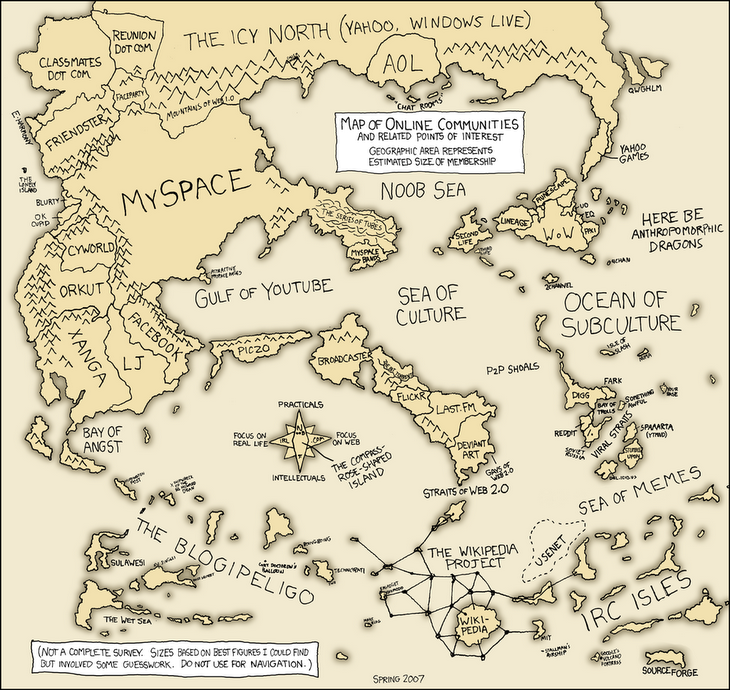
“To skilled online players, it’s easier to fake flesh-world personae than to maintain a consistent long-term online presence.” (Mortensen and Walker)
Pros:
• In an Internet setting, the ethnographer can “lurk” and thus be rendered invisible- enhanced objectivity. This position is usually also socially acceptable.
• However, lurking for the sake of ethnography may not be quite as acceptable- some information can only be learnt through the processes of interaction and participation, but this is also often made easier on the Internet.
Cons:
• Community on the Internet as illusory; research proving computer-mediated communication is not rich enough to sustain meaningful relationships.
• Rapidly evolving pace of technology poses many challenges to fixing an ethnographic work to a particularly meaningful time.
• Virtual fieldwork can be exhausting and overwhelming, highly uncertain.
• Blogging poses the challenge of blurring the distinction between the field and the writing up.
Some Questions...
• How to interpret and describe a textual landscape that is constantly expanding and being altered?
• Rather than transcribing and textualizing a community, the ethnographer is instead faced with the problem of justification- what, truly, can we add to something that describes itself better than we could?
• Mediated communication is defined by a distancing variable- in this case, the textuality and lack of presence associated with the Internet. Might this be at the root of such distrust, so many privacy concerns, so much misrepresentation?
Some ideas raised: videotape users, log chat sessions, network diagrams.
• Focus on the debates concerning multiple identities and dynamic communities, rather than traditional over-fetishised notions of community.
• Network ethnography relies on Social Network Analysis techniques (Howard)- the Internet makes this easier- mechanical objectivity.
• Wakeford: 3 types of online textualized activities: information spaces (WWW), communication spaces (listservs), and interaction spaces (AIM, IRC)
• Mason and Dicks: Ethnographic Hypermedia Environment works with notions of authorship, as the reader is granted agency in navigation and restructuring of the hypertext ethnography.
• Making an objective claim relies on knowledge of objects, which is informed by the kinds of claims one wishes to make.Thus, the production of ethnographic knowledge, particularly on the Internet, must be considered in the context of the ethnographer’s assumptions. Basic theoretical assumptions about anthropology may be at stake: society, the self, nature/culture distinctions. The Internet is not exotic, ‘net ethnographers do not hold position or special access…search engines hold more power. So the power of the ethnographer is in the investigatory and intersubjective potentials… telling the stories, explicating vocabularies, delineating new forms of group structure and communication.
---
The blogging is a good start, I like presenting my process and making connections between ideas. However, this article was a bit of a downer. What is the point? Do cultures even exist on the Internet? Perhaps I should discard the notion of "culture" altogether, and concentrate on human interaction. True interaction is embodied, but you don't need a body for that. All you need is an embodied mind, and not even full concentration at that.
A past paper I wrote grappled endlessly with the concept of the "real". Is the Internet "reality". Can computer-mediated communication come close to face to face interaction. Etcetera etcetera. On and on. Making distinctions. Trying to make distinctions. Everything is distinctions, muddy, muddy, muddy distinctions, and this virtual arena is no different. And by that I mean it's just different. I think I'm going to settle on that: this novel form of communication and connection. Not culture, but communitas.
I think I should make a little project of creating a network diagram, and see where that leads me... maybe overlapping multiple communities/multiple identities...
March 19, 2007


March 16, 2007
A dream I awoke from.
I am standing in a room, it's kind of bouncy and round, and the walls encircling me are covered with monitors, consoles, keypads, speakers... one screen is of incoming e-mails, a hundred e-mail accounts for a hundred separate identities. Another screen displays whole pages of text flipping past as a program picks up its pertinent information, summarizes and files it. Moments pass and suddenly I glance above me, and am shocked to find a window through which the most bizarre cyborg gazes back at me, eyes slightly concealed beneath small monitors, ears plugged into half a dozen conversations discussing psychology, ethics, geography, pollution, the best deal on a new car, and one with oneself in a public diary on the Internet.
How are we engineering ourselves? What are the crucial digital parts pf the social organism of the future? What are the perils we will come to face? How am I not myself?
How are we engineering ourselves? What are the crucial digital parts pf the social organism of the future? What are the perils we will come to face? How am I not myself?
March 15, 2007
Aside: Come Together
Last night, I walked into my family living room to find my dad on the couch, listening intently to his cellphone. He looked up at me excitedly and said, "Jenny, listen, your whole family is on the phone!" He pressed speakerphone, and I could hear several of my uncles and aunts speaking to my grandmother, lying in a hospital bed hours away at a holistic care facility. A few weeks ago, my grandmother was terminally diagnosed with cancer. She is mother to 14 children, ten of whom were currently connected to her via conference call. She told us she'd had a rough day, and that she would return home in a week. Starting with the oldest, each of my aunts and uncles told her they loved her and believed in her, that they were praying for her. Tears came to my eyes as the sheer beauty of their collective engagement hit me.
She couldn't talk much, but the rest of my family stayed on the line long after she left to rest. The conversation was lively, though occasionally confusing, and my Uncle Jack took the lead in going through a list of tasks to be independently assigned. Their goal: to recreate the healing environment that had been helping her so much in the past week. They were working in perfect symbiosis: insurance matters handled by Mary (who works in insurance), medicinal supplies questions answered by Joe (who runs a medicinal supplies store), my mother providing medical advice, and Mike discussing the specifics of hiring aides. Faced with the enormous challenge of organizing a schedule for care, I offered to find a calender wiki they could all have access to. "You can do that?" they asked. 'Modern technology can do that," I responded. I wanted badly to offer something, anything to help. They seemed not to realize how potently they had just exemplified the power of technology to bring people closer, to bridge the gaps of time and space and provide a means for communication to flow quickly and easily.
It took me all of ten minutes to find said wiki (30boxes.com). Users can share calendars as well as to-do lists, which are easily viewable either by themselves or integrated onto a virtual desktop (your "Webtop"). However, 30Boxes is still rather individuated, so I did a search for "group calendar wiki" and found that PBWiki had integrated the 30Boxes application- and PBWiki was exactly what I needed. I was able to easily create a wiki-site complete with a calendar, a to-do list, a blog, an address book, and a photo album. It will be interesting to watch the site evolve- who catches on, how many people lose interest, how they use the site. etc;
She couldn't talk much, but the rest of my family stayed on the line long after she left to rest. The conversation was lively, though occasionally confusing, and my Uncle Jack took the lead in going through a list of tasks to be independently assigned. Their goal: to recreate the healing environment that had been helping her so much in the past week. They were working in perfect symbiosis: insurance matters handled by Mary (who works in insurance), medicinal supplies questions answered by Joe (who runs a medicinal supplies store), my mother providing medical advice, and Mike discussing the specifics of hiring aides. Faced with the enormous challenge of organizing a schedule for care, I offered to find a calender wiki they could all have access to. "You can do that?" they asked. 'Modern technology can do that," I responded. I wanted badly to offer something, anything to help. They seemed not to realize how potently they had just exemplified the power of technology to bring people closer, to bridge the gaps of time and space and provide a means for communication to flow quickly and easily.
It took me all of ten minutes to find said wiki (30boxes.com). Users can share calendars as well as to-do lists, which are easily viewable either by themselves or integrated onto a virtual desktop (your "Webtop"). However, 30Boxes is still rather individuated, so I did a search for "group calendar wiki" and found that PBWiki had integrated the 30Boxes application- and PBWiki was exactly what I needed. I was able to easily create a wiki-site complete with a calendar, a to-do list, a blog, an address book, and a photo album. It will be interesting to watch the site evolve- who catches on, how many people lose interest, how they use the site. etc;
March 6, 2007
Lit Review: Profiles as Conversation: Networked Identity Performance on Friendster, by danah boyd and Jeffrey Heer
o The Friendster profile represents not a static individual, but rather “a communicative body in conversation with other represented bodies.”
o Communication as multimodal; performance and interpretation.
o How are unknown audiences negotiated in light of such public-private technologies as blogs and photosharing communities such as Flickr?
Background
o Description of content/functions
o Visual example of a profile
o Purpose of site: initially, dating, but interpreted as presentation of self, playful network-building, competition & voyeurism.
o Audience: gay men, bloggers, Burners
o History: Since 2003, has rapidly declined in popularity amongst initial members.
o Methodology
o Ethnography: 9 mo. Participant-observation, interviews, surveys, focus groups; 200 participants; 1.5 million profiles
o Visualization: Egocentric & interactive
Context
o Internal homophily / homogeneity
o As with Facebook, the network grew in population and diversity and challenged conceptions of perceived audience
o Playfulness depicted by Fakesters, encouraging creative performance while also mocking serious networkers…
Conversing
o Exchanging information- from performance → conversation
o Semi-public (bulletin board) & private (messaging)
o Embodiment through profiles
• Markers: photos, relationship status, looking for,
o Cultural rules: when is friending appropriate? What are the deeper meanings beneath the various facets of the profile? Reciprocity of testimonials…
o Photosharing as conversation and reinforcement of social bonds
o Friendster vocabulary much like Facebook vocabulary- a “friendster” / “Facebook friend”
Frozen Performances
o Lack of updating profiles – frozen identities, “time capsules”…
o Future a digital graveyard of past identity performance?
o Confusion of public/private in the virtual realm- persistence
---
This study could serve as useful in comparative analyses- Friendster was one of the first online social networks to become popular, as well as one of the first to become unpopular for a host of reasons (namely, the impact of moderating that resulted in the "Facebook Genocide", a lack of network limitations, a lack of new interactive content- that is, until Facebook became popular). Will MySpace head in a similar direction? Same potential for Tribe if it sells out...
New forms of conversation through digital content, especially photosharing. Facebook's "photo tagging" function was key to its popularity boom. The ability to add content of any sort is essential for conversation.
MySpace: User's can edit their own profiles as well as the comments they leave others with HTML, granting users an enormous degree of agency. However, this can get messy when profiles take minutes to load content (often encounter blaring music, seizure-inducing videos, slow-loading photo galleries, inane ego-capsules).
Facebook: Much cleaner than MySpace, but also much less agency. Users can import blogs, create slick Event and Group pages and invite users, and share content from the web (including video and audio).
Tribe: Users can choose from a variety of profile templates and arrange the content blocks on those templates. Again, less agency, however users are given a great variety of easy fill-in-the-blank templates. Above all, Tribe is the least susceptible to media-overload- message board forums are still the principle tenet of groups (Tribes), and users can choose the hierarchy of the information they divulge about themselves.
o Communication as multimodal; performance and interpretation.
o How are unknown audiences negotiated in light of such public-private technologies as blogs and photosharing communities such as Flickr?
Background
o Description of content/functions
o Visual example of a profile
o Purpose of site: initially, dating, but interpreted as presentation of self, playful network-building, competition & voyeurism.
o Audience: gay men, bloggers, Burners
o History: Since 2003, has rapidly declined in popularity amongst initial members.
o Methodology
o Ethnography: 9 mo. Participant-observation, interviews, surveys, focus groups; 200 participants; 1.5 million profiles
o Visualization: Egocentric & interactive
Context
o Internal homophily / homogeneity
o As with Facebook, the network grew in population and diversity and challenged conceptions of perceived audience
o Playfulness depicted by Fakesters, encouraging creative performance while also mocking serious networkers…
Conversing
o Exchanging information- from performance → conversation
o Semi-public (bulletin board) & private (messaging)
o Embodiment through profiles
• Markers: photos, relationship status, looking for,
o Cultural rules: when is friending appropriate? What are the deeper meanings beneath the various facets of the profile? Reciprocity of testimonials…
o Photosharing as conversation and reinforcement of social bonds
o Friendster vocabulary much like Facebook vocabulary- a “friendster” / “Facebook friend”
Frozen Performances
o Lack of updating profiles – frozen identities, “time capsules”…
o Future a digital graveyard of past identity performance?
o Confusion of public/private in the virtual realm- persistence
---
This study could serve as useful in comparative analyses- Friendster was one of the first online social networks to become popular, as well as one of the first to become unpopular for a host of reasons (namely, the impact of moderating that resulted in the "Facebook Genocide", a lack of network limitations, a lack of new interactive content- that is, until Facebook became popular). Will MySpace head in a similar direction? Same potential for Tribe if it sells out...
New forms of conversation through digital content, especially photosharing. Facebook's "photo tagging" function was key to its popularity boom. The ability to add content of any sort is essential for conversation.
MySpace: User's can edit their own profiles as well as the comments they leave others with HTML, granting users an enormous degree of agency. However, this can get messy when profiles take minutes to load content (often encounter blaring music, seizure-inducing videos, slow-loading photo galleries, inane ego-capsules).
Facebook: Much cleaner than MySpace, but also much less agency. Users can import blogs, create slick Event and Group pages and invite users, and share content from the web (including video and audio).
Tribe: Users can choose from a variety of profile templates and arrange the content blocks on those templates. Again, less agency, however users are given a great variety of easy fill-in-the-blank templates. Above all, Tribe is the least susceptible to media-overload- message board forums are still the principle tenet of groups (Tribes), and users can choose the hierarchy of the information they divulge about themselves.
March 5, 2007
Lit. Review: Participatory Genre, by Thomas Erickson
• Problematizes the notion of “virtual communities,” defending instead the position that digital communication is a participatory genre.
• Genre: purpose of the communication, regularities of form and substance, and the institutional, social, and technological forces which underlie those regularities.
• What is unique to online communication is its highly participative and rapidly evolving nature.
• Community:
o Membership: Can be open or closed, links people together based on commonalities.
o Relationships: A community is partially overlapping networks of relationships- some strong, some weak, some
nonexistent.
o Commitment and reciprocity.
o Shared values and practices.
o Collective goods.
o Duration: Expected to have a long existence.
• What does seem of importance is the creation of a shared informational artifact that is brought about through virtual discourse- whether or not personal relationships are formed.
• Genres evolve over time through reciprocal interaction between institutionalized practices and individual human action- the Internet works to speed up this evolutionary process.
• Method: Restricted attention to about 6 conferences within the online community Café Utne.
• A linguistic analysis of the Cafe's conversations, in message board format, and the ways in which participants engage with one another, considering the dearth of social pressure to respond. This dearth is also compensated for through extensive jokes and wordplay.
• Properties of the discourse medium: sequentiality is preserved, all participants see the same thing, newcomers can read the whole conversation before they participate.
With the advent of this age of "egocasting", virtual discourse is increasingly tied to the personal profiles of participants, thus decreasing the need for introductory posts. What struck me as a particularly interesting point in this article was the discussion of how the discourse medium shapes participation. A quick glance at a message board thread will supply the user with an arsenal of information needed to assess the conversational rhythm, the audience, the content and the length of the average response. There is a considerable lack of social pressure to engage in the discourse itself- a marked difference from face-to-face interactions. "Lurking", in 'net geek terminology, is the common practice of following virtual conversations without actually participating. Lurking is acceptable in the virtual realm because it goes entirely undetected- however, in the physical realm such a practice would be labeled as spying or eavesdropping.
This article is quite dated (1997), and centered on old-school message board communities. Where and how does group discourse occur in the communities I am exploring?
1. Myspace: 22 general forums. Each poster's profile icon appears next to their username, age, location and gender. Respondants can quote a previous post, or simply reply to it. If message boards are too lifeless, a user also has the option of visiting chat rooms designated for each forum.
2. Facebook: Users can post publicly visible messages for groups they are members of, events they are interested in, posted photos and shared items, as well as "notes" (Facebook blogs) and individual profiles. However, they are not traditional message boards, but rather time-stamped, individual comments that are centered more on the group/event/photo/item/person in question, rather than a coherent "conversation".
3. Tribe: Each Tribe has as its focal point a traditional message board, but membership is necessary in order to post. Many Tribes have open membership, while some tribes require permission from the tribe administrator in order to join.
• Genre: purpose of the communication, regularities of form and substance, and the institutional, social, and technological forces which underlie those regularities.
• What is unique to online communication is its highly participative and rapidly evolving nature.
• Community:
o Membership: Can be open or closed, links people together based on commonalities.
o Relationships: A community is partially overlapping networks of relationships- some strong, some weak, some
nonexistent.
o Commitment and reciprocity.
o Shared values and practices.
o Collective goods.
o Duration: Expected to have a long existence.
• What does seem of importance is the creation of a shared informational artifact that is brought about through virtual discourse- whether or not personal relationships are formed.
• Genres evolve over time through reciprocal interaction between institutionalized practices and individual human action- the Internet works to speed up this evolutionary process.
• Method: Restricted attention to about 6 conferences within the online community Café Utne.
• A linguistic analysis of the Cafe's conversations, in message board format, and the ways in which participants engage with one another, considering the dearth of social pressure to respond. This dearth is also compensated for through extensive jokes and wordplay.
• Properties of the discourse medium: sequentiality is preserved, all participants see the same thing, newcomers can read the whole conversation before they participate.
With the advent of this age of "egocasting", virtual discourse is increasingly tied to the personal profiles of participants, thus decreasing the need for introductory posts. What struck me as a particularly interesting point in this article was the discussion of how the discourse medium shapes participation. A quick glance at a message board thread will supply the user with an arsenal of information needed to assess the conversational rhythm, the audience, the content and the length of the average response. There is a considerable lack of social pressure to engage in the discourse itself- a marked difference from face-to-face interactions. "Lurking", in 'net geek terminology, is the common practice of following virtual conversations without actually participating. Lurking is acceptable in the virtual realm because it goes entirely undetected- however, in the physical realm such a practice would be labeled as spying or eavesdropping.
This article is quite dated (1997), and centered on old-school message board communities. Where and how does group discourse occur in the communities I am exploring?
1. Myspace: 22 general forums. Each poster's profile icon appears next to their username, age, location and gender. Respondants can quote a previous post, or simply reply to it. If message boards are too lifeless, a user also has the option of visiting chat rooms designated for each forum.
2. Facebook: Users can post publicly visible messages for groups they are members of, events they are interested in, posted photos and shared items, as well as "notes" (Facebook blogs) and individual profiles. However, they are not traditional message boards, but rather time-stamped, individual comments that are centered more on the group/event/photo/item/person in question, rather than a coherent "conversation".
3. Tribe: Each Tribe has as its focal point a traditional message board, but membership is necessary in order to post. Many Tribes have open membership, while some tribes require permission from the tribe administrator in order to join.
March 3, 2007
Research Proposal
Introduction
In the past 20 years, the Internet has become increasingly populated by a variety of new sorts of communities and forms of communication. This phenomenon has resulted in the formation of groups of dispersed peoples coming together on the basis of common interests, agendas, and the exchange of information. Through participant-observation, case study, textual/linguistic analysis, and interview methods, I will be examining the experiences of those involved in these communities, including my own involvement. In particular, I am interested in how these communities define themselves, if they are indeed communities (or something else altogether), and how individuals represent their identities and exhibit social and cultural capital within the virtual arena coined “cyberspace”. Furthermore, I am drawn to investigate the implications of online communities for contextualized identities, as well as the influence of cultural and linguistic differences in online interactions.
Background
Virtual communities are represented in myriad ways, and I plan to make the following my main sites of research: online social networking sites, in particular MySpace, the Facebook, and Tribe.net, and online blogging communities such as LiveJournal and Blogspot. I am seeking to explore these communities as cultural products, enriched through new and underresearched communication practices and identity representations. However, the advent of social networking sites such as MySpace and Facebook, as well as new social media (such as photo- and video-sharing tools) has resulted in a mainstreaming of virtual community membership that is increasingly tied to daily life. This is further complicated by the ever-increasing visibility of corporations and consumerism in popular sites, particularly MySpace. The sociocultural impact of these technologies on everyday life will be examined, as well as the blurred line between functional and social uses of Internet communities. Furthermore, how does access to these social technologies, and the status symbols conveyed by their possession, contribute to social and cultural capital? While popular conceptions and trends concerning online communities will be explored, I am particularly interested in the ways in which marginal groups are formed and sustained online, and how status is construed.
The development of online social networking has allowed for the creation of virtual communities that transcend spatial and physical limitations, often in creative and uninhibited ways. How do virtual environments allow for these types of spontaneous community creation? Victor Turner discussed how the flexibility and mobility of modern industrial culture increases the chances for spontaneous community formation that can occur “both in and out of time”. In this state of liminality, then, people are freed from their ordinary social roles, allowing for new and emergent states of knowing and being known. How others negotiate this freedom from physical markers of identity is a key area of my research. Turner’s notions of liminality in the context of Internet communities are to be complicated by the tendency to archive social information, as exhibited through the popularization of visual media and blogging in the online communities I will be investigating.
Some studies have shown that Internet use is positively correlated with feelings of social alienation (Kim & Kim; Wellman et al.). Howard Rheingold, who coined the term “virtual community” in 1993, sought to debunk the critique that virtual communities are alienating and superficial through a discussion of the merits of both strong and weak social ties in the formation of identity and knowledge. While strong familial and friendship relationships are important for emotional support and self-identity, a network of more superficial relationships serves to increase one’s social capital and capacity to get things done. A study by Wellman and Haythornthwaite found that those who were active offline were also more active online, further contesting the hypothesis that Internet use has a causal relationship to introversion and social alienation. I seek to complicate this issue through exploring the ways in which virtual communities are changing the nature of communication in everyday life, granting new forms of agency to the individual user at the expense of publicizing social information.
Mobile communication as a modern phenomenon extends beyond the Internet. In a collection of essays titled Perpetual Contact: Mobile Communication, Private Talk, Public Performance, Kenneth Gergen discussed the “challenge of absent presence” in the context of new mobile communication technologies. He emphasized the power of monologic technologies that provide information but cannot be directly spoken with. I seek to understand this problem through investigation into the role of the Internet in providing new ways for users to engage in dialogue about information. How has technology affected the ways in which people understand time and their ability to control (or be rendered powerless in the face of) the consumption of information? Much of my past research has reflected a desire of individuals for creating and controlling “safe spaces” and personal niches within the virtual arena, thus weeding out irrelevant information. It is evident that deeper investigation into the psychological, social and cultural effects of modern social technologies is warranted, given the problematic discourse that arises from these phenomena.
Method
Multiple forms of ethnography will be explored in this research. Throughout the course of the next year, I will be immersing myself in the online communities previously mentioned, while also recording and engaging with the everyday discourse concerning virtual communication. In exploring the immensely popular social networking site MySpace, a case study analysis of an informant deeply absorbed in the community will illuminate the complex emotional nature of mediated communication as one individual’s foundation of social interaction. This informant has engaged with MySpace as a primary mode of social interaction for the past five years, and can thus provide insight into the evolution of virtual communication.
With regard to the Facebook, I will be exploring its social impact on the Wesleyan community through in-depth, face-to-face interviews and participant-observation, allowing me to also analyze the role this site plays in community gossip and group affiliation. As one interviewee described, “you don’t exist if you’re not on the Facebook”. I seek to understand the Facebook through the ways in which people attach particular values to various qualities pertinent to individual and group identities, ways of communicating, and the myriad ways in which Facebook users project their own identities through the use of irony, playfulness, and the flaunting of cultural capital.
Tribe.net is a fascinating setting for exploring the globalizing nature of online social networks. Thus far, I have befriended a dozen individuals from across the globe: Romania, Morocco, Brazil, and Spain (to name a few). How do individuals from so many different cultures find common ground through computer-mediated communication? Research by R.D. Laing points out the fact that the United States constitutes over 50% of the Internet user population. How is virtual communication conceptualized in other cultures? Another point of interest is the concept of neo-tribalism prevalent amongst Tribe members. As a response to the perceived “society of strangers” propagated by modern industrial societies, some believe that it is necessary to establish a global network of connected tribes that interact cooperatively, and see Tribe.net as one means of establishing a “neo-tribal” society. Participant observation, e-mail correspondence, and online interviews will be my primary methods of inquiry, as well as promoting dialogue on group message boards.
Online diary communities will be textually analyzed, and it is here that I seek to further engage with issues of language and self-presentation. Motivations for publicizing the private will be examined using both in-person and online interview methods. Also of interest is the nature of anonymity within the context of online diary communities, such as the Wesleyan Anonymous Confession Board, and how anonymous social gossip is interpreted and analyzed in everyday discourse. The allure of gossip obtained anonymously through the often concealed practice of Internet surveillance will be explored through in-person interviews with various members of the Wesleyan community.
Ethics
On a final note, the practice of online ethnography raises ethical issues that must be confronted in the process of my research. A common concern is the fact that some Internet users perceive some publically accessible spaces as private. Also of issue is the rapidly evolving nature of the Internet, which renders much of observed data transient. In confronting these issues, every effort will be made to protect the anonymity of participants through paraphrasing and pseudonyms. In some cases, such as data garnered through online diary sites, consent from the participant will be requested. With consideration to the transient nature of virtual discourse, this ethnographic study will be situated in time and with respect to changing conditions within the sites and as portrayed through popular media. I am seeking to tell the stories of and explore the issues and concerns raised by my research participants. Above all, the autonomy of the individuals portrayed in this ethnography will be acknowledged with empathy and care.
In the past 20 years, the Internet has become increasingly populated by a variety of new sorts of communities and forms of communication. This phenomenon has resulted in the formation of groups of dispersed peoples coming together on the basis of common interests, agendas, and the exchange of information. Through participant-observation, case study, textual/linguistic analysis, and interview methods, I will be examining the experiences of those involved in these communities, including my own involvement. In particular, I am interested in how these communities define themselves, if they are indeed communities (or something else altogether), and how individuals represent their identities and exhibit social and cultural capital within the virtual arena coined “cyberspace”. Furthermore, I am drawn to investigate the implications of online communities for contextualized identities, as well as the influence of cultural and linguistic differences in online interactions.
Background
Virtual communities are represented in myriad ways, and I plan to make the following my main sites of research: online social networking sites, in particular MySpace, the Facebook, and Tribe.net, and online blogging communities such as LiveJournal and Blogspot. I am seeking to explore these communities as cultural products, enriched through new and underresearched communication practices and identity representations. However, the advent of social networking sites such as MySpace and Facebook, as well as new social media (such as photo- and video-sharing tools) has resulted in a mainstreaming of virtual community membership that is increasingly tied to daily life. This is further complicated by the ever-increasing visibility of corporations and consumerism in popular sites, particularly MySpace. The sociocultural impact of these technologies on everyday life will be examined, as well as the blurred line between functional and social uses of Internet communities. Furthermore, how does access to these social technologies, and the status symbols conveyed by their possession, contribute to social and cultural capital? While popular conceptions and trends concerning online communities will be explored, I am particularly interested in the ways in which marginal groups are formed and sustained online, and how status is construed.
The development of online social networking has allowed for the creation of virtual communities that transcend spatial and physical limitations, often in creative and uninhibited ways. How do virtual environments allow for these types of spontaneous community creation? Victor Turner discussed how the flexibility and mobility of modern industrial culture increases the chances for spontaneous community formation that can occur “both in and out of time”. In this state of liminality, then, people are freed from their ordinary social roles, allowing for new and emergent states of knowing and being known. How others negotiate this freedom from physical markers of identity is a key area of my research. Turner’s notions of liminality in the context of Internet communities are to be complicated by the tendency to archive social information, as exhibited through the popularization of visual media and blogging in the online communities I will be investigating.
Some studies have shown that Internet use is positively correlated with feelings of social alienation (Kim & Kim; Wellman et al.). Howard Rheingold, who coined the term “virtual community” in 1993, sought to debunk the critique that virtual communities are alienating and superficial through a discussion of the merits of both strong and weak social ties in the formation of identity and knowledge. While strong familial and friendship relationships are important for emotional support and self-identity, a network of more superficial relationships serves to increase one’s social capital and capacity to get things done. A study by Wellman and Haythornthwaite found that those who were active offline were also more active online, further contesting the hypothesis that Internet use has a causal relationship to introversion and social alienation. I seek to complicate this issue through exploring the ways in which virtual communities are changing the nature of communication in everyday life, granting new forms of agency to the individual user at the expense of publicizing social information.
Mobile communication as a modern phenomenon extends beyond the Internet. In a collection of essays titled Perpetual Contact: Mobile Communication, Private Talk, Public Performance, Kenneth Gergen discussed the “challenge of absent presence” in the context of new mobile communication technologies. He emphasized the power of monologic technologies that provide information but cannot be directly spoken with. I seek to understand this problem through investigation into the role of the Internet in providing new ways for users to engage in dialogue about information. How has technology affected the ways in which people understand time and their ability to control (or be rendered powerless in the face of) the consumption of information? Much of my past research has reflected a desire of individuals for creating and controlling “safe spaces” and personal niches within the virtual arena, thus weeding out irrelevant information. It is evident that deeper investigation into the psychological, social and cultural effects of modern social technologies is warranted, given the problematic discourse that arises from these phenomena.
Method
Multiple forms of ethnography will be explored in this research. Throughout the course of the next year, I will be immersing myself in the online communities previously mentioned, while also recording and engaging with the everyday discourse concerning virtual communication. In exploring the immensely popular social networking site MySpace, a case study analysis of an informant deeply absorbed in the community will illuminate the complex emotional nature of mediated communication as one individual’s foundation of social interaction. This informant has engaged with MySpace as a primary mode of social interaction for the past five years, and can thus provide insight into the evolution of virtual communication.
With regard to the Facebook, I will be exploring its social impact on the Wesleyan community through in-depth, face-to-face interviews and participant-observation, allowing me to also analyze the role this site plays in community gossip and group affiliation. As one interviewee described, “you don’t exist if you’re not on the Facebook”. I seek to understand the Facebook through the ways in which people attach particular values to various qualities pertinent to individual and group identities, ways of communicating, and the myriad ways in which Facebook users project their own identities through the use of irony, playfulness, and the flaunting of cultural capital.
Tribe.net is a fascinating setting for exploring the globalizing nature of online social networks. Thus far, I have befriended a dozen individuals from across the globe: Romania, Morocco, Brazil, and Spain (to name a few). How do individuals from so many different cultures find common ground through computer-mediated communication? Research by R.D. Laing points out the fact that the United States constitutes over 50% of the Internet user population. How is virtual communication conceptualized in other cultures? Another point of interest is the concept of neo-tribalism prevalent amongst Tribe members. As a response to the perceived “society of strangers” propagated by modern industrial societies, some believe that it is necessary to establish a global network of connected tribes that interact cooperatively, and see Tribe.net as one means of establishing a “neo-tribal” society. Participant observation, e-mail correspondence, and online interviews will be my primary methods of inquiry, as well as promoting dialogue on group message boards.
Online diary communities will be textually analyzed, and it is here that I seek to further engage with issues of language and self-presentation. Motivations for publicizing the private will be examined using both in-person and online interview methods. Also of interest is the nature of anonymity within the context of online diary communities, such as the Wesleyan Anonymous Confession Board, and how anonymous social gossip is interpreted and analyzed in everyday discourse. The allure of gossip obtained anonymously through the often concealed practice of Internet surveillance will be explored through in-person interviews with various members of the Wesleyan community.
Ethics
On a final note, the practice of online ethnography raises ethical issues that must be confronted in the process of my research. A common concern is the fact that some Internet users perceive some publically accessible spaces as private. Also of issue is the rapidly evolving nature of the Internet, which renders much of observed data transient. In confronting these issues, every effort will be made to protect the anonymity of participants through paraphrasing and pseudonyms. In some cases, such as data garnered through online diary sites, consent from the participant will be requested. With consideration to the transient nature of virtual discourse, this ethnographic study will be situated in time and with respect to changing conditions within the sites and as portrayed through popular media. I am seeking to tell the stories of and explore the issues and concerns raised by my research participants. Above all, the autonomy of the individuals portrayed in this ethnography will be acknowledged with empathy and care.
Subscribe to:
Posts (Atom)


 Posts
Posts