October 9, 2007

Mass Media Belongs to the Masses

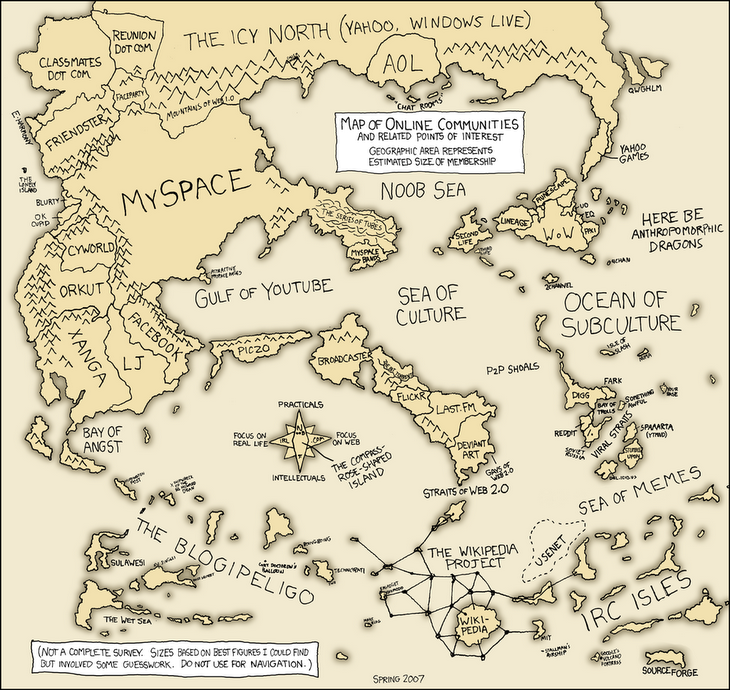
The character of mass media has been shifting dramatically over the past century- from the one-directional consumption of television, to the dialogical (yet niche) nature of online bulletin boards, to the enormous multimedia production of today. As the tools of new media increase in accessibility and expand in ubiquity, we find ourselves in conversation with a public audience that is more or less evident.

Knowing who one's audience is can be a tricky process. Blogs, websites, and publicly-accessible online profiles entail invisible publics. The creation of Friend Lists and the implementation of privacy features restricts one's audience and enhances awareness of it. Through the lens of the social graph, we can create categorical definitions of our audiences by labeling clusters of relations.

(From the looks of it, it would appear that my social network revolves around the following sites: Wesleyan, Boston, NY, San Francisco, Washington D.C, and the Northwest US):


There is something intrinsically satisfying in visual representation that text lacks. There are also few things more desirable than that which reflects oneself, however iconically.

TouchGraph, the company behind this Facebook application, says on their website:
"Traditional search engines provide a way to sift through this data. However, the greatest insights can be achieved not by sifting, but by looking at the big picture to see how items are connected."


Just the name of the company- TouchGraph, beckons us outside of the textuality of the Internet (a quality that is becoming progressively less prominent), allowing us to grasp our wider place in the virtual world on a more intuitive level.

Such data also allows us to understand exactly how limited our individual, direct scope actually is. I predict that the practice of mirroring real-life social networks will soon become secondary to the process of producing engaging media- which, as the Internet becomes increasingly searchable, will find its place amongst wider taste fabrics. These "taste fabrics" are constructed through "word of mouth" reconfigured to the modern sense- that is, hyperlinked. In turn we may find ourselves navigating visual representations of the taste fabrics we create through our Google searches, our social networks, and our own content.

Emancipation from the material bases of inverted truth this is what the self-emancipation of our epoch consists of. This "historical mission of installing truth in the world" cannot be accomplished either by the isolated individual, or by the atomized crowd subjected to manipulation, but now as ever by the class which is able to effect the dissolution of all classes by bringing all power into the dealienating form of realized democracy, the Council, in which practical theory controls itself and sees its own action. This is possible only where individuals are "directly linked to universal history"; only where dialogue arms itself to make its own conditions victorious.
-Guy Debord

October 5, 2007

Musings on the Big Picture

I have been thinking of online social networks as pertinent examples of a generational trend, marked by the increasing appropriation of the media and proliferation of contextualized interpretations by disparate individuals, connected through shared taste fabrics that are founded, by and large, on mass media. The rise of Web 2.0 signifies a shift toward user-generated content in the form of blogs, photo albums, videos, music, niche communities, message board dialogue, playful interaction, computer media, and creative displays of identity (what I call the "mashup").

The locale of the hearth (that which is safe, secure) has shifted, from the family home theater clustered around the television to a dynamic mirror of ourselves as relational wholes, albeit individually fragmented. We have begun to bridge the gap between producers and consumers of media- increasing interactivity allows for a two-way dialogue as opposed to the directional nature of mass media.

However, all is not oral. New media is rather a hybrid of oral and written language- at once casual yet permanent, private yet public, intimate yet mediated. We are creating the media, but must not forgot the role of the media in inculcating our understandings of reality.

September 22, 2007

Plaintively Researching

These past few weeks have been a rush of novel experiences, as I reconfigure my identity in an extremely pointed way. I have been meeting so many new people, and first conversations almost inevitably touch upon my research, which is essentially what i do (who i am?) right now.

As a result, I've taken to carrying a digital voice recorder in my pocket. It's mere presence has a similar effect on me as speaking in front of a crowd of people: intense social phobia. I treat the object gingerly, awed by its potential to preserve the situation so very perfectly in a peculiar mode. Tonight, a friend who promotes his tracks on MySpace spoke of Google's vast database of categorized interest nodes, sending advertisements directed uniquely at his individual identity as derived from his web browsing habits. Google's rumored launch to "out-open" Facebook- that is to say, become the next leading online social network, is of particular interest to me, as is the increasing popularity of niche social networking sites, blogospheres, and Second Life.

September 10, 2007

Survey on Online Social Networking Habits!

I am conducting a short survey for users of Facebook, MySpace, and/or Tribe.net.

Your participation in this survey is entirely voluntary, and you may terminate participation at any time prior to the completion of this survey without penalty. Please understand that the information you provide will be viewed only by the researcher, and that any responses published will not enable identification of me in any way.

Questions and concerns can be directed to Jenny Ryan (researcher) @
jaryan@wesleyan.edu.
Further information and future publications can be found at http://webnography.blogspot.com

I Agree, Continue to Survey!

September 6, 2007

Changing Attitudes Toward Facebook

As the tech world continues to grow wild for Facebook, the veteran users in my midst- college students- continue to grow indifferent, even annoyed- or so their group discourse would have me believe. "The applications were pretty fun at first," said one energetic, people-loving friend, "I like throwing food at my friends and turning them into zombies... but it got old real fast." "They're stupid, they're annoying, I just really don't care at all anymore," said another friend, who'd spent his past semester abroad, "I mean, I guess it's useful for keeping in touch with people you don't care enough about to e-mail."

"Well, I care so little that I let her," Dave points a finger at his girlfriend, "go in and change my whole profile around. It's ridiculous, and I haven't even changed it back." They giggle for awhile.

"There are some useful applications," I point out.

"Well, there're so many of them, I don't feel like sifting through all of that crap. Facebook's turning into MySpace."

At the same time, I've found that my friends on Facebook continue to be highly active, having become skilled at interacting with the more useful features of the site. 25% of the most recent 50 emails in my inbox are Facebook notifications of some sort- generally, event listings, friend requests, wall messages, and pokes. These are some of the ways in which we attempt to connect to one another through forming and maintaining relationships and collective cohesion, digitally.

My conclusion? It's just not "cool" to like Facebook- one is better off being critical- but many of us depend on it in some way or another as a way of maintaining social bonds. We've grown addicted.

September 2, 2007

Log the Third

Today, after my sister expressed her love for me on my Facebook wall (as she is wont to do), I recorded my first video wall post. Unfortunately, I'm unable to "repost" the video here, but I will say it was quite simple, and rather successful! Facebook recently implemented a variety of options on what was once a user "wall" constrained to text alone. Now, one can record video, post a link, post a band (one needs to first register their band at ReverbNation and upload a few songs, which can then be posted on one's profile, or linked to on another's wall), send a randomly-generated fortune cookie, give a "zombie hug", send a cookie, give a daisy, or post a popular song (when I clicked on this, there was a search bar, as well as 3 popular songs listed: Avril Lavigne, 50 Cent, and Death Cab for Cutie).

I also spent a solid 15 minutes taking screen captures of my friend's MySpace profile. I made myself stop at 50 shots, that's how long his profile page is. Lots of links, artistic images, poetry, politically-oriented buttons and banners, the usual favorite books and movies and such, a long introduction (that is prefaced with:
"TOTALLY NOT INTERESTED IN THE FOLLOWING:
your band (unless your organic/synthetic spiritual sounds and presentation could totally wow me, DON'T EVEN BOTHER)
Promoters of any kind!(go away)
spiders, crawlers, spammers, etc go away i don't like you!
people...who freak me out. (it's pretty hard to accomplish)

and now! on to the good stuff!"

His comments were nearly as fun to sift through as the profile itself. Beautiful images, replete with some animated sparkles or color shifts, adorned his walls. The requisite "Thanks for the add!" comment was also a strong presence. The majority of the content was "New Age" in nature- faeries, Alex Grey, and my favorite:

August 27, 2007

Log the Second

I ran across an interesting thread on Tribe.net yesterday entitled "What is Technoshamanism?" You can read it here, but in a nutshell, the respondees described technoshamanism as a means of uniting the past and the present, or the spiritual and the technological. From dancing around a bonfire to the beat of the drums, to dancing all night long to electronic trance music, the end goal is a spiritual connection to the universe that dates back to the beginning of humankind's time on this planet.

I have to simply marvel, at times, how meticulously the system of Facebook is run. Nothing is deleted, all is stored. Upon deleting my Facebook account, I learned that the moment I logged in again, my entire account- the photos, the messages, the wall posts- would be rekindled from my momentary lapse of Facebook identity, as if I had taken a vacation... which, admittedly, I had.

The new frontier for individualism, the virtual frontier, is at this point still an open one. However, as this sphere becomes increasingly dominated by large corporate networks, understanding the illusory nature of agency is critical. John Barlow's Declaration for the Independence of Cyberspace has never been more poignant.

Log the First

It is the first night living alone - this one, right now. Telling myself I need to take a break from the carrying, the unpacking, the arranging of my possessions in an aesthetically pleasing manner, I hop onto the internet to check messages. A familiar name pops out at me from a Facebook notification- a dear friend who'd spent the entirety of the past year in Spain. She writes to tell me she'll be at Wesleyan on Tuesday, and I go from alone in the glow of the monitor to basking in the glow of love, instantly.

I click the 'Home' button, and scroll through my News Feed. A tiny heart appears at the bottom of the screen- a man who'd led a Buddhist retreat had a new girlfriend! And they'd hooked up in 2006 and it was "fabulous". This is way better than tabloids, because I actually sorta know this guy. I mean, we're Facebook Friends.

MySpace is plastered with Dane Cook. MySpace is for bros. My 19 year old cousin assaults the ears of visitors to her profile with screamo and concludes her welcome message with "i probably don't like you." All of my friend requests are from electronic musicians. I do enjoy electronic music, by and large. A friend of mine who recently began producing tracks just joined MySpace, and already has over 400 friends. I asked if he'd been spending a lot of time "friending" MySpacers, and he replied, "well, half of them have friended me". His Comments board is plastered with psychedelic images, a few of them animated. There is an image of a woman whose moniker contains the word "suicide," holding a pair of black panties beneath a caption that reads "Thanks for the add! xoxo".

That is all.

August 18, 2007

On Technoshamans and the Rise of Neotribalism

Asked to attempt a summation of the online social networking community known as tribe.net, I have taken to replying with the single phrase, "technoshamanism". It seems the word has not yet been taken up by many, so I'll attempt a definition here.

(For a little background information, you'd be keen to check out a term project I worked on for my Anthropology of Dance class, entitled "The Trance Dance Experience".)

A technoshaman is one who integrates modern technology into primordial practices in order to induce transcendent experiences. Now, such a description evokes remnants of that anthropological black mark- the noble savage- and thus I proceed with caution, unwilling to romanticize:

Technoshamanism seeks to rediscover the roots of human experience while utilizing modern tools. Such tools can range from repetitive electronic music, to synthetic drugs, to new technologies such as biofeedback. The states thus induced might range from supersensory to meditative. Modern "rave" culture (and I use this term with caution as well, for the rave scene has become inundated by the mainstream, thus necessitating an emergent subculture(s)) incorporates just such tools to achieve just such states, and where site and ideology merge, we have our subculture.

Regardless of terminology, the essence of such subcultures is the pursuit of the collective unconscious, consciously realized and enacted. When I say "neotribal," I refer to the tribal experience as it is recreated in the modern day. Safe spaces are created through collective artistic action; drugs consumed that serve to enhance feelings of empathy, community, clairvoyance, and/or transcendence; music played that serves to enhance said feelings and provide the collective pulse. This occurs with varying degrees of success, depending on whether individuals collaborate effectively to achieve the same goals.

The Internet is, quite naturally, one of those modern technologies that is utilized by technoshamans as a means of tapping into the collective neural network. As it exists apart (or, at the very least, disjointed) from time and space, the shape and texture of the Internet resembles that of technoshamanism itself. That's all I've got for now.

August 13, 2007

My Dad's Checked Me Out on Facebook, GAH!

It was bound to happen eventually. Last week, I received a Facebook friend request from my dad. When I followed the link, however, the friend request had disappeared. Apparently my father wised up pretty quickly- it was much easier to log into my sister's account (she uses his laptop all the time), and check me out from the inside. Last night, my sister was showing me some pictures on Facebook- we showed one to my dad, who commented, "oh, I've seen those." We looked up, startled. "Oh, what's the matter? There's nothing bad on there," he recovered quickly. We stared at one another for a long minute.

Later that night, relaxing in our nifty new hot tub, I broached the subject once more. "So, I got a friend request from you last week, but you'd disappeared. I guess you caught on to the personal nature of Facebook?" He nodded imperceptibly. "So, tell me if this is what happened- you joined the site, realized you couldn't simply view people's profiles without adding them as friends, and decided to stalk us through Kelly's account instead?" He smiled sheepishly, confirming my suspicions. I felt, and not for the first time, worried and exposed. But only for a moment... with relief I remembered that both my brother and sister have access only to my Limited Profile, which prevents them from viewing my "Friends Only" photo albums. Three cheers for conscientiousness!

Two New Ones: Multiply and Yuwie

A few days ago, at an outdoor psytrance party in Boston, I caught up with a friend I had made at another party- a German cardiac surgeon-in-training. I asked how we could keep in touch, and he responded instantly, "e-mail is best". I agreed, and the next day received an invitation to join the social networking site Multiply. I liked it instantly: utterly content-based, Multiply "is all about user powered, relationship-relevant content. Every post in your news feed is shared and discussed by people you know, either directly or indirectly through friends of friends." Multiple blogs can be uploaded, video and photo archives shared, mp3s uploaded, reviews and events posted, and personal messages sent.

A new SNC startup, Yuwie, pays its users 50 cents for every 1,000 page views. Each time content is uploaded, a message is sent, content is viewed (including pictures) or a friend accepts an invitation to the site, it counts as a page view. I find it a pretty blatant example of the increasing commodification of social life through new technologies. However, it is slightly comforting that at least someone out there is seeking to grant users their rightful profit for the "work" they do to keep the founders of SNCs rich and popular.

August 10, 2007

Reflections on Methodology

Even the acknowledgment, as requisite as it is in the field of anthropology, of the problematic nature of representing the "other" (ethnocentrism, racism, colonialism, imperialism, etc;) has become tired, stationary, and ultimately beleaguered by jargon. I seek the active creation of an ethnography both by and for the people- accessible as an inspired, collaborative story-telling. Such an endeavor thus expands the reach of information, rather than folding in upon itself in the mobius strip of academia.

Have I simply made a case for irresponsible, decontextualized ethnogaphy? The feminist concern with being "spoken for" by the dominant underlies my desire to closely examine a cultural form I can safely call my own. My autoethnography is, or so I hope, supplemented and lent legitimacy in the sharing of it, and in the incorporation of myriad perspectives.

Your comments would be much appreciated.

July 6, 2007

My Personal SNC History

I've been a member of MySpace since December 2004 when I was a college sophomore, about a year after the site launched. I was skeptical. Over the past two and a half years I've acquired exactly 75 friends. I rarely searched for people, preferring to accept or (more often) reject friend requests. I emphasize the rejection bit in tandem with the aforementioned skepticism- the vast majority of friend requests I received were from emo boys with bands or men attempting to woo me. MySpace took on an identity, in my mind, of a virtual "meat market". Rather than meat, however, what is being consumed seems to primarily consist of young women, CPU-heavy (not to mention gaudy) profile pages, and a seemingly infinite number of musicians. The friend requests from artists quite frequently piqued my interest, and musicians and bands make up nearly half of my MySpace friends.

I never made much of an effort on MySpace to accumulate friends, and my profile is somewhat "pimped out" only after a friend told me how lame it was. The *real" social networking service, the one all my friends used and that didn't bombard me with crappy music and headache-inducing graphics, was Facebook. Simple, clean, neat- I didn't have to worry that my parents would find me there, and practically everyone I knew at school used it (thus, for instance, it was highly likely I could find not only kids in my classes, but a phone number or screenname if I had a question about a paper). I have 350 friends on Facebook, and nearly every one is someone I've met face to face.

Last summer I lived in Boston, fell in love with psytrance, and discovered a new way in which I could communicate and solidify the casual friendships I made on the dance floor: tribe.net. Though I have a mere 40 friends on Tribe, what matters is not so much my own collection of friends and spiffy personal profile, but rather the groups ("tribes") I'm a part of. The history of tribe.net is imbued with the sounds and styles of neo-hippies, as evidenced by its popularity amongst Burners (those who attend the annual Burning Man gathering) in the San Francisco Bay area. Activity on Tribe is quite unique from most SNCs I've been a member of: when someone adds you as a friend, they almost always include a personal message; I have several friends from around the globe who share things in common with me; each "tribe" consists primarily of topical forums (less a *badge* than a way to actually share information about a subject with others in the know).

I will continue to expand on this internet autobiography as the months progress, there are many good stories I should definitely get written down! To those readers I know are out there: feel free to share your own experiences... no, encouraged!

June 30, 2007

Sex and Gender Performance on Facebook

It's been difficult to blog recently, difficult to find my own words and articulate my own thoughts amidst this constant flood of information. However, I have been absorbing quite a lot, thanks in large part to my ever-so-useful Google homepage, in which I can organize the well over a dozen RSS feeds I read regularly, my gmail, the livejournals and podcasts of my friends, my del.icio.us bookmarks, and the handful of widgets I find the most useful (such as Google Maps, blog search, Google Docs, wikipedia and YouTube).

I've just returned from yet another venture through the blooming fields of Facebook, having added two more applications:

SGO: Concerns sex and gender orientation. Facebook's options are rather limited, however with the addition of this app one can differentiate between sex and gender, gender identity and gender presentation, as well as specify who one is interested in. I recall a Facebook group that advocated more diverse and politically correct options for sex and gender orientation, as well as allowing users to articulate more than one relationship- these options are now available. For more information, check out the SGO FAQ and the Relationships++ application, which allows one to specify more forms of "Looking For" (such as swinging and polyamory) as well as multiple forms of relationships (such as BFFs, civil unions, and "seeing other people than").

Socialmoth: Users can post anonymous confessions that are read by other users. The most touching or intriguing gain "hearts" that other users give in response. Thus far, I've yet to see anything particularly spicy... most confessions follow along the lines of "I wish he loved me back." or derogatory "flames".

An update on the "Honesty Box" app: Thus far, I've learned two things about myself: I inadvertantly offended someone, who found it best to let me know only in the most aggravatingly anonymous form possible, and that I'm "out of control". Assessment: the inclusion of this app has thus far served only to make me slightly paranoid and quite self-conscious.

--

I read a blog post recently regarding MySpace's plan to build and expand MySpace TV, as well as allowing third party applications. Such moves are being made in order to maintain their top social network status amidst the frenzy surrounding YouTube and Facebook. MySpace's reputation for processor-heavy, cluttered profile pages has prompted a growing concern over Facebook's development. Whatevs.

June 12, 2007

It's Been Awhile: SNC News!

Facebook has recently integrated the Developer's Platform into its core site, allowing users to choose from over 200 applications.

Among the most popular:
-Top Friends: Choose up to 24 friends to display directly on your profile, allowing you to both a) play favorites and b) shorten the number of clicks it takes too check up on your best friends.
-Free Gifts: Don't feel like giving to charity? Give little gifts (represented as occasionally clever icons) for your friends to display proudly on their profiles- for free!
-Video: Yes yes, now you can post videos on your profile also! Or send video messages!
-Flikster Movies: Share what movies you've seen recently with your friends- great for recommendations.
-iLike: Add music that you've been playing through iTunes. It also lists upcoming concerts, allowing you to see who else may be attending.
-Trakzor: This only works if your friends install the application also- but you can see who is viewing your Trakzor page. Note- stalking is still a 100% safe and viable Facebook activity- if you don't want to be tracked, simply don't visit people's Trakzor pages.

My personal favorites:
-Graffiti: Placed right above a profile's Wall, allows friends to draw on your wall.
-Games: Play a Battleship-type game (using sushi as playing pieces as opposed to ships), strip blackjack (they censor out the genitalia- rated E for everyone!), and more (play tetris while you wait for other users to join your game- either random or from one of your networks).
-Honesty Box: Allow your friends to anonymously tell you exactly what they think of you (don't worry, it's private- you can revel in your shame/anger/surprise in peace!). However, like the Trakzor app, your anonymous commentator also needs to install the app in order to send you a message. Once again, a useless application unless/until it becomes popular.
-(fluff)Friends: Add little graphic friends to your profile (mine is a flying giraffe I named Sasha).
-Extended Info: Add more info boxes to your profile (I added "Things I Am Looking At Right Now" and "Summer Schedule").
-Wis.dm: A Q&A site, Wis.dm's Facebook app asks questions of users, pairing them to other users who've answered similarly. Users gain points as they answer questions- a veritable smorgasbord of possibilities for advertisers.

----

MySpace is working on a news site, currently in Beta: http://news.myspace.com . I especially like the integration of Event news from LinkedIn and MeetUp. They've also recently developed a profile customizer utility that's incorporated within the site, removing the necessity of seeking external MySpace Layout sites for the non-HTML-savvy.

Also of note: For some reason or another, the number of pornography accounts requesting my friendship is exploding. At least they are easy to swiftly detect and decline- a game of "spot-the-thong".

May 15, 2007

Lit Review: A familiar Face(book): Profile elements as signals in an online social network (Lampe, Ellison, & Steinfeld)

In the third of a continuing series of Facebook research projects, Lampe et al; drew data from over 30,000 Facebook profiles at Michigan State University in order to uncover the relationships between the amount and type of profile elements presented and number of friends.

Walther's Social Information Processing Theory
: Online, lack of traditional cues leads to the development of new social cues, such as spelling ability.

Signaling Theory: Profile elements are signals used by individuals to communicate personal qualities that are interpreted by others in order to make judgments.
-Donath differentiates between assessment signals (which are observable qualities) and conventionial signals (indicated through social conventions). Online signals are generally conventional.
-In the world of Facebook, relationships are generally formed first offline. Thus, the structure of Facebook encourages honesty in profiles. Dishonesty is typically playful or ironic in nature.
-The researchers propose that the number of legitimate conventional signals included in Facebook profiles is proportionate to the size of one's online social network, as well as the signaling value of less verifiable cues (such as interests).

Common Ground Theory: Profile creation is motivated by a desire "to establish common frames or reference that enhance mutual understanding."
-Community membership is integral to assessing the amount of shared understandings, working to establish common frames of reference.
-Information derived from Facebook profiles works much in the same way as face-to-face "interviewing", indicating shared common ground that may enhance understanding between individuals (such as shared location or academic major).

Transaction Cost Theory: In establishing these common frames of reference through profiles, costly negotations ensue that work to enhance communication between interactants.
-Facebook profiles reduce the cost of connections by creating an easy way for individuals to search for those who share their interests or other attributes. Thus, the more information that is provided by an individual, the more likely they are to be found by others, enhancing the number of connections displayed by that individual.
-From this lens, the researchers suggest that the more verifiable elements and contact information is exhibited in one's Facebook profile, the greater the effects will be on the number of friends that person has.

The study used automated scripts to gather profile information, which was then encoded into four variables:
1. Control Variables: Network characteristics. (Sex, Length of Membership, Institutional Status, Last Updated)
2. Referents Index: Common points of reference, possibly assessment signals. (Hometown, High School, Residence, Concentration)
3. Interests Index: Conventional signals of identity. (Favorite Movies/Music/Books/TV Shows/Quotes, Interests, Political Views, About Me)
4. Contact Index: Willingness to share off-site connections. (Relationship Status, Looking For, Website, Address, Birthday, AIM, Email)
5. Dependent Variables: Total number of friends (Same School, Other School)

Results
-Users completed 59% of fields on average.
-Median number of preferences listed: 5 interests, 1 book, 5 movies, 3 music, 0 TV shows, 36 characters in "About Me" section.
-Median number of friends: 75 same school, 68 other school, 0.53 ratio.
-Number of friends is highly correlated with undergraduate status, as well as how long the account has been active.
-The act of providing information on one's profile is highly correlated with number of friends, most notably High School (92:35), AIM (100:50), Birthday (80:26), Favorite Music (83:37), and About Me (88:56). The first three aid in supporting pre-existing bonds, such as high school bonds, while the former provide information about one's identity to all users.
-There is a weak correlation between the AMOUNT of information in profiles and the number of friends. The researchers posit two possible explanations: either a user with many friends feels social pressure to include more information, or such a user includes more information while also seeking out more people to add as friends.

---
One of the main limitations described by the researchers is that their study focused on the behaviors of Facebook users, but not their attitudes toward or motivations behind these behaviors, and that they did not examine the content of profile fields, but rather the existence of them.

My examination of online social networking communities will be considerably less quantitative than many of the studies I have been reviewing. An emphasis on qualitative interviewing of SNC members (both face-to-face and online) will be a considerable benefit to the current research in this field.

The Age of Egocasting?

Rosen, a technology journalist, discusses emerging online community practices in terms of a modern-day process she has coined “egocasting”. She documents the recent history of communicative technologies, which allow individuals to control with increasing precision the information they consume. Popular contraptions such as TiVo and the iPod allow individuals the capacity to avoid the sounds, images, and ideas we don’t agree with. She warns of the potential of this power for crafting a culture that is profoundly impatient and critical of all that does not align with their ideologies of choice.

TiVos and iPods will never destroy us. But our romance with technologies of personalization has partially fulfilled Krutch’s prediction. We haven’t become more like machines. We’ve made the machines more like us. In the process we are encouraging the flourishing of some of our less attractive human tendencies: for passive spectacle; for constant, escapist fantasy; for excesses of consumption. These impulses are age-old, of course, but they are now fantastically easy to satisfy. Instead of attending a bear-baiting, we can TiVo the wrestling match. From the remote control to TiVo and iPod, we have crafted technologies that are superbly capable of giving us what we want. Our pleasure at exercising control over what we hear, what we see, and what we read is not intrinsically dangerous. But an unwillingness to recognize the potential excesses of this power—egocasting, fetishization, a vast cultural impatience, and the triumph of individual choice over all critical standards—is perilous indeed.


The parallels to online communities are cutting. Though our culture frequently heralds the globalizing force of technology, there are darker implications that this technology may allow use to blind ourselves entirely to ideas and information that contest our beliefs and challenge our comfortable notions of ourselves, others, and the world at large.

May 9, 2007

The Sociocultural Appropriation of Web 2.0?

I was notified via Tribe.net today of a new online startup by Daniel Pinchbeck (Technoshaman, Wesleyan dropout, and author of Breaking Open the Head and 2012: The Return of Quetzalcoatl), Reality Sandwich. The site is to begin as an online magazine dedicated to the "re-imagining" of an intentional, international community of new-age shamans and neo-hippies. It is planned to evolve into an extensive, global social networking site. Among the first articles can be found discussions of the "ethnosphere", an interview with Abbie Hoffman, 21st century shamans, a "recipe for happiness" and an article about the practical application of digital utopian ideals in Web 2.0 communities:

My primary focus in blog will be the ongoing struggle to create an Internet that serves the public interest, one that incorporates the highest ideals that the evolution of web 2.0 points toward. I will watch the industry and I will watch the tech watchers and give you my honest perspective. I will tell you about companies that are doing good work and trying to improve things, and alert you to those that are being sneaky. In the same way as buying green produce supports and helps people make deeper changes in industry practices, we can vote with our on-line attention and dollars, giving our business to those online companies who put you in the middle of the picture.


Pinchbeck is a controversial figure in New Age discourse, and has been described by many as a modern-day Timothy Leary, though Terence McKenna is a more appropriate comparison. His ambitious goals to evolve the global consciousness through the appropriation of technology and communication practices is reminiscent of Stewart Brand's Whole Earth Catalog (see From Counterculture to Cyberculture, part 1 and part 2).

Implications for Research
Is this a new stage in the rise of digital utopianism? Are we witnessing the rise of technoshamanism? How does this New Age subculture find strength in global, online communities (such as Tribe)?

May 8, 2007

Lit Review: The Online Nomads of Cyberia

Based on fieldwork amongst a community of online gaming fans, Knorr argues that the field of anthropology is well-suited for the study of online communities as sites of sociocultural appropriation. The habitat of an online community is located within the Internet infrastructure, a dynamic space that utilizes multiple forms of mediated technology. Rather than limiting communication to the common shared interest, members of the group exchange gossip, create hierarchies, and establish new spaces for group interaction when older forms are obliterated. The community in question is described as a “nomadic tribe” that retains interpersonal structure regardless of geographic or even Internet space. The members of this community can best be described, not as consumers of technology, but as active creators of their online habitat. In this sense Internet communication technologies are reconstructed through a process of appropriation. So too are social networking communities appropriated as they are reworked to suit individual groups, as is the case in online activism and the geographical dispersion of subcultures.

May 3, 2007

Lit Review: Information Revelation and Privacy in Online Social Networks (The Facebook Case) (Gross & Acquisti)

The researchers conducted an analysis of over 4,000 college students using Facebook at Carnegie Mellon, utilizing the lens of information revelation and related privacy implications.
-Sought to examine the openness of individuals in revealing information (such as contact information, political and sexual orientation, and intimate details of one's personal life) freely posted in the public realm of the Internet.
-Collected actual field data, rather than surveys or experiments.

Information Revelation and Online Social Networking
1. Identifiability
-Varies according to the nature of the site, though most encourage identifiable photos.
2. Types of information elicited
-range from the semi-public to the private to entirely open-ended (diary communities).
3. Visibility of information
-Can be viewed by all members or limited to one's personal network.

-Anecdotal evidence reveals an utter willingness of members to reveal private information.
-Social Network Theory and Privacy: Discussions center on the complex nature of one's propensity to disclose personal information, the importance of weak ties in the formation of social capital, and expectations of privacy.
-In the offline world, relationships are dynamic and can exist at multiple levels of intimacy. Online, relationships are reduced to simply "friend or not".
-Though not necessarily supportive of strong ties, the Internet facilitates the formation of a large and dispersed network of weak ties.
-Situating the Internet as a vast network of rather weak ties, it has been described by some as an imagined community (Anderson), and thus the meaning of trust must be renegotiated, as well as the meaning of intimacy.
-The Internet slightly facilitates meaningful interaction while greatly enhancing the ability of others to access your information.
-Privacy Implications: Photos, demographic data, unique tastes may lead to a re-identification of an individual belonging to more than one SNC. This occurs either through recognition of a pseudonymous user by searching for this information, or knowledge of unknown characteristics of an identified subject on another site.
-Members are often not fully aware of a hosting site's privacy policies concerning information disclosure, or the magnitude of the site's user population and/or data archival.
-Risks include identity theft, stalking, embarrassment and blackmailing.
-Factors in information revelation include peer pressure, perceived benefits outweighing potential harm, casual attitudes regarding privacy, lack of awareness of threat, trust in the service and its members, or the SNC interface itself.

TheFacebook.com
-College-oriented SNCs are often based on a shared real space that is extended to a bounded virtual domain.
-Increased sense of trust and intimacy, however outsider access and rapid network expansion quickly challenge the "realness" of the community and expectations of privacy.
-Photo: 91%; Birthday: 87.8%; Phone: 39.9%; Residence: 50.8%; Dating Preferences, Relationship Status, Religious and Political Views
-Facebook encourages validity of information and a valid e-mail address.
-->89% real names, 8% fake names, 3% first name only
-->91% provide images: 61% directly identifiable, 80% useful for identification, 12% unrelated - in comparison to Friendster: 23% joke images, 55% directly identifiable
-->CMU students average 78.2 friends at CMU and 54.9 at other schools
Data Visibility and Privacy Preferences: Default settings allow everyone at same institution to view full profile, and full name/institution/status/photo show up in any general search. However, visibility and searchability are able to be defined by the individual user. Less than 3% of users alter their privacy settings.

Privacy Implications
-Facebook users appear generally unconcerned about information disclosure and potential ramifications.
1. Stalking: Physical presence can be determined based on location and class schedule; AIM (listed by 77.7% of users).
2. Re-Identification: the linkage of non-explicit information (name, address) with explicit information (common attributes). This can be based on demographics (all one needs is zip code, gender, and birthdate- provided by 44.3% of users), face (provided by 55.4%), social security number and identity theft (birthdate, residence, phone number)
3. Building a Digital Dossier: Sensitive data revealed in college, such as sexual orientation and political reviews, is archived and can potentially be mined in the future.
4. Fragile Privacy Protection: Social networks can be hacked! E-mail addresses can be hacked, manipulation of users (when 250,000 users were sent a friend request, 30% were willing to make all of their information available by accepting), advanced search features are available to anyone in the network looking to search for someone at any college

---
This article is slightly dated (2005), and concerns over privacy on the Internet have since grown exponentially due to media dramatization and new features implemented by Facebook (namely, the News Feed, which encouraged many to finally implement some of the privacy options made available to users). A simple survey tapping into perceived privacy, protective behaviors, and perceived audience would be easy to implement- Facebook does make recruiting participants a lot easier! Also, Facebook has since updated their privacy policy- a little highlighted review:

We may use information about you that we collect from other sources, including but not limited to newspapers and Internet sources such as blogs, instant messaging services and other users of Facebook, to supplement your profile. Where such information is used, we generally allow you to specify in your privacy settings that you do not want this to be done or to take other actions that limit the connection of this information to your profile (e.g., removing photo tag links).

We do not provide contact information to third party marketers without your permission. We share your information with third parties only in limited circumstances where we believe such sharing is 1) reasonably necessary to offer the service, 2) legally required or, 3) permitted by you.

We may be required to disclose user information pursuant to lawful requests, such as subpoenas or court orders, or in compliance with applicable laws. We do not reveal information until we have a good faith belief that an information request by law enforcement or private litigants meets applicable legal standards. Additionally, we may share account or other information when we believe it is necessary to comply with law, to protect our interests or property, to prevent fraud or other illegal activity perpetrated through the Facebook service or using the Facebook name, or to prevent imminent bodily harm. This may include sharing information with other companies, lawyers, agents or government agencies.

If the ownership of all or substantially all of the Facebook business, or individual business units owned by Facebook, Inc., were to change, your user information may be transferred to the new owner so the service can continue operations.

Individuals who wish to deactivate their Facebook account may do so on the My Account page. Removed information may persist in backup copies for a reasonable period of time but will not be generally available to members of Facebook.